2026 Sales Tax Rate Changes by State
Running a business feels like you are constantly chasing a moving target, especially when it comes to the administrative nightmare of tax compliance. You wake up on the first of the month only to realize a small municipality three states away changed its district rate by 0.125%, and now your checkout system is under-collecting. This guide is designed to cut through that noise, providing a deep dive into the 2026 Sales Tax Rate Changes by State so you can protect your margins and avoid those dreaded "back tax" notices from state auditors.
The Shifting Landscape of 2026 Sales Tax Rates
The sales tax landscape is undergoing a significant transformation driven by shifting economic priorities. Many states are moving away from traditional reliance on income taxes and are instead bolstering their budgets through consumption taxes. This shift means that while your personal tax burden might feel lighter in some regions, the complexity of managing retail transactions has never been higher. Legislative sessions in 2025 and early 2026 have been particularly aggressive in adjusting base rates to account for infrastructure projects and social programs.
For the average online seller, these changes aren't just numbers on a spreadsheet; they represent a fundamental shift in how you must approach your pricing strategy. If you are selling into a state that has just increased its rate, and you haven't updated your tax engine, you are effectively paying that tax out of your own pocket. I’ve seen small businesses lose thousands of dollars in a single quarter simply because they weren't tracking 2026 Sales Tax Rate Changes by State with enough precision. It’s a frustrating, invisible drain on your hard-earned revenue.
The volatility isn't limited to just the state level. We are seeing a massive surge in "special tax districts" which are often created to fund specific localized projects like a new stadium, a regional transit hub, or even a local library system. These districts don't always align with county or city borders, creating a jigsaw puzzle of tax obligations. Understanding How Combined Sales Tax Rates Work is the only way to truly grasp why a customer in one part of a town pays a different total than someone just two miles down the road.
Legislative Drivers Behind Rate Hikes
The primary driver for rate hikes in 2026 is the sunsetting of various federal pandemic-era grants that previously propped up state budgets. Now that those funds have dried up, states are looking to their sales tax departments to fill the gap. In states like Nebraska and West Virginia, we’ve seen intense debates about raising the sales tax floor to facilitate a total elimination of state income tax. This "tax swap" model is becoming increasingly popular in conservative-leaning legislatures, but it places the entire compliance burden on the shoulders of retailers.
Another major factor is the expansion of the tax base to include more services and digital products. Historically, sales tax was meant for "tangible personal property"—things you could drop on your foot. But today, the definition has expanded. Many states are now looking at Digital Products Sales Tax by State as a way to capture revenue from streaming services, cloud storage, and even professional consulting. If you sell anything that exists in the digital realm, 2026 is the year you likely have to start worrying about nexus in states you previously ignored.
Infrastructure and Education Funding
Local referendums are often the culprit behind those pesky mid-year rate changes. In many jurisdictions, voters have approved temporary or permanent sales tax increases specifically earmarked for education. For instance, several counties in Georgia and Florida use a local option sales tax (LOST) or an education local option sales tax (ELOST) that must be renewed every few years. If a renewal fails, or if a new one is passed, the rate can flip overnight.
Imagine you are a seller based in Atlanta, but you have a significant customer base in Florida. You might be aware of the Florida Sales Tax Rate (6% + County Surtax), but are you tracking the specific sunset dates for the surtaxes in Hillsborough or Pasco County? These hyper-local shifts are where most businesses fail. They assume that because the state rate is steady, their compliance is handled. In reality, the state rate is just the foundation of a much taller, much more complicated building.
The Impact of Economic Volatility
Inflation has had a dual effect on sales tax. On one hand, higher prices for goods mean more tax revenue for states even if the rate remains the same. On the other hand, the cost of state-funded projects has skyrocketed, forcing many governors to propose rate increases just to keep existing projects on schedule. This has led to a flurry of activity in statehouses across the country, resulting in a record number of rate adjustments scheduled for 2026.
I often talk to sellers who feel like the system is rigged against them. Why should a business in Ohio have to keep track of a tiny rate change in a rural county in Nevada? The reality is that since the South Dakota v. Wayfair: What It Means for Sellers decision, the burden of "knowing" has shifted entirely to the merchant. The states are not going to call you to tell you the rate changed; they expect you to have the systems in place to catch it yourself.
Major State Level Changes Coming in 2026
When we look at the specific states making waves this year, Illinois stands out as a primary example of how political shifts impact your day-to-day operations. After years of deliberation, the state has finally moved to eliminate its state-level grocery tax. While this is great for consumers at the checkout line, it is a nightmare for retailers who now have to reconfigure their systems to distinguish between "qualifying food" and "prepared food." This is a perfect example of why the Illinois Sales Tax Rate 2026 is more than just a single percentage.
In the southern part of the country, we are seeing a trend toward more frequent local adjustments. Tennessee and Alabama continue to have some of the highest combined rates in the country because their local jurisdictions are given a lot of leeway to add their own layers. When you look at the Tennessee Sales Tax Rate (7% + Local), you have to realize that 7% is just the starting point. By the time you add in the local options, many sellers are collecting nearly 10%, which can lead to significant cart abandonment if not handled transparently.
Illinois and the End of the Grocery Tax
The elimination of the Illinois grocery tax is perhaps the most significant "rebound" change of the year. For decades, Illinois was one of the few states that taxed groceries, albeit at a reduced rate. Starting in 2026, that state-level tax is gone, but here is the catch: local municipalities have been given the authority to implement their own grocery taxes to replace the lost revenue. This means that instead of a uniform 1% state tax on food, you might now have a 0% rate in one town and a 1.25% "local food tax" in the next town over.
This creates a massive classification hurdle. Retailers must now ensure their inventory systems can accurately identify what qualifies as a "grocery" under the new law. In many cases, if you sell a rotisserie chicken that is hot, it is taxed at the full Chicago Sales Tax Rate, but if that same chicken is cold and in the refrigerator case, it might be exempt. This level of granularity is exactly why businesses are moving toward automated solutions like Avalara to handle the real-time classification of thousands of SKUs.
Florida’s Moving Targets on County Surtaxes
Florida is a "destination-based" state, meaning the tax rate is determined by where the buyer receives the product. This makes Florida Sales Tax Rate 2026 particularly tricky because of the discretionary sales surtax. Each of Florida's 67 counties can impose its own surtax, and these rates are subject to change every year on January 1st. In 2026, we are seeing several counties adjust these surtaxes to fund transportation and environmental conservation efforts.
The real frustration for sellers in Florida is the $5,000 cap on surtaxes. If you sell a high-ticket item, like a piece of industrial machinery or a vehicle, you only collect the surtax on the first $5,000 of the purchase price. However, the base state rate of 6% applies to the entire amount. If your system isn't configured to handle these "bracketed" tax rules, you will either overcharge your customer (risking a lawsuit) or underpay the state (risking an audit).
California’s District Tax Evolution
California remains the "final boss" of sales tax complexity. With hundreds of overlapping district taxes, the California Sales Tax Rate (7.25% Base + Districts) can vary wildly. In 2026, several new district taxes have been enacted to address homelessness and public transit. These are often small increments—0.1% or 0.25%—but they add up. Because California is a hybrid-origin state for certain transactions but destination-based for district taxes, you have to be incredibly careful.
If you are confused by terms like "District Use Tax," you aren't alone. Most sellers find it impossible to keep up without a California Sales Tax Rate by City & County lookup tool. California’s CDTFA is notoriously aggressive with audits, and they specifically look for businesses that are collecting the state base rate but failing to collect the local district taxes. Even if you don't have a physical store in California, reaching the Economic Nexus Threshold in California means you are on their radar.
Local Jurisdictions and the Hidden Rate Hikes
The real "gotchas" in 2026 aren't coming from the state capitals; they are coming from city halls and county boards. We call these "hidden" rate hikes because they rarely make national headlines, yet they affect millions of transactions. A city in Kansas might decide to implement a "Community Improvement District" (CID) that adds an extra 1% to sales within a single shopping mall. If your tax software only looks at the ZIP code, you will miss this entirely.
This is why I always tell people that Sales Tax by ZIP Code (and Why ZIP Isn't Enough). A single ZIP code in a place like Aurora, Colorado, can contain three different tax rates depending on which side of the street the house is on. We are seeing a massive increase in these micro-jurisdictions. These entities are desperate for revenue to fund very specific local needs, and sales tax is the easiest way for them to get it without raising property taxes on their residents.
Why ZIP Codes Fail You
ZIP codes were designed by the USPS to deliver mail, not by tax authorities to collect revenue. They often cross city lines, county lines, and even state lines. If you rely on a five-digit ZIP code to determine your 2026 Sales Tax Rate Changes by State, you are essentially gambling with your compliance. In many high-growth areas, new developments are being annexed into cities, changing their tax status while their ZIP code remains the same.
To get it right, you need geocoding. This involves using the exact latitude and longitude of an address to pinpoint its location within the various overlapping tax jurisdictions. Many modern tax engines, including Avalara, use this technology to ensure that every single penny is accounted for. Without it, you are likely either over-taxing your customers in low-rate areas or leaving yourself vulnerable in high-rate districts.
The Rise of Home-Rule Cities in Colorado
Colorado is a unique nightmare for tax professionals. It is a "home-rule" state, which means that many cities collect and administer their own sales taxes independently of the state. If you sell to a customer in a Colorado Home-Rule Cities Sales Tax jurisdiction, you might have to file a separate tax return directly with that city. In 2026, more Colorado cities are asserting their home-rule authority, making the Colorado Sales Tax Rate 2026 one of the most complex in the nation.
For a small business, the prospect of filing a dozen different tax returns for one state is overwhelming. You have to track the different due dates, different filing portals, and different definitions of what is taxable. Some home-rule cities might tax Digital Products Sales Tax by State while the state of Colorado does not. This lack of uniformity is a significant barrier to growth for e-commerce companies looking to expand into the Rocky Mountain region.
Parish-Level Complexity in Louisiana
Louisiana is the only state that uses "parishes" instead of counties, and it takes local autonomy to an extreme. The Louisiana Parish Sales Tax Complexity is legendary because each parish can have its own rules, its own rates, and its own tax holidays. We are seeing several parishes increase their rates to fund coastal restoration projects. When you combine the state rate with parish and city rates, you often end up with the Louisiana Sales Tax Rate (Highest Combined 10.11%) in the country.
Managing Louisiana sales tax requires a dedicated approach. You cannot simply lump everything into one bucket. You have to be aware of the Orleans Parish Sales Tax Rate specifically if you have customers in New Orleans, as the rules there differ significantly from rural parishes like Tensas or Cameron. The state has made some efforts to centralize filing through the Louisiana Sales Tax Commission, but the underlying rate complexity remains.
Sales Tax Rate Comparison and Data Table
To help you visualize the landscape, I’ve put together a comparison of several key states and their projected combined rates for 2026. Keep in mind that these are "average" combined rates; your specific rate will depend on the exact delivery address.
| State | Base State Rate | Max Local Rate | Average Combined (2026) | Trend for 2026 |
|---|---|---|---|---|
| California | 7.25% | 3.50% | 8.85% | Increasing (New Districts) |
| Texas | 6.25% | 2.00% | 8.19% | Stable but High |
| New York | 4.00% | 4.875% | 8.52% | Stable |
| Illinois | 6.25% | 4.75% | 8.80% | Volatile (Grocery Shift) |
| Tennessee | 7.00% | 2.75% | 9.55% | Stable (Top Tier) |
| Washington | 6.50% | 4.10% | 9.40% | Increasing (Transit) |
| Florida | 6.00% | 2.00% | 7.02% | Local Fluctuations |
| Colorado | 2.90% | 8.30% | 7.78% | Home-Rule Expansion |
As you can see from the table, the "Base State Rate" often tells only half the story. In states like Colorado, the local rates can be nearly triple the state rate! This is why it is so critical to use a Sales Tax Calculator: How to Calculate Sales Tax that pulls from a live database rather than a static list you downloaded six months ago.
High-Tax vs. Low-Tax Jurisdictions
When you look at the Highest & Lowest Sales Tax States 2026, you’ll notice a clear geographic divide. The Pacific Northwest and the Deep South tend to have the highest combined rates. This is often because these states have lower or no property and income taxes. Conversely, states in the Northeast often have higher income taxes but more moderate sales tax rates.
If your business is sensitive to price competition, you need to be aware of how these taxes impact your "out-the-door" price. A customer in Seattle might see a 10.55% tax at checkout, while a customer in Oregon sees 0%. If you aren't communicating these costs clearly, you might face a high rate of abandoned carts in high-tax zones. Understanding Why Is Sales Tax Higher in Some Cities? can help you explain these costs to frustrated customers who think you are the one pocketing the extra money.
Understanding the Combined State + Local Sales Tax Rates
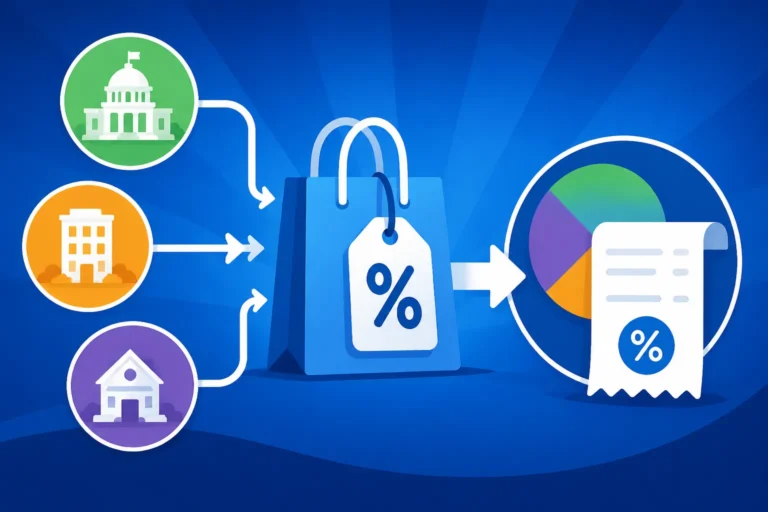
The "Combined Rate" is the sum of every jurisdiction that has a "claim" on that specific transaction. This usually includes the state, the county, the city, and any special districts (transit, school, or stadium). In 2026, the average combined rate across the U.S. is hovering around 7.5%, but in major metropolitan areas, it frequently exceeds 9%.
When you are setting up your Shopify or Amazon store, you need to make sure you are utilizing the Combined State + Local Sales Tax Rates Explained logic. Some platforms do a better job than others at calculating this automatically. If you are using a basic setup, you might only be collecting the state-level tax, which leaves you liable for the local portion. States like Alabama and Arizona are particularly aggressive about collecting these local "add-ons," and they won't hesitate to come after out-of-state sellers.
How E-commerce Sellers Can Prepare for 2026 Changes
Preparation is the only antidote to the stress of sales tax. If you wait until you receive a nexus notification letter to start thinking about this, you are already behind. The first step for any seller is to perform a thorough "nexus audit." This means looking at your sales volume and transaction counts in every state to see if you have crossed the Economic Nexus Thresholds Guide for that jurisdiction.
Once you know where you have nexus, the next step is registration. You cannot legally collect sales tax until you have a Seller's Permit Explained: What It Is & How to Get One. Collecting tax without a permit is actually a crime in some states—it’s considered fraud. In 2026, many states are making the registration process easier through the Streamlined Sales Tax Registration (SST) program, which allows you to register for multiple states at once.
Monitoring Economic Nexus Thresholds
Since 2018, nearly every state with a sales tax has adopted "economic nexus" laws. These laws state that if you do a certain amount of business in a state (usually $100,000 in sales or 200 transactions), you must collect and remit sales tax. However, in 2026, we are seeing a trend where states are eliminating the transaction count threshold. For example, Kentucky Drops 200-Transaction Threshold (Aug 2026), moving to a sales-only model.
This is actually good news for small sellers who have a lot of low-value orders but don't hit the $100,000 mark. But you have to stay vigilant. If a state changes its threshold and you stop collecting, you might be fine—but if they lower it and you don't start collecting, you're in trouble. Always keep a close eye on the Economic Nexus by State 2026: Thresholds Guide to see where your liabilities currently sit.
Implementing Real-Time Rate Lookups
Static tax tables are dead. In the fast-paced environment, you need an API-driven solution that provides real-time rate lookups at the moment of checkout. This ensures that you are always using the most current 2026 Sales Tax Rate Changes by State. Companies like Avalara offer integrations that plug directly into your shopping cart, taking the guesswork out of the process.
Real-time lookups also help with address validation. By checking the address against a master database, the software can correct typos and ensure the tax is calculated based on the precise location. This reduces the number of rejected transactions and ensures your tax returns are accurate. If you are still manually entering tax rates into your website's back-end, you are spending time on a low-value task that carries a high-value risk.
Managing Multi-State Compliance
As your business grows, you will inevitably find yourself with nexus in five, ten, or even twenty states. Managing the different filing frequencies (monthly, quarterly, or annually) is a full-time job. You need to know the Sales Tax Due Dates by State 2026 to avoid late fees and interest, which can quickly spiral out of control. Most states require electronic filing, so you’ll need to set up accounts in multiple state portals.
One way to simplify this is to use Sales Tax Automation: Is It Worth It?. For most businesses doing over $1M in revenue, the answer is a resounding yes. Automation software can pull your sales data, categorize the transactions, calculate the tax, and even file the returns for you. It turns a week-long monthly headache into a ten-minute review process. Just make sure the software you choose has a robust engine that is updated daily for the 2026 Sales Tax Rate Changes by State.
Specific Category Changes: Groceries, Digital Goods, and SaaS
Not all items are taxed equally, and 2026 is seeing some major shifts in what is considered "taxable." We’ve already discussed the grocery changes in Illinois, but there is a broader movement across the country to re-evaluate Sales Tax on Services: What's Taxable by State. As the economy becomes more service-based, states are looking for ways to tax everything from gym memberships to lawn care.
Digital products are another hot-button issue. If you sell e-books, software downloads, or streaming access, you need to check the Digital Products Sales Tax by State rules for 2026. Some states consider these to be the same as physical goods, while others have created entirely new tax categories for them. If you are selling a subscription, you might even be subject to "SaaS" (Software as a Service) tax rules, which vary wildly from state to state.
The Digital Goods Tax Expansion
The trend for 2026 is clear: more states are taxing digital goods. States that previously stayed away from this area are now realizing how much revenue they are losing as consumers move from physical DVDs and books to digital streaming and Kindle downloads. When you look at the Sales Tax on Digital Products by State, you’ll see that many "no-tax" states are reconsidering their stance.
The challenge for sellers is determining where the "sale" happens. Is it where the server is located? Where the customer’s billing address is? Or where they actually download the file? In 2026, most states have settled on the "shipping address" (which for digital goods is usually the billing address) as the point of taxation. If you don't have a system to track this, you could be missing out on tax collection in dozens of states.
Grocery Exemptions and Reductions
While Illinois is eliminating its grocery tax, other states like Alabama and Mississippi continue to tax food at the full state rate. However, there is growing political pressure to change this. In 2026, we are seeing several states propose "phased-in" reductions. For example, Sales Tax on Groceries in Alabama is being reduced by 1% as part of a multi-year plan, provided the state’s "rainy day" fund remains at a certain level.
This "if/then" legislation makes compliance very difficult. You have to know not just the current rate, but the economic conditions that might trigger a rate change mid-year. If you sell food products, you must also be aware of the Candy & Soda Sales Tax (The Flour Test). In many states, if a product contains flour, it's considered "food" (lower tax), but if it doesn't, it’s considered "candy" (higher tax). Keeping track of these nuances for thousands of products is nearly impossible without help.
SaaS Taxation Trends
If you run a SaaS business, 2026 is a pivotal year. More states are clarifying their rules, but "clarifying" often means "taxing." For instance, Is SaaS Taxable in Texas? (80% Rule) remains one of the most complex regulations to navigate. In Texas, software as a service is considered a data processing service, and only 80% of the price is taxable. In other states, it might be 100% taxable, or not taxable at all if it's "custom" rather than "canned."
We are also seeing a rise in "Cloud Computing" taxes. Some cities, like Chicago with its "Lease Transaction Tax," apply a specific tax to anything accessed remotely on a server. If you have customers in major tech hubs, you need to be very specific about how you characterize your services on your invoices. A slight change in wording can be the difference between a 0% tax rate and a 9% tax rate.
Tools and Resources for Tracking 2026 Changes
You don't have to do this alone. There are more resources available now than ever before to help you navigate 2026 Sales Tax Rate Changes by State. The first place you should always check is the Department of Revenue (DOR) website for each state where you have nexus. Most states have a mailing list you can join to receive "Tax Alerts" whenever a rate changes.
However, if you are selling in more than a handful of states, checking individual DOR websites is a recipe for burnout. This is where professional-grade tools come in. Whether you choose a full-service provider like Avalara or a more DIY approach with specialized lookup tools, having a centralized source of truth is essential for your sanity and your bottom line.
State Department of Revenue Portals
While they aren't always the most user-friendly websites, state DOR portals are the definitive source for tax law. In 2026, many states have upgraded their portals to provide better Sales Tax Rate Lookup Tools Compared. You can often type in an address and get the exact combined rate. The downside is that you have to do this for every single transaction if you don't have an automated system.
These portals are also where you will find information on "Tax Holidays." Many states offer a Sales Tax Holidays by State 2026: Full Calendar for back-to-school items, energy-efficient appliances, or even disaster preparedness supplies. During these weekends, certain items are tax-free up to a specific dollar amount. If your system isn't programmed to handle these temporary changes, you’ll end up overcharging your customers and dealing with a customer service nightmare.
Automation Software for Real-Time Updates
For the modern e-commerce entrepreneur, automation is the only way to scale. Software like Avalara doesn't just calculate tax; it provides a comprehensive compliance ecosystem. It can handle everything from Registering for Sales Tax in Multiple States to calculating the tax on international orders (VAT/GST). By linking your sales channels (Shopify, Amazon, eBay, etc.) to a single tax engine, you ensure consistency across all your platforms.
The real value of automation is found during an audit. If a state auditor comes knocking, you can pull a report showing exactly how every penny was calculated and why a certain item was exempt. This level of transparency usually leads to much faster (and less painful) audits. In 2026, when states are looking for revenue, being "audit-ready" is one of the best investments you can make.
Professional Consultation and VDAs
If you’ve realized that you should have been collecting tax for the last three years but haven't, don't panic. You may be eligible for a Voluntary Disclosure Agreements (VDA) Explained. This is a program where you "come clean" to the state, pay your back taxes, and in exchange, the state waives your penalties and limits the "look-back" period. It’s a way to hit the reset button on your compliance.
I always recommend talking to a sales tax expert or a CPA before entering into a VDA. They can help you calculate your liability and negotiate the best terms with the state. Sales tax is a complex field, and while software handles the day-to-day, a human expert is invaluable for high-level strategy and handling disputes. As we navigate the 2026 Sales Tax Rate Changes by State, having both a great tool and a great advisor is the ultimate winning combination.
Disclaimer
This guide is for informational purposes only and does not constitute legal, tax, or professional financial advice. Sales tax laws and rates are subject to frequent changes by legislative and administrative bodies. You should consult with a qualified tax professional or legal advisor to determine how these changes specifically affect your business and to ensure full compliance with all local, state, and federal regulations.