Sales Tax on Digital Products by State
Trying to figure out sales tax for your digital products can feel like deciphering an ancient, ever-changing riddle. With every state defining "digital product" differently (or not at all!), it's tough to know when and where you need to collect sales tax. This comprehensive guide will cut through the confusion, helping you understand the state-specific rules for taxing digital products so you can stay compliant and stress-free.
The Wild West of Digital Product Taxation
Selling digital products in today's online world is fantastic, right? Low overhead, global reach, infinite scalability! But then reality hits: sales tax. Unlike physical goods, which have a clear presence and easily understood rules, digital products often fall into a murky gray area. It’s like the tax world is still trying to catch up to the internet, and us small business owners are left to navigate the shifting sands. This isn't just a minor annoyance; it's a real headache that can lead to significant compliance risks if not handled correctly.
Why Digital Products Are So Complicated
The core of the complexity lies in their very nature: they're intangible. Historically, sales tax was designed for tangible personal property – think a widget you could hold in your hand. When states started to expand their tax bases to include services or digital items, they often did so in piecemeal fashion, leading to a patchwork of laws that vary wildly from one jurisdiction to the next.
For example, what one state defines as a "digital download" subject to tax, another might consider an exempt "information service." Is streaming a movie a rental of tangible property (like a VHS tape used to be), or is it a non-taxable service? These distinctions are critical, and they are often debated and litigated, leaving businesses guessing. This lack of uniformity means you can't assume a rule that applies in California will apply in New York, or even across the county line in some cases. It's truly a state-by-state, often city-by-city, analysis.
Common Characteristics of Taxable Digital Goods
Despite the variations, there are some common types of digital products that states often look to tax. Generally, if a digital product can be downloaded, streamed, or accessed electronically, and it replaces a traditional tangible good or service, it's more likely to be considered taxable.
Think about these categories:
- Digital Downloads: This is a big one. E-books, music files, software downloads, games, digital art, stock photos, and even downloaded reports or templates. If a customer pays to download something directly to their device, many states consider this a taxable transaction. The key is often whether the customer gets permanent possession or a right to use it indefinitely.
- Streaming Services: Netflix, Spotify, Hulu – these are prime examples. Many states now explicitly tax subscription-based streaming services for movies, music, and other content. This often falls under "amusements" or "entertainment" services, but some states classify it as a rental of digital property. The trend is definitely towards taxing these more universally.
- Software as a Service (SaaS): This is a tricky one because it blurs the line between a product and a service. For a deeper dive into this, check out our guide on Is SaaS Taxable? Software-as-a-Service by State. If your customers don't download the software but access it remotely over the internet (like a cloud-based CRM or accounting software), some states consider this a taxable service, while others see it as a lease of tangible personal property, and still others exempt it entirely. Texas, for instance, has a specific rule regarding the percentage of labor involved.
- Digital Games and In-App Purchases: The gaming industry is huge, and many states are keen to get a piece of that revenue. Digital game downloads, virtual currency, extra lives, cosmetic items – these often fall under the umbrella of taxable digital goods in states that have broadened their definitions.
It’s crucial to remember that even within these categories, specific state laws can create nuances. For example, an e-book might be taxable, but a digital newspaper subscription could be exempt if physical newspapers are exempt.
A State-by-State Look at Digital Product Sales Tax
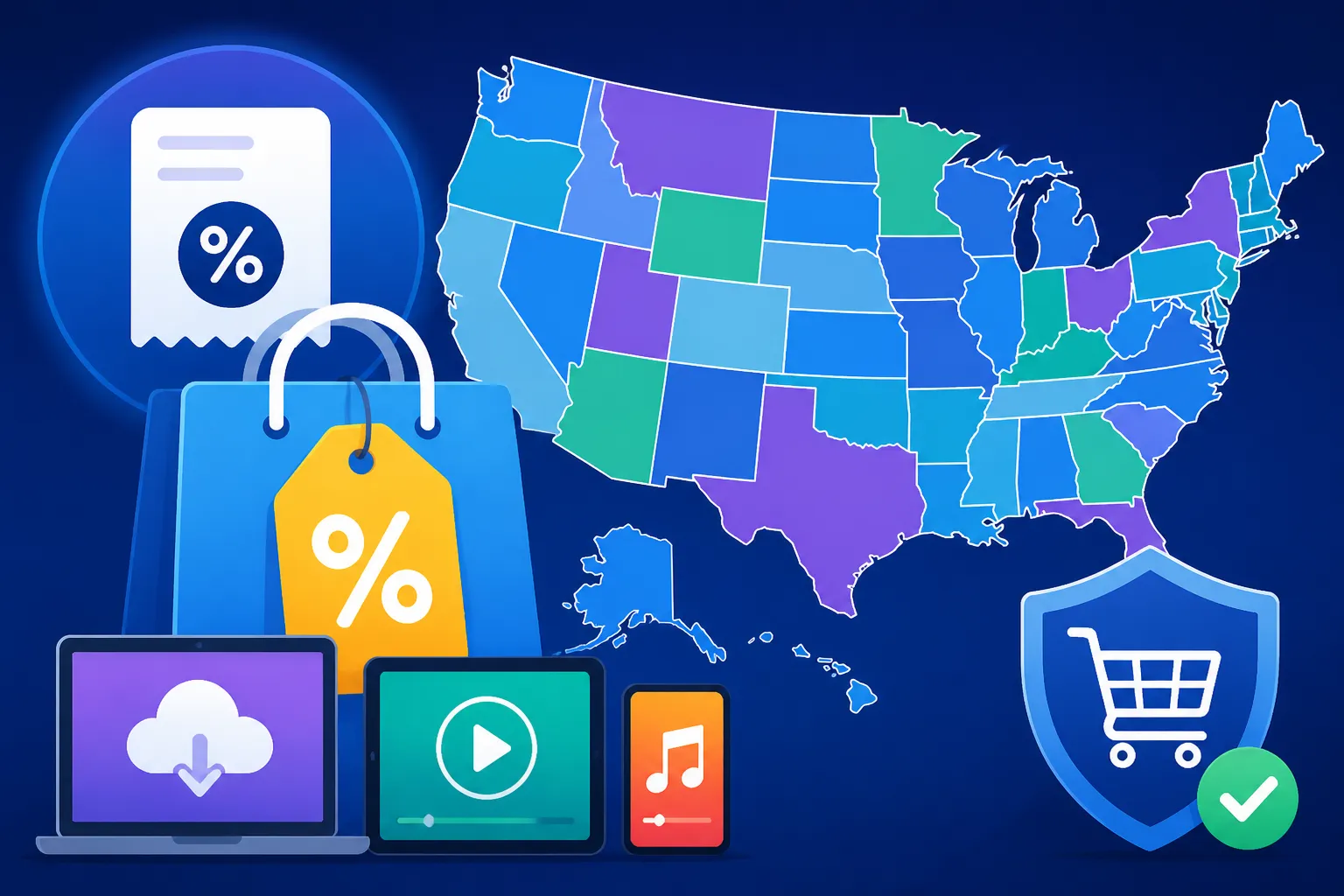
When it comes to sales tax on digital products, there's no national playbook. Each state has its own definitions, exemptions, and interpretations. What might be fully exempt in one state could be fully taxable in a neighboring one, making it incredibly challenging for online sellers who serve customers across the country. This fragmented landscape is precisely why many businesses struggle to accurately apply sales tax. For a general overview of all state tax rates, you can refer to our article on Sales Tax Rates by State 2026: All 50 States.
States That Broadly Tax Digital Products
Some states have taken a more aggressive stance, expanding their sales tax base to include a wide range of digital products. These states often define taxable tangible personal property broadly enough to encompass digital goods, or they explicitly list digital products as taxable.
- Texas: This is a prime example. Texas generally treats digital products as taxable if the corresponding tangible version would be taxable. This includes downloaded software, e-books, music, and even certain digital photographs. If you sell a picture that could be printed and framed, its digital counterpart is likely taxable. They also have specific rules for SaaS, generally taxing it.
- Washington: The Evergreen State is another one with broad taxation of digital products. They generally consider electronically delivered products and services to be taxable if a similar physical product or service would be taxable. This covers everything from digital music and movies to software and online games.
- Ohio: Ohio classifies electronically delivered software, digital books, music, videos, and other digital content as "digital audio works," "digital audiovisual works," or "digital books," and generally subjects them to sales tax. They really broadened their definitions to capture these modern transactions.
- Pennsylvania: Interestingly, Pennsylvania has a fairly broad sales tax that includes many services, and digital products generally follow suit. Electronically delivered prewritten software, digital books, music, and videos are typically subject to sales tax.
This means if you're selling digital content into these states, you'll almost certainly need to collect sales tax from your customers. The onus is on you, the seller, to know these rules.
States With Specific Exemptions or Nuances
Then there are states that have a more nuanced approach, often with specific exemptions or very particular definitions that can make a difference. It's rarely a straightforward "yes" or "no."
- California: California's stance on digital products can be a bit tricky. Generally, the state tends to consider electronically delivered software as taxable if the customer obtains permanent possession (like a download). However, many streaming services or temporary access to digital content might be exempt as services, not tangible personal property. The lines are incredibly fine, so it’s essential to understand the distinction between a "sale of tangible personal property" and a "service." Our guide on Are Digital Downloads Taxable? delves deeper into these specific nuances.
- New York: New York generally taxes "prewritten computer software" whether it's delivered electronically or physically. However, other digital products like e-books, music, and streaming services are often exempt from sales tax unless specifically deemed taxable under certain scenarios. This state provides a great example of how you can have one type of digital product taxed and another exempt.
- Florida: While Florida generally taxes tangible personal property, it often exempts services. For many digital products that aren't considered "tangible personal property," like most streaming services or certain software delivered as a service, they may be exempt. However, downloaded software with permanent rights might be taxable, depending on the specifics. This is where the distinction between what's considered a "product" versus a "service" really comes into play. You might find our article on Sales Tax on Services: What's Taxable by State helpful for understanding the broader service taxation landscape.
These states require a careful reading of their tax codes or consultation with a sales tax expert to ensure proper collection. The temptation to guess can be costly.
States That Don't Tax Most Digital Products
Finally, some states have either not updated their tax laws to explicitly include digital products or have specifically exempted them. This is often because their sales tax laws are strictly tied to tangible personal property, and they haven't made the legislative leap to tax intangible digital goods.
- Alaska, Delaware, Montana, New Hampshire, and Oregon: These states have no statewide sales tax, so by default, they don't tax digital products (or anything else). However, even in these states, there might be local sales taxes, especially in Alaska.
- Massachusetts: Many digital products, including e-books, music downloads, and streaming services, are generally not subject to sales tax in Massachusetts, as they are often viewed as intangible and not specifically listed as taxable.
- Illinois: Illinois generally exempts electronically delivered software and digital goods from sales tax unless they come with a tangible medium (like a CD-ROM). This means most pure digital downloads or streaming services are not taxed at the state level.
It's a huge relief when your customers are in one of these states, but don't let your guard down entirely. Tax laws are always subject to change, and what's exempt today could be taxable tomorrow.
Here's a simplified overview of how some states generally treat common digital products. Keep in mind, this is a broad generalization, and specific circumstances (like permanent vs. temporary access) can always change the outcome.
| State | Digital Software (Download) | E-books/Music/Video (Download) | Streaming Services | SaaS (Cloud Access) | General Approach |
|---|---|---|---|---|---|
| California | Often Taxable | Often Exempt | Often Exempt | Often Exempt | Nuanced; focuses on "tangible" transfer, services exempt |
| Florida | Potentially Taxable | Often Exempt | Often Exempt | Often Exempt | Primarily taxes tangible goods, services generally exempt |
| Illinois | Generally Exempt | Generally Exempt | Generally Exempt | Generally Exempt | Focus on tangible personal property, digital usually exempt |
| New York | Prewritten Software Taxable | Often Exempt | Often Exempt | Often Exempt | Complex; specific items may be taxed |
| Ohio | Taxable | Taxable | Taxable | Taxable | Broadly taxes digital products |
| Pennsylvania | Taxable | Taxable | Taxable | Taxable | Broadly taxes digital products |
| Texas | Taxable | Taxable | Taxable | Taxable | Broadly taxes digital products |
| Washington | Taxable | Taxable | Taxable | Taxable | Broadly taxes digital products |
This table provides general information and is not exhaustive. Always verify with specific state tax guidance.
Navigating Nexus and Compliance for Digital Sellers
Beyond understanding what's taxable, you also need to figure out where you're supposed to collect sales tax in the first place. This concept is called "nexus," and it's the legal connection a business has with a state that requires it to collect and remit sales tax. For online sellers of digital products, nexus can pop up in unexpected ways. If you're wondering, "Do I need to collect sales tax for online sales?," our guide on Sales Tax for Online Sellers: Complete Guide has more detailed information.
Understanding Economic Nexus for Digital Sales
Before the landmark South Dakota v. Wayfair Supreme Court decision in 2018, nexus was primarily physical: having an office, a warehouse, or employees in a state. But Wayfair changed everything, introducing "economic nexus." This means that even if you don't have a physical presence in a state, you can still be required to collect sales tax if your sales into that state exceed certain economic thresholds.
For digital product sellers, this is a huge deal. You could be a sole proprietor in Oregon, selling e-books globally, and suddenly find yourself with nexus in Texas because you sold over $500,000 worth of e-books to Texans in the last year. These thresholds vary by state, but commonly they are:
- A certain dollar amount of sales: Often $100,000, but some states like California and Texas set it at $500,000.
- A certain number of transactions: Many states initially included a 200-transaction threshold, but a growing number, like Kentucky, are dropping this.
You need to track your sales into every state, both in dollar amount and transaction count, to see where you've established economic nexus. Our article on Economic Nexus by State 2026: Thresholds Guide provides a comprehensive breakdown of these thresholds for each state. This isn't just about collecting sales tax; once you meet these thresholds, you'll also need to consider Registering for Sales Tax in Multiple States and obtaining a sales tax permit for each state where you have nexus. To understand the different types of nexus, check out Sales Tax Nexus Explained Physical vs Economic.
Tools and Strategies for Staying Compliant
Given the labyrinthine nature of digital product sales tax, manually tracking and calculating everything is a recipe for disaster, especially as your business grows. Imagine trying to keep up with every state's definition of a "digital book" and its unique tax rate! This is where technology becomes your best friend.
Sales tax compliance software is designed to automate this complex process. These solutions integrate with your e-commerce platform or accounting software to:
- Determine Nexus: Help you identify where you've crossed economic nexus thresholds.
- Calculate Rates: Automatically calculate the correct sales tax rate based on the customer's location (destination-based sourcing is common for digital goods) and the specific taxability of your product in that state.
- Manage Exemption Certificates: If you sell to businesses with resale certificates, the software can help you manage and validate these.
- File Returns: Prepare and often even file your sales tax returns on time for each state where you're registered.
Companies like Avalara offer robust solutions that can handle the intricacies of Digital Products Sales Tax by State, ensuring you're collecting the right amount from the right customers. This kind of automation isn't just convenient; it's a critical shield against audits and penalties. Without it, you could spend countless hours poring over state tax publications or risk making errors that could cost your business dearly. For a comparison of available options, read our guide on the Best Sales Tax Compliance Software 2027.
My advice? Don't try to be a sales tax guru yourself. Focus on what you do best – creating amazing digital products – and let the experts or the technology handle the tax complexities. Staying compliant means proactively monitoring your sales thresholds and having a system in place to accurately calculate and remit sales tax. Knowing How to Get a Sales Tax Permit by State is the first practical step once you determine you have nexus. It’s a lot to manage, but with the right tools, it becomes a manageable part of doing business online.
Disclaimer
Please remember, the information provided in this article is for informational purposes only and does not constitute tax, legal, or accounting advice. Sales tax laws are complex and constantly changing. Always consult with a qualified tax professional or state tax authority for advice specific to your business and jurisdiction.