How Combined Sales Tax Rates Work
You’ve probably been there: you’re shopping in a trendy downtown district, and the total on your receipt feels a little higher than it was at the mall just ten miles away. It’s a common frustration that leaves many of us wondering if the cashier made a mistake. This guide pulls back the curtain on how combined sales tax rates actually work so you can stop guessing and start understanding your true costs.
The Anatomy of a Combined Sales Tax Rate
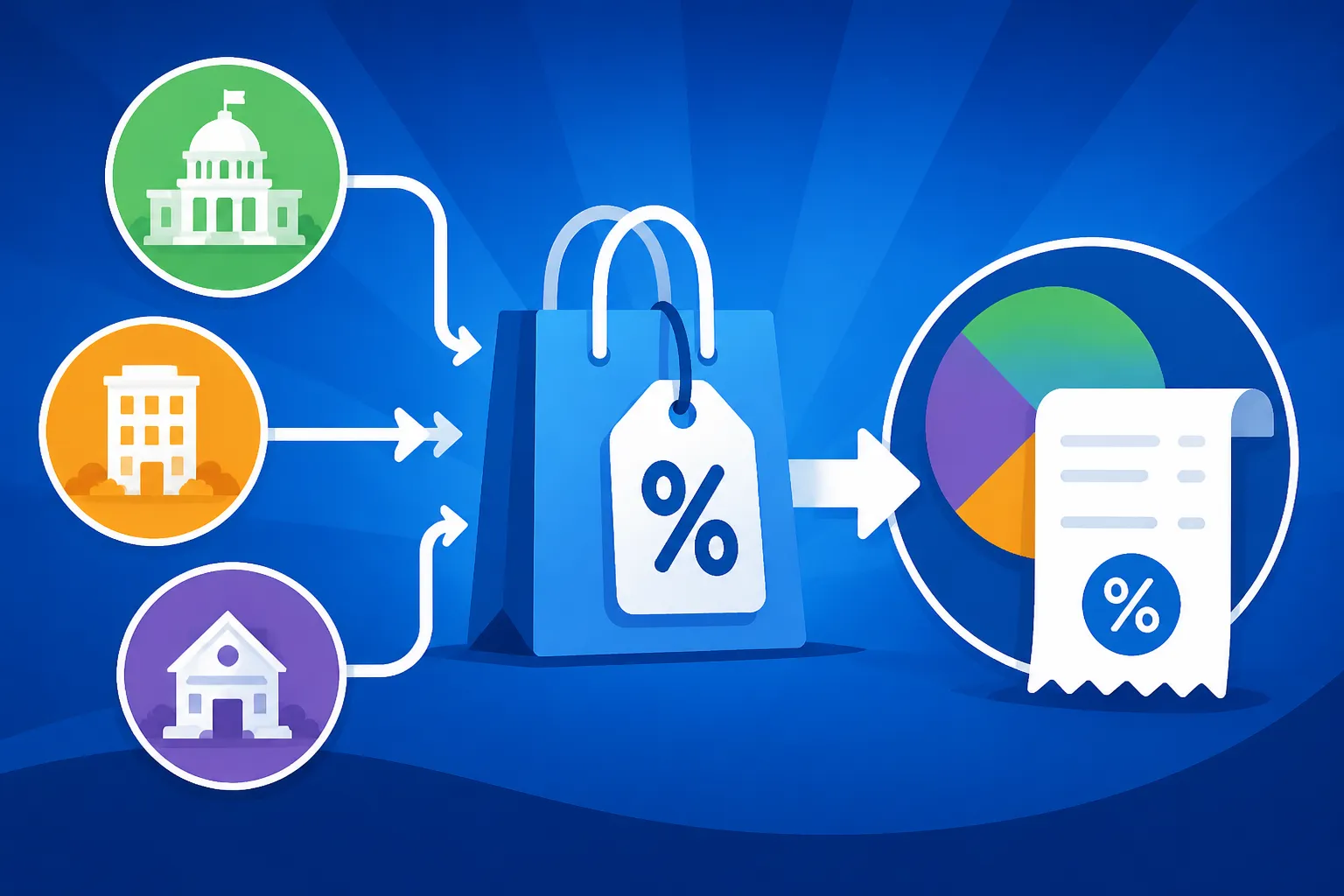
When you look at a sales tax rate, you aren't just looking at one single number from the governor's office. Instead, you're looking at a stacked "wedding cake" of various tax jurisdictions that all want a small piece of the transaction. Understanding this layering is the first step toward demystifying why a 6% state rate ends up being 9.5% at the register. It’s a complex dance of legislation and local needs that varies wildly from one street corner to the next.
The Statewide Base Rate
The foundation of any combined rate is the state-level tax. Most states in the U.S. have a baseline rate that applies to every taxable purchase made within their borders. For example, if you are looking at the California Sales Tax Rate (7.25% Base + Districts), that 7.25% is the starting point. It’s the portion of the tax that goes toward state-level infrastructure, schools, and social programs. This rate is usually set by the state legislature and changes far less frequently than local rates, providing a somewhat stable floor for the total calculation.
However, even this base rate isn't universal. Some states have surprisingly high base rates to compensate for a lack of income tax, while others keep it low to remain competitive. When you're trying to figure out How Combined Sales Tax Rates Work, you always start by identifying this state-level percentage. It acts as the anchor for everything else that follows. If you move across state lines, this is the first number that will shift, often significantly impacting your monthly budget if you're making large purchases like electronics or furniture.
In some rare cases, the state might even have a "zero" base rate. We see this in the States With No Sales Tax (NOMAD Explained), where the state government finds its revenue through other means. But for the vast majority of Americans, the state rate is the unavoidable first layer of the tax sandwich. It’s the part of the bill that feels the most official, yet it’s often the smallest part of the headache for business owners trying to stay compliant.
County and Municipal Add-ons
Once you move past the state level, things get localized. Counties and cities have the authority in most states to tack on their own percentages. This is often where the "sticker shock" happens. A city might decide to add a 1% tax to fund a new stadium, or a county might add 0.5% to improve rural roads. These local add-ons are why the Combined State + Local Sales Tax Rates Explained can be so different even within the same geographic region. You might drive five minutes into the next town and suddenly find yourself paying a different total.
These local taxes are a primary tool for municipal governments to generate revenue without relying solely on property taxes. For a shopper, it means the "true" price of an item is rarely the price on the tag. For a business, it means you have to know exactly which side of the city limit your storefront—or your customer’s front door—sits on. I’ve spoken to dozens of small business owners who were caught off guard because they didn't realize their new warehouse was technically inside a city zone with a mandatory 2% municipal add-on.
The variation here is staggering. In some states, like Oregon or New Hampshire, these local add-ons are non-existent. In others, like Alabama or Texas, they are aggressive and widespread. This local layering is a big reason why the Average Sales Tax Rate by State can be a misleading statistic; it doesn't account for the high-tax pockets in major metropolitan areas that drive up the actual cost of living for millions of residents.
Special Purpose Districts
This is the "hidden" layer that catches everyone off guard. Beyond states, counties, and cities, there are Special Purpose Districts (SPDs). These are jurisdictions created for a very specific reason—think transit authorities, school districts, or even "Library Districts." If you’ve ever wondered why your total was a fraction of a percent higher in a specific shopping center, it’s likely because that mall sits within a Special Development District.
SPDs are incredibly specific. They might cover only a few blocks or a single industrial park. For instance, in some parts of the country, a "Transit District Tax" might be added to any purchase within a certain radius of a subway station. These rates are usually small—often 0.1% to 0.5%—but when they are stacked on top of state, county, and city rates, they push the final number into the double digits. Managing these micro-rates is why many companies turn to a solution like Avalara to ensure they aren't accidentally under-collecting and inviting an audit.
The logic behind these districts is usually "user-pays." If a new shopping development requires massive road upgrades, the local government might create an SPD so that the shoppers using those roads are the ones paying for them through a slightly higher sales tax. While it sounds fair in theory, it creates a logistical nightmare for anyone trying to calculate How to Calculate Sales Tax (Step by Step) without the help of sophisticated software. You can't just look at a map; you often have to look at specific tax boundary shapes that don't align with anything else.
Why Your ZIP Code Is a Terrible Tax Tool
If you've ever typed your ZIP code into an online checkout and seen the tax change, you might think the five-digit code is the gold standard for tax accuracy. In reality, relying on ZIP codes is one of the biggest mistakes a business or a savvy shopper can make. ZIP codes were designed by the USPS for one thing: delivering mail efficiently. They were never intended to be tax boundary markers, and the two systems often clash in ways that can cost you a lot of money.
Overlapping Jurisdictions
A single ZIP code can contain multiple tax rates. This happens because ZIP code boundaries are based on mail routes, which often cross city lines, county lines, and special district borders. If you are using Sales Tax by ZIP Code (and Why ZIP Isn't Enough) to determine your tax liability, you might be applying a 9% rate to someone who should only be paying 7.5% because they live on the "wrong" side of an invisible line. I’ve seen this happen in sprawling suburban areas where one ZIP code covers three different incorporated towns, each with its own municipal tax.
This overlapping creates a "gray zone" for compliance. For a business owner, charging the wrong rate based on a ZIP code isn't just a small error—it's a legal liability. If you over-collect, you could face class-action lawsuits; if you under-collect, you owe the state the difference out of your own pocket. This is why many modern e-commerce platforms have moved away from ZIP codes and toward geo-location or full-address validation.
Imagine a scenario where a ZIP code sits 60% in a high-tax city and 40% in an unincorporated county area. If you simply use the "average" for that ZIP, you are wrong 100% of the time. This is a common pain point that software like Avalara is designed to solve by pinpointing the exact latitude and longitude of a transaction to determine the precise tax "stack" that applies. It’s the difference between a rough guess and a legal certainty.
The Boundary Line Dilemma
The "Boundary Line Dilemma" is a real-world problem where two neighbors across the street from each other pay different sales tax rates. This isn't an exaggeration. In many jurisdictions, a city boundary might run right down the middle of a major road. One side of the street is within the city limits and pays a 1% municipal tax, while the other side is in the county and is exempt from that specific add-on.
For retailers, this is a nightmare. If you have a store on one side of the street, your prices might look higher than your competitor across the way, even if your pre-tax prices are identical. This contributes to the confusion surrounding Why Is Sales Tax Different in Every City? and can lead to customer dissatisfaction. People don't like feeling like they are being "cheated" by a few pennies just because of where a store is located.
Furthermore, these boundary lines aren't static. Cities frequently annex new land, and special districts can be formed or dissolved. A boundary that was accurate last year might be completely different today. Keeping up with these shifts requires constant vigilance. If you're a business owner, you have to stay informed about 2026 Sales Tax Rate Changes by State and local annexations to ensure your registers are programmed correctly every single morning.
Real-World Examples of Rate Volatility
To really understand how these layers work, it helps to look at some of the most complex areas in the United States. Some cities have turned sales tax into a high-art form of complexity, blending dozens of different legislative requirements into a single, massive percentage. Let's look at how the numbers actually break down in places where "simple" doesn't exist.
The Chicago Breakdown
Chicago is often cited as the poster child for high sales tax, and for good reason. When you make a purchase in the Loop, you aren't just paying the Illinois state rate. You are paying the state, the county, the city, and a very significant transit authority tax. This is why the Chicago Sales Tax Rate (Highest Big City) often hovers around 10.25%. It’s a steep number that impacts everything from a cup of coffee to a new car.
| Jurisdiction Layer | Rate Contribution | Purpose |
|---|---|---|
| Illinois State | 6.25% | General State Fund |
| Cook County | 1.75% | County Services |
| City of Chicago | 1.25% | Municipal Operations |
| RTA (Transit) | 1.00% | Regional Transportation Authority |
| Total Combined Rate | 10.25% | Final Consumer Cost |
As you can see from the table, the state only takes a little more than half of the total. The rest is a localized stack. This is why looking at Sales Tax on a $100 Purchase by State can be so misleading; if you're in Chicago, that $100 item is going to cost you $110.25, while in a rural Illinois town, it might only cost you $106.25. That four-dollar difference might not seem like much on one item, but over a year of household spending, it adds up to thousands.
California's District Tax Complexity
California takes local taxes to an even more granular level with its "District Taxes." While the base rate is 7.25%, that is rarely what you actually pay. Instead, voters in specific areas frequently pass measures to add 0.1% or 0.5% for specific local projects. This is what's known as a California District Taxes Explained. In some parts of Los Angeles or San Francisco, you might be paying into three or four different districts simultaneously.
What makes California particularly difficult is that these districts don't always follow city or county lines. A district might be formed to fund a specific hospital or park system that spans parts of two different counties. This creates a patchwork quilt of tax rates that makes it nearly impossible for a human to calculate How Much Is Sales Tax in Los Angeles? without a database.
Because California is such a massive economy, these small variations have huge implications for e-commerce. If you're a seller in New York shipping to a customer in a tiny California district, you are responsible for knowing that customer's specific district rate. This is where the automation provided by Avalara becomes a lifeline, as it handles the mapping of these overlapping districts in real-time so the seller doesn't have to manually check a thousand-page tax code for every order.
Sourcing Rules: Origin vs. Destination
One of the most confusing parts of combined rates for online sellers is deciding which rate to charge. Is it the rate where the business is located, or the rate where the customer is standing? This is the core of the "Sourcing" debate, and different states have very different rules. Getting this wrong is a surefire way to end up with an audit notice in your mailbox.
Destination-Based Sourcing
Most states in the U.S. use destination-based sourcing. This means the sales tax rate is determined by where the buyer receives the product. If you are a business in a low-tax rural area shipping a package to a customer in a high-tax city, you must charge the rate of the customer's city. This is why the question Is Sales Tax Based on Billing or Shipping Address? is so critical—the shipping address almost always wins.
Destination sourcing is meant to be fair to the local governments. If a customer is using the infrastructure and services of a specific city, that city wants the tax revenue from the customer’s purchases, regardless of where the store is located. However, for a small business, this is a logistical nightmare. Instead of managing one tax rate for their storefront, they suddenly have to manage thousands of rates for every potential shipping destination in the country.
This complexity is the primary reason why states eventually agreed to the South Dakota v. Wayfair: What It Means for Sellers decision. It acknowledged that while destination sourcing is the law of the land, it requires businesses to have robust tools to track these rates. If you’t using an automated system, trying to keep up with the Tennessee Sales Tax Rate (7% + Local) and all its local variations for every customer in that state is basically a full-time job.
Origin-Based Sourcing
A smaller number of states use origin-based sourcing. In these states, the tax rate is determined by where the seller is located. If your warehouse is in an origin-based state, you charge the same rate to every customer in that state, regardless of where they live. This is significantly easier for businesses to manage because the rate stays consistent for every transaction.
However, origin sourcing is becoming less common as states look to capture more revenue from the booming e-commerce sector. Even in origin states, the rules can get murky when you have "nexus" (a legal presence) in multiple locations. Understanding the nuances of Origin vs Destination Sales Tax Sourcing is vital because if you apply origin rules in a destination state, you will likely be under-collecting in high-tax areas and over-collecting in low-tax ones, both of which are major compliance red flags.
Some states are even "hybrid" states, where they use one rule for state taxes and another for local taxes. It sounds like something out of a bureaucratic fever dream, but it's the reality for many businesses. This is another area where Avalara provides essential clarity, as their engines are programmed to recognize the sourcing rules for every single jurisdiction in the country, ensuring that the "Hero" of your compliance strategy—automation—is doing the heavy lifting.
Managing Compliance and Rate Changes
If you think you've finally mastered your local rates, don't get too comfortable. Sales tax rates are not set in stone; they are among the most frequently changed numbers in the financial world. Keeping your business compliant means more than just a one-time setup; it requires a commitment to ongoing maintenance and a healthy respect for the complexity of the law.
Tracking Mid-Year Adjustments
While many taxes change on the first of the year, sales tax rates can change whenever a local election or a legislative session dictates. It’s not uncommon for a new rate to take effect on April 1st or July 1st. These are often referred to as 2026 Sales Tax Rate Changes by State. If your POS system or online store isn't updated on the exact day the change occurs, you are immediately out of compliance.
These adjustments can be triggered by many things: a temporary "holiday" ending, a new bond measure being passed, or even a correction to a previous boundary error. I've seen businesses lose their entire profit margin on a large sale because a rate increased by 0.5% overnight and they didn't update their system. It’s a painful way to learn that the "small" numbers matter.
For businesses operating in multiple states, tracking these changes manually is a recipe for disaster. You would have to monitor thousands of local government websites every week. Instead, most successful companies rely on a central "source of truth." Whether you are looking at Louisiana Sales Tax Rate (Highest Combined 10.11%) or a small town in Idaho, you need a system that updates automatically. This is why the integration of tax software into the "back office" of modern retail is no longer an option—it’s a necessity.
Automation Tools like Avalara
At a certain point, the human brain simply cannot keep up with the math required for total compliance. This is where professional-grade automation tools come into play. A solution like Avalara doesn't just look up a rate; it handles the entire lifecycle of the tax. From validating the address to determining the correct sourcing rule and then calculating the "stack" of state, county, and local taxes, it removes the guesswork that leads to errors.
Using automation is about more than just avoiding audits; it’s about providing a better experience for your customers. No one likes reaching the final checkout page and seeing a "Tax" line that feels arbitrary or incorrect. When you use a system that calculates Sales Tax Calculator: How to Calculate Sales Tax with precision, you build trust. Your customers know they are paying exactly what the law requires—no more, no less.
Furthermore, these tools often handle the "filing" side of the equation. Once the tax is collected, it has to be remitted to the correct authorities. Imagine having to write 50 different checks to 50 different local municipalities every month. Automation consolidates that data, making the end-of-month reporting a breeze rather than a breakdown. For any business looking to scale, investing in a robust tax engine is the single best way to ensure that growth doesn't come with a side of legal trouble.
How to Manually Calculate a Combined Rate
Even with all the tools available, it’s good to know how to do the math yourself. Whether you’re double-checking a receipt or trying to estimate the cost of a large purchase, understanding the formula can save you from surprises. It’s a straightforward process, but it requires you to be meticulous with your data.
The Formula
To calculate the combined rate, you simply sum up the decimal versions of every individual tax that applies to your location. For example, if you are in a state with a 6% rate, a county with a 1% rate, and a city with a 2.5% rate, your combined rate is 9.5%. When applying this to a purchase, you multiply the subtotal by 0.095.
If you are trying to find the Sales Tax Rate by Address Lookup, make sure you are searching for each of these layers individually. You can't just take the state rate and guess the rest. I always recommend starting with the state's Department of Revenue website, as they usually provide a list of all current local add-ons.
- Find the State Rate (e.g., 6.25%)
- Find the County Rate (e.g., 1.00%)
- Find the City Rate (e.g., 2.00%)
- Find the Special District Rate (e.g., 0.50%)
- Total: 6.25 + 1.00 + 2.00 + 0.50 = 9.75%
Once you have that total, you can use a Sales Tax Calculator: How to Calculate Sales Tax to double-check your math. It’s a great way to verify that you haven't missed a small transit tax or a school district fee that might be hidden in the fine print of your local tax code.
Common Pitfalls to Avoid
The most common mistake people make is "double-taxing" themselves by adding a rate that is already included in another total. Some websites report a "combined county rate" that already includes the state base. If you then add the state base again, your math will be way off. Always clarify if the number you are looking at is a "stand-alone" local rate or a "combined" local rate.
Another pitfall is ignoring the "taxability" of the item itself. Not everything is taxed at the same rate. For example, Is Clothing Taxable? Sales Tax on Apparel by State can vary wildly, with some states offering exemptions for items under a certain price. If you’re calculating the tax on a $200 jacket, but the first $110 is tax-exempt, your simple percentage multiplication will be wrong.
Lastly, remember that sales tax is usually calculated on the final sale price after discounts but before shipping (depending on the state). If you use a coupon, you only pay tax on the amount you actually handed over. However, if you are in a state where Is Shipping Taxable? Freight Sales Tax by State applies, you have to add the shipping cost to the subtotal before you apply your combined rate. It’s these small details that separate a rough estimate from an accurate calculation.
Sales Tax Disclaimer
The information provided in this guide is for informational and educational purposes only and does not constitute legal, tax, or financial advice. Sales tax laws, rates, and regulations are subject to frequent change and vary significantly by jurisdiction. Always consult with a qualified tax professional or accountant to ensure compliance with your specific tax obligations. No "Hero" solution or software can replace the value of professional counsel tailored to your unique business situation.