Sales Tax by ZIP Code (and Why ZIP Isn’t Enough)
You are likely here because you just realized that a five-digit ZIP code is a remarkably blunt instrument for something as sharp and unforgiving as state tax law. It happens to the best of us: you set up your online store, plug in a basic ZIP-based tax calculator, and assume you are compliant, only to discover months later that you have been under-collecting in one neighborhood and over-charging in another. This guide dives deep into why relying on ZIP codes for sales tax is a dangerous gamble and provides a roadmap for achieving true rooftop-level accuracy.
The Illusion of Accuracy in ZIP Code Lookups
When you enter a ZIP code into a search bar, you usually get a single percentage back. It feels definitive. It feels like "the answer." However, that number is often just a weighted average or the rate for the most populous part of that ZIP code. In the world of tax compliance, "close enough" is an invitation for a state auditor to camp out in your office for three weeks. The fundamental issue is that ZIP codes were never designed to delineate tax boundaries; they were designed to help a mail carrier find a mailbox.
How ZIP Codes Are Designed for Mail vs Tax
The United States Postal Service (USPS) created ZIP codes in 1963 to improve mail sorting and delivery. A ZIP code represents a collection of delivery routes, not a geographic boundary that respects political or tax-related borders. A single delivery route might wind through three different unincorporated areas, a city center, and a special school district. Because the post office cares about the efficiency of a truck’s path, ZIP codes often disregard the very lines that state and local governments use to determine who owes what.
When you look at Sales Tax Rates by State 2026: All 50 States, you begin to see that the complexity starts at the top and trickles down into a chaotic mess of local jurisdictions. A ZIP code might be the "address," but it is not the "location" in the eyes of a tax authority. For example, a home might have a ZIP code associated with a major city because that is where the post office is located, but the house itself sits physically outside the city limits. If that city has a 2% local tax and the county doesn't, a ZIP-based calculator will charge that 2% erroneously, or worse, miss it when it’s actually due.
The Problem of Boundary Overlap
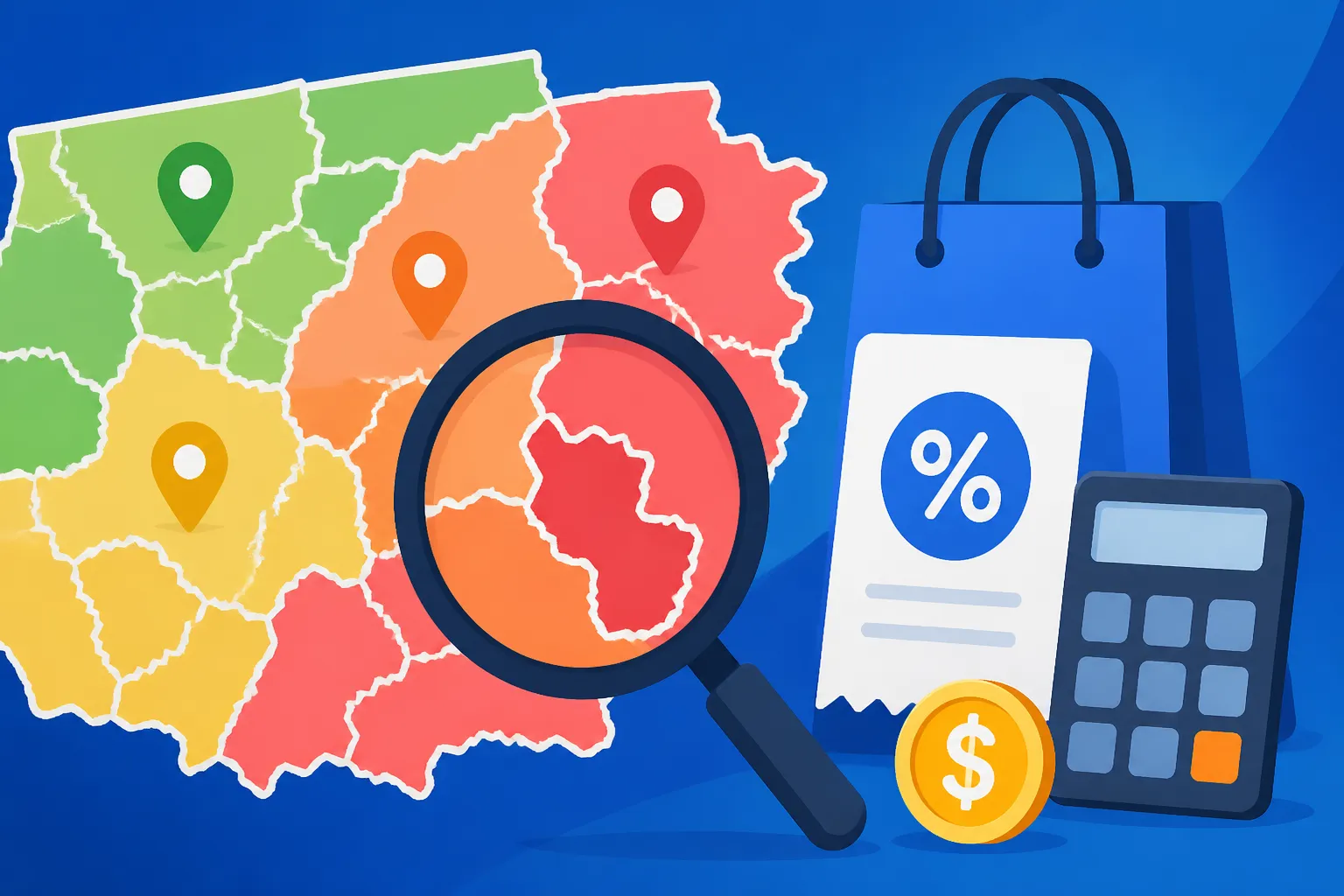
Imagine a street where the even-numbered houses are in one county and the odd-numbered houses are in another. This is not a hypothetical scenario; it happens in thousands of locations across the United States. If both sides of the street share a ZIP code, a standard lookup tool has a 50% chance of being wrong for every house on that block. This overlap is the primary reason why Sales Tax by ZIP Code (and Why ZIP Isn't Enough) remains a major pain point for growing businesses.
In high-growth suburban areas, boundaries change frequently. New housing developments might be annexed by a city to provide services, changing the tax rate overnight, while the ZIP code remains exactly the same. If your tax engine isn't updated with geospatial data that recognizes these annexations, you are essentially using a map from 1990 to navigate a city built in 2025. This lag between boundary changes and ZIP code updates creates a "compliance gap" that can lead to massive back-tax liabilities.
Why Weighted Averages Fail the Audit Test
Some lower-end tax tools try to solve the ZIP code problem by using a "weighted average" of all the rates found within that ZIP. If 80% of the ZIP code pays 8% tax and 20% pays 7%, the tool might just charge everyone 7.8%. This is a disaster. There is no such thing as a 7.8% tax rate in that area. You are now over-collecting from some and under-collecting from others. State auditors do not look at your "average" collection; they look at individual transactions. If you under-collected on a $5,000 sale because of a ZIP code average, you owe the difference out of your own pocket, plus interest.
Anatomy of a Sales Tax Rate: State, County, City, and District
To understand why a ZIP code isn't enough, you have to understand the "layer cake" of American sales tax. When a customer checks out, the total percentage they see is rarely a single tax. It is a composite of several different jurisdictions all reaching into the same pocket at the same time. This is where Combined State + Local Sales Tax Rates Explained becomes vital knowledge for any seller.
The Base State Rate
The first layer is the state itself. Most states have a base rate that applies to all taxable transactions occurring within their borders. However, even this isn't universal. If you are operating in States With No Sales Tax (NOMAD Explained), your base rate is zero, but you might still have to worry about local-level "home-rule" taxes in certain parts of the country, like Alaska.
The state rate is the easiest part to get right, but it’s only the beginning. For instance, if you’re selling in a state with a 6% rate, that’s your starting point. But in most of the U.S., you will never actually charge just 6%. The state allows counties, cities, and special districts to pile their own percentages on top of that base, creating a total rate that can fluctuate wildly within just a few miles.
Local Add-ons and Surcharges
The second and third layers are usually county and municipal (city) taxes. Counties might implement taxes to fund jails, roads, or general funds. Cities do the same for police, fire departments, and local parks. This is why Highest & Lowest Sales Tax States 2026 lists can be so deceiving. A state might have a low base rate, but the local add-ons can push the total over 10%.
The real challenge occurs when a city’s boundaries don't align with a ZIP code. A customer might live in a "census-designated place" that has a mailing address for City A but is legally part of City B. If City A has a 3% local tax and City B has 1%, using the ZIP code for City A will result in a 2% over-collection. In many states, over-collecting tax is just as legally problematic as under-collecting, as it can lead to class-action lawsuits or "unjust enrichment" charges from the state.
Special Purpose Districts (SPDs)
The final, and most invisible, layer is the Special Purpose District. These are jurisdictions created to fund a very specific project: a new stadium, a regional transit system, a library branch, or even a water treatment plant. These districts often have bizarre, non-geometric shapes that follow a specific transit line or a watershed.
SPDs are the ultimate "ZIP code killers." A single ZIP code could contain four different SPDs, each applying to only a few blocks. For example, if you are shipping a package to a customer in a "Transportation Development District," you might need to add an extra 0.5%. If you miss it, you are non-compliant. If you charge it to someone three houses down who isn't in the district, you’re in trouble. Understanding these nuances is why California District Taxes Explained is such a popular topic; California is the king of these overlapping special districts.
Why ZIP Codes Fail in High-Complexity States
Some states are "easy" because they have a single statewide rate or very few local jurisdictions. But if your business has Economic Nexus by State 2026: Thresholds Guide compliance requirements in the "Big Three" of tax complexity—California, Colorado, and Alabama—ZIP codes are essentially useless.
California's District Tax Maze
California is famous for its "District Taxes." While the base rate is relatively stable, the local districts are a nightmare for the uninitiated. In places like Los Angeles or the Bay Area, you can cross three different tax jurisdictions just by walking a few blocks to get a coffee. Each of these districts has its own reporting requirements on the state return.
If you rely on a ZIP code in California, you are almost guaranteed to get the rate wrong. A ZIP code in the San Fernando Valley might cover parts of the City of Los Angeles (higher tax) and unincorporated LA County (lower tax). If you sell a high-ticket item, like a car, the difference is massive. This is why people constantly search for How Much Is Sales Tax on a Car by State and find that the answer for California depends entirely on the exact "rooftop" address of the buyer.
Colorado’s Home-Rule Headache
Colorado is arguably the most difficult state for sales tax compliance. Why? Because it is a "Home-Rule" state. In most states, the Department of Revenue collects all the local taxes and distributes them back to the cities. In Colorado, many cities are "Home-Rule," meaning they collect their own taxes, set their own rules, and have their own audits.
A ZIP code in Colorado might cover a Home-Rule city and a non-Home-Rule part of the county. If you use a ZIP code tool, you might not only get the rate wrong, but you might miss the fact that you need to file a completely separate tax return with the city itself. This is why Colorado Home-Rule Cities Sales Tax knowledge is a survival skill for e-commerce sellers. One ZIP code error in Colorado could lead to you being audited by the state and three different cities simultaneously.
Alabama's Local Complexity
Alabama shares a similar "Home-Rule" style struggle. There are hundreds of local jurisdictions that can change their rates with very little notice. Alabama is a state where "Destination Sourcing" (taxing based on where the buyer is) meets local autonomy. If you are shipping goods across Alabama, relying on a ZIP code lookup will frequently lead to errors in both the rate collected and the jurisdiction to which you report that money.
For a business owner, this means you aren't just looking for a percentage; you're looking for a name. You need to know if the money belongs to the City of Birmingham or an unincorporated part of Jefferson County. A ZIP code cannot tell you that. Only a system that uses full address validation and geospatial mapping can provide that level of detail.
| Feature | ZIP Code Lookup | Geospatial (Rooftop) Lookup |
|---|---|---|
| Accuracy Basis | USPS Delivery Routes | Lat/Long & Legal Boundaries |
| Boundary Awareness | Poor (Often ignores city lines) | High (Identifies exact tax lines) |
| Audit Protection | Low (Averages lead to errors) | High (Transaction-level precision) |
| Update Frequency | Monthly/Quarterly (Postal changes) | Real-time (Boundary annexations) |
| Special Districts | Often missed or estimated | Fully mapped and included |
| Compliance Level | Basic/Risky | Enterprise-Grade |
The Real-World Consequences of Inaccurate Tax Rates
You might think, "Is a 0.25% error really that big of a deal?" In isolation, perhaps not. But sales tax is a volume game. When you multiply small errors by thousands of transactions over several years, the numbers become terrifying.
Audit Risk and Penalties
When a state auditor arrives, they don't just ask for your totals; they perform "sample audits." They will take a random selection of 100 invoices and check every single one for accuracy. If they find that your ZIP code tool was off by 0.5% on 20 of those invoices, they will extrapolate that error rate across your entire revenue for the last three or four years.
Suddenly, a few cents of error per transaction turns into a $50,000 assessment, plus a 25% penalty for negligence, plus interest. State governments are increasingly aggressive because sales tax is a primary source of revenue. They know that businesses using ZIP code lookups are "low-hanging fruit" for audit collections.
Customer Dissatisfaction and Cart Abandonment
In the age of instant information, customers are savvy. If a customer in a low-tax unincorporated area sees that you are charging them the "Big City" tax rate because of their ZIP code, they feel cheated. They might not complain; they might just abandon their cart and shop elsewhere.
On the flip side, if you under-charge them and then have to send an awkward email asking for more money because your system made a mistake, you've destroyed the customer's trust. Accuracy isn't just about the government; it’s about the user experience. Using a robust system like Avalara ensures that the tax is right the first time, keeping your checkout process smooth and professional.
The Hidden Costs of Manual Corrections
If you realize your ZIP code tool is failing, you might try to "fix" it manually. Your accounting team might spend hours every month looking up addresses on government websites to verify rates. This is an incredibly expensive way to solve a problem that technology has already mastered. The labor cost of manual tax lookup far outweighs the cost of a professional tax engine. Furthermore, manual lookups are prone to human error, which brings you right back to the audit risk you were trying to avoid.
Moving Beyond the ZIP: Geospatial Tax Solutions
The gold standard for modern tax compliance is "Geospatial" or "Rooftop-level" accuracy. Instead of looking at a five-digit number, these systems look at the actual coordinates of the delivery address.
Rooftop-Level Accuracy (Latitude/Longitude)
Geospatial systems take a physical address and "geocode" it, turning it into precise latitude and longitude coordinates. The system then overlays these coordinates onto digital maps of every tax jurisdiction in the country—state, county, city, and special districts. This ensures that even if a house is on the very edge of a city line, the tax is calculated based on its legal location, not its post office.
Professional tools like Avalara maintain these digital maps in real-time. When a city annexes a new block or a school district passes a new levy, the map is updated. When your customer enters their address, the calculation happens in milliseconds, pulling the exact combined rate for that specific spot on the earth. This is the only way to be 100% certain you are compliant with Sales Tax for Online Sellers: Complete Guide standards.
Address Validation Requirements
A geospatial system is only as good as the address it’s given. This is why top-tier tax engines include address validation. Before calculating the tax, the system checks the address against the USPS database to ensure it actually exists and corrects minor typos (like "St" vs "Ave").
This process does two things: it ensures the geocoding is accurate, and it reduces shipping errors. If a customer enters a non-existent address, the system flags it immediately. By validating the address first, software like Avalara ensures that the "rooftop" it’s looking for is real, providing a secondary layer of protection for your logistics team.
Integrating Real-Time Tax Engines
The modern way to handle this is via API integration. Whether you use Shopify, Magento, NetSuite, or a custom-built platform, you can connect your checkout to a real-time tax engine. This removes the "lookup" step entirely. The customer types their address, and the correct tax—down to the penny—appears instantly.
This integration also handles the "Sourcing" logic. Some states require you to charge tax based on where your warehouse is (Origin), while others require tax based on where the customer is (Destination). Understanding Origin vs Destination Sales Tax Sourcing is built into these engines, so you don't have to keep track of which state follows which rule.
Step-by-Step: How to Find the Correct Sales Tax Rate
If you aren't ready for a full enterprise integration, you can still improve your accuracy by following a more rigorous manual process than just a ZIP lookup.
Identifying the Sourcing Rule
First, determine if the state you are selling into is an Origin or Destination state. If you are in a Destination state (which most are), the tax is based on the delivery address. If you are in an Origin state, the tax is based on your location. This simple distinction changes everything. If you are confused about this, reviewing a Resale Certificate by State: Complete Guide can often help clarify how different states view the "location" of a sale.
Using State-Level Lookup Tools
Instead of a generic Google search for "ZIP code tax," go directly to the State Department of Revenue website. Many states, like Texas or California, offer their own address-based search tools. These are more accurate than ZIP code lists, though they are still tedious to use for every single order.
When using these tools, pay attention to the "Jurisdiction Code" or "Area Code" provided. This is the information you will need when it comes time to file your tax return. Collecting the right amount of money is only half the battle; reporting it to the right city or county is what keeps you out of the audit room.
Monitoring for Rate Changes
Tax rates are not static. They change frequently, usually on the first day of a quarter (January 1, April 1, July 1, or October 1). If you are doing this manually, you need to check for updates at least once a month. This is the most common place where manual systems fail—they miss a 0.1% increase that happened on July 1st, and by December, they have six months of under-collected tax to account for. Automating this with Avalara eliminates this risk, as the rates are updated for you automatically.
The Long-Term Value of Precision
Switching from ZIP-based tax to rooftop-level tax feels like a big step, but it is a fundamental part of "leveling up" your business. As you grow and hit nexus in more states, the complexity of managing thousands of ZIP codes manually becomes an impossible task.
Investing in accuracy early on prevents the "compliance debt" that sinks many mid-sized companies. It allows you to focus on your products and your customers, rather than living in fear of a letter from a state tax authority. Sales tax is complicated, but it doesn't have to be a mystery. By moving beyond the ZIP code, you are taking control of your financial health and ensuring your business is built on a solid, compliant foundation.
Disclaimer
This guide is provided for informational purposes only and does not constitute professional tax, legal, or accounting advice. Sales tax laws and regulations are subject to frequent change and vary significantly by jurisdiction. You should consult with a qualified tax professional or "Certified Public Accountant" (CPA) to determine the specific compliance requirements for your business and to ensure that your tax collection and filing processes meet all current legal standards. No warranty, express or implied, is made regarding the accuracy or completeness of the information contained herein.