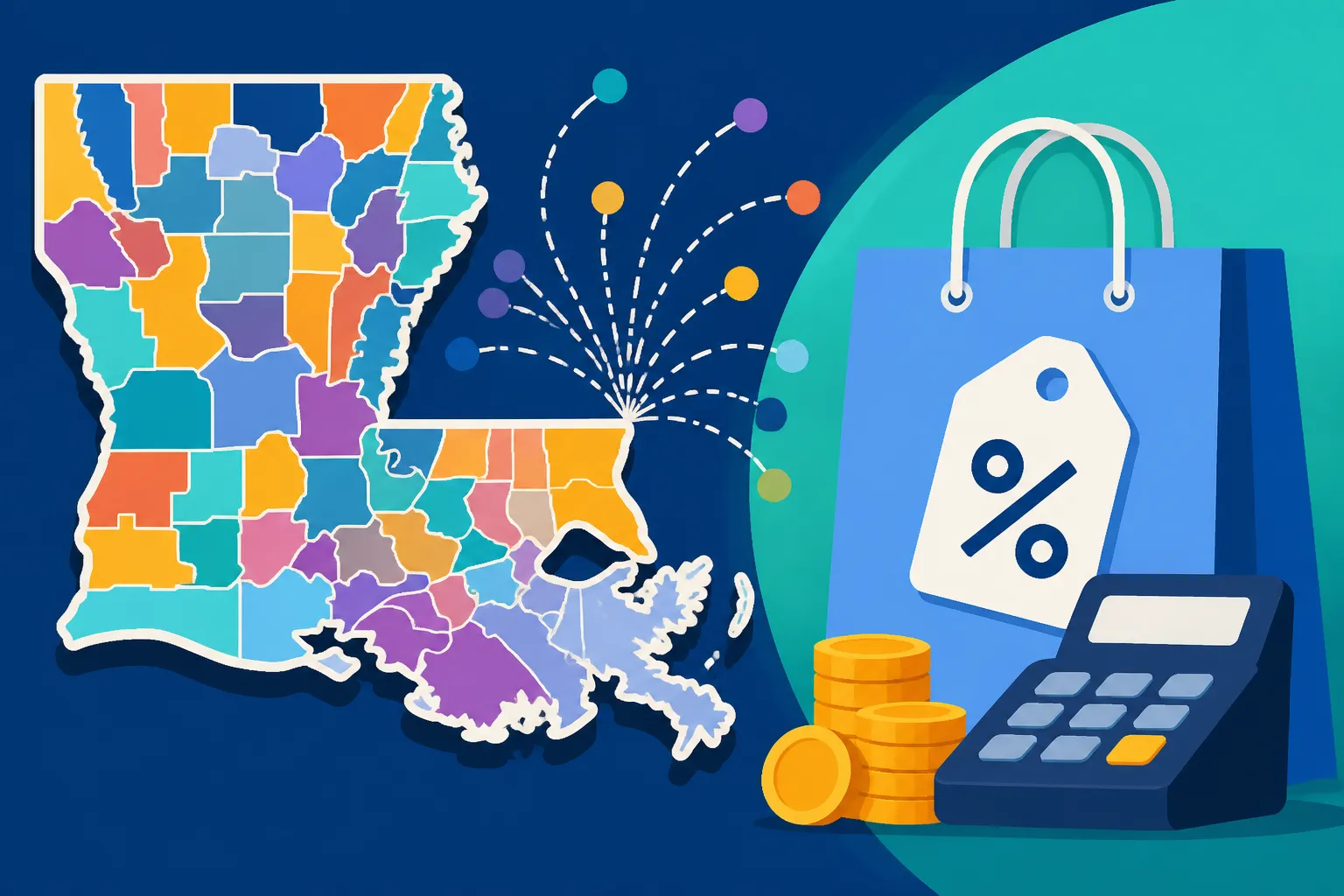
Louisiana Parish Sales Tax Complexity
If you have ever tried to file a sales tax return in Louisiana, you know it feels less like accounting and more like navigating an ancient labyrinth without a map. The sheer administrative burden of tracking sixty-four different parishes, each with its own set of rules and collectors, is enough to keep any business owner up at night. This guide breaks down the madness of Louisiana local taxes, helping you understand how to stay compliant without losing your mind.
The Unique Structure of Louisiana Sales Tax
Louisiana is one of the few remaining "home-rule" states in the country, which is a polite way of saying that local jurisdictions have a massive amount of power over their own tax laws. While most states have a central department of revenue that handles everything, Louisiana splits the responsibility. You aren't just dealing with the state government; you are dealing with a patchwork of local authorities that often operate independently of one another.
State Base Rate vs Local Add-ons
At the top level, you have the state sales tax rate, which is currently set at 4.45%. On its own, that sounds manageable, but it is rarely the rate you actually charge a customer. Almost every square inch of the state is covered by additional parish, city, and special district taxes. By the time you add these up, the combined rate often exceeds 9% or even 10%. This is why the Louisiana Sales Tax Rate (Highest Combined 10.11%) is frequently cited as one of the highest in the nation.
For a business, this means every single transaction requires a precise lookup. You can't just assume a flat rate for the whole state. If you are selling a piece of furniture to a customer in New Orleans, you have to account for the state rate, the Orleans Parish rate, and potentially any municipal or school board taxes that apply to that specific street address. It is a granular level of detail that many out-of-state sellers find completely overwhelming.
The Concept of Home Rule Authority
Home rule is the legal foundation that allows Louisiana parishes to be so difficult. Under the state constitution, parishes have the right to define their own tax bases and manage their own collections. This creates a situation where the Louisiana Parish Sales Tax Complexity is built into the very law of the land. Because parishes have this autonomy, they don't always follow the state’s lead on what is taxable and what isn't.
Imagine a scenario where you sell a specific type of industrial machinery. The state might grant an exemption for that item, but the parish where your customer is located might decide they want their cut regardless of what the state says. This lack of uniformity means you have to maintain separate taxability matrices for different parts of the state. This is a far cry from the Average Sales Tax Rate by State models seen in more centralized regions like Washington or Florida.
Why Parishes Are the Wild West of Sales Tax
In most states, if you get audited, a single auditor from the Department of Revenue shows up, looks at your books, and leaves. In Louisiana, because each parish is its own taxing authority, you could theoretically be audited by the state and then audited separately by every single parish where you have a physical presence or significant sales. This decentralized system is the primary driver of the Louisiana Parish Sales Tax Complexity that businesses dread.
Local Tax Collectors and Independent Audits
Each of Louisiana's 64 parishes has its own local tax collector. These aren't just branch offices of the state; they are independent entities. Some parishes use the local sheriff’s office, while others have a dedicated sales tax department or school board. Because these collectors are responsible for funding local services like roads and schools, they are incredibly protective of their revenue.
If a parish believes you haven't been collecting the correct amount, they have the authority to initiate an audit. This is where tools like Avalara become essential for growing businesses. Without a way to automate the tracking of these local jurisdictional boundaries, you are essentially guessing, and guessing is an invitation for a parish auditor to knock on your door. When you consider the Sales Tax Penalties & Late Filing by State, Louisiana's local penalties can be particularly aggressive because the money is so vital to local budgets.
Variations in Taxable Bases
One of the most frustrating aspects of Louisiana Parish Sales Tax Complexity is that the "taxable base"—what actually gets taxed—can differ between the state and the local level. For example, the state might offer a "tax holiday" for certain items or exempt certain manufacturing inputs, but the parish might choose not to participate in those exemptions.
A common pain point is the taxation of digital goods and services. While the state has moved toward taxing modern products, you have to check the specific local ordinance to see if a parish follows suit. Specifically, as of recently, Louisiana Now Taxes SaaS (Jan 2025), but how each parish interprets "software as a service" can still vary based on their local codes. This means a single invoice might have a 4.45% state tax applied to one line item, but a 5% local tax applied to a completely different set of line items on that same bill.
Navigating Economic Nexus in a Decentralized State
After the Supreme Court's Wayfair decision, the rules for out-of-state sellers changed forever. Louisiana had to figure out how to collect tax from online retailers without violating the Commerce Clause by making it "unduly burdensome." Their solution was the creation of a centralized commission for remote sellers, but while this helped, it didn't eliminate the complexity for everyone.
Remote Sellers Information Commission
The Louisiana Remote Sellers Information Commission (RSIC) was designed to act as a single point of contact for businesses that do not have a physical presence in the state but meet the Economic Nexus Threshold in Louisiana. If you are a remote seller, you generally register with the RSIC and file one return at a single "remote seller" rate (currently 8.45%). This is a massive relief compared to filing in every parish.
However, there is a major catch. As soon as you have "physical nexus"—like a salesperson living in the state, a warehouse, or even inventory in an Amazon FBA center—you are no longer a "remote seller." You are now a "dealer," and you are back to the Louisiana Parish Sales Tax Complexity of filing individual returns with each parish collector. This "trap" catches many growing e-commerce brands that start as remote sellers but eventually trigger physical presence through growth or logistics.
Thresholds and Registration Requirements
To trigger economic nexus in Louisiana, a business typically needs to have more than $100,000 in sales or 200 separate transactions into the state. While many states are moving away from the transaction count, Louisiana has historically used both. You need to keep a close eye on your numbers because the moment you cross that line, the clock starts ticking on your Sales Tax Registration Guide for Louisiana.
Failing to register on time can lead to a mountain of back taxes. Because Louisiana parishes can be so protective, they often share data. If you register for a New Orleans Sales Tax Rate permit, don't be surprised if other nearby parishes start asking why you haven't registered with them too. It is a highly connected network of local collectors who are all looking for their slice of the pie.
Filing and Remittance: The Multi-Return Headache
If you are a business with physical nexus in Louisiana, the administrative work is staggering. Unlike a state like Texas where you file one return and the state distributes the money to the cities, in Louisiana, you are often cutting dozens of different checks to dozens of different offices.
Parish by Parish Filing
For a business with a broad footprint, the monthly filing process looks like this: you prepare your state return for the Department of Revenue, then you prepare a separate return for Jefferson Parish, another for Orleans Parish Sales Tax Rate, another for East Baton Rouge, and so on. Each of these has its own portal, its own login, and its own quirks.
This is why many veterans in the industry recommend using a service like Avalara to consolidate this data. Manually logging into 20 different parish websites every month is not just a waste of time; it is a massive liability. One typo on a Louisiana Sales Tax Filing & Due Dates form can result in a notice that takes months to resolve.
Common Errors and Penalty Risks
The most common error in Louisiana is using the wrong local rate because of a ZIP code. As we often discuss, Sales Tax by ZIP Code (and Why ZIP Isn't Enough) is a dangerous game in Louisiana. ZIP codes are for delivering mail, not for determining tax jurisdictions. A single ZIP code in Louisiana can span multiple parishes or city limits, each with a different tax rate.
If you charge the 9% rate for a customer who actually lives in a special district with a 9.5% rate, you are under-collecting. Over time, that 0.5% adds up. During an audit, the parish will demand that missing 0.5% plus interest and penalties out of your own pocket. Because you didn't collect it from the customer at the time of sale, you are the one left holding the bag.
Comparison of Local Tax Burdens
To give you an idea of how much these rates can vary, look at how some of the major population centers compare. Even within the same general region, the Louisiana Parish Sales Tax Complexity means your tax liability can shift significantly just by crossing a parish line.
| Jurisdiction | State Rate | Local Parish/City Rate | Total Combined Rate | Collector Authority |
|---|---|---|---|---|
| New Orleans (Orleans Parish) | 4.45% | 5.00% | 9.45% | City of New Orleans |
| Baton Rouge (E. Baton Rouge) | 4.45% | 5.50% | 9.95% | City-Parish Revenue |
| Metairie (Jefferson Parish) | 4.45% | 4.75% | 9.20% | Sheriff's Office |
| Lafayette (Lafayette Parish) | 4.45% | 4.00% – 5.50% | 8.45% – 9.95% | School Board |
| Shreveport (Caddo Parish) | 4.45% | 4.60% – 6.10% | 9.05% – 10.55% | Caddo Sales Tax Comm. |
As you can see, the collector isn't always the same type of office. Dealing with a Sheriff's office for tax questions is a very different experience than dealing with a School Board. Each has its own culture and its own level of responsiveness.
Strategies for Managing Louisiana Compliance
Given the Louisiana Parish Sales Tax Complexity, you cannot afford to "wing it." You need a strategy that relies on technology and constant monitoring of legislative changes. The state is currently in a period of significant tax reform, and what was true two years ago might not be true today.
Automation and Software Solutions
For any business doing more than a handful of sales a month in Louisiana, automation is the only way to survive. Software like Avalara integrates directly with your shopping cart or ERP system to calculate the exact tax down to the latitude and longitude of the customer's address. This removes the "ZIP code guesswork" and ensures you are collecting the right amount for the right parish.
Beyond calculation, these tools can also handle the filing. Instead of you logging into dozens of parish portals, the software aggregates your sales data and files the returns on your behalf. This is especially helpful when dealing with California District Taxes Explained or other complex states, but in Louisiana, it is arguably more critical than anywhere else in the country.
Keeping Up with Rate Changes
Louisiana local rates change frequently. Parishes often pass new bonds for schools or infrastructure that result in a 0.25% or 0.5% increase. These changes don't always happen on a predictable schedule like the first of the year. You might get a notice in July that a rate is changing in August.
Staying compliant means regularly checking for 2026 Sales Tax Rate Changes by State and specifically looking for local ordinances in Louisiana. If you aren't using an automated system, you should at least sign up for the mailing lists of the local collectors in the parishes where you have the most sales. Being proactive is the only way to avoid the "catch-up" payments that bankrupt small businesses during an audit.
Louisiana Sales Tax Disclaimer
The information provided in this guide is for educational and informational purposes only and does not constitute legal, tax, or accounting advice. Louisiana's sales tax laws and local parish regulations are subject to frequent changes and complex interpretations. You should consult with a qualified tax professional or CPA who specializes in Louisiana multi-jurisdictional tax compliance to discuss your specific business situation and ensure you are meeting all current legal requirements.