South Dakota v. Wayfair: What It Means for Sellers
Before 2018, understanding sales tax for online businesses felt, in some ways, deceptively simple. Most sellers only had to worry about collecting sales tax in states where they had a physical presence – a store, an office, an employee. But for modern sellers reaching customers across state lines, this old rule became a huge problem for states trying to fund local services. Then came a game-changing Supreme Court decision: South Dakota v. Wayfair, Inc. This ruling completely reshaped the sales tax landscape, turning what used to be a clear line in the sand into a maze of new obligations for countless businesses. This guide is here to demystify what Wayfair means for you, how economic nexus works, and what steps you need to take to stay compliant in this new era.
Before Wayfair: The Physical Presence Rule Era
For decades, the foundation of sales tax collection for remote sellers (businesses selling into a state where they didn't have a physical store) rested on a principle known as the "physical presence rule." This rule, while seemingly straightforward, proved to be an increasingly challenging and outdated concept as the digital age blossomed. It essentially meant that if your business didn't have a physical "footprint" in a state, you weren't obligated to collect sales tax from customers in that state.
The Quill Corp. v. North Dakota Precedent
The physical presence rule was firmly established by a 1992 Supreme Court case, Quill Corp. v. North Dakota. In this case, the Supreme Court ruled that a business needed to have a substantial physical connection – or "nexus" – within a state before that state could compel it to collect sales tax. For a business like Quill, which sold office supplies via mail order, this meant if they didn't have property, employees, or a store in North Dakota, they didn't have to collect North Dakota sales tax. This decision was rooted in concerns about the administrative burden on businesses if they had to comply with potentially thousands of different state and local sales tax rules. The technology back then simply wasn't equipped to handle that kind of complexity easily.
This ruling created a relatively clear, albeit often frustrating, boundary for businesses. If you had a warehouse in California, you collected California sales tax. If you didn't, but sold to Californians, you generally didn't. This offered a degree of certainty but also led to a significant loss of potential revenue for states as remote sales grew. The simplicity it offered was largely for the sellers who could avoid collecting in many states, rather than for the states themselves or the local communities that relied on sales tax revenue for schools, roads, and public services.
How eCommerce Challenged the Status Quo
Fast forward to the late 1990s and into the 21st century, and the world of commerce was changing dramatically. The internet made it possible for businesses to sell goods and services to anyone, anywhere, with just a few clicks. Suddenly, a small online boutique operating out of a garage in Oregon (a state with no statewide sales tax) could sell to customers in New York or Texas without needing a single physical location or employee in those states. This completely bypassed the physical presence requirement.
States watched with growing alarm as their sales tax revenues, a crucial component of their budgets, eroded. Consumers, especially those looking for a deal, often favored online retailers who didn't charge sales tax, creating an unfair competitive advantage over local brick-and-mortar stores that did have to collect. Local businesses, paying local property taxes and collecting sales tax, found themselves at a disadvantage against remote sellers who seemingly operated without the same obligations. This growing disparity and the massive revenue hole it created for states eventually set the stage for a new legal challenge, arguing that the Quill decision was no longer suitable for the modern economy. It was becoming abundantly clear that the old rules, designed for a catalog mail-order era, simply couldn't keep pace with the explosion of eCommerce.
The Landmark Decision: South Dakota v. Wayfair, Inc.
The stage was set for a showdown, and South Dakota stepped up to be the standard-bearer for states seeking to reclaim sales tax revenue from remote sellers. The case of South Dakota v. Wayfair, Inc. wasn't just another legal squabble; it was a constitutional challenge that ultimately pulled the rug out from under decades of established sales tax precedent.
Background of the Case
In 2016, South Dakota passed a law that directly challenged the Quill physical presence rule. Their argument was straightforward: the state was losing substantial tax revenue due to out-of-state retailers who weren't collecting sales tax, and local businesses were being put at an unfair disadvantage. To address this, South Dakota enacted Senate Bill 106, which mandated that remote sellers collect and remit sales tax if, in the previous or current calendar year, they either:
- Had over $100,000 in gross revenue from sales of goods or services delivered into South Dakota, OR
- Engaged in 200 or more separate transactions for delivery of goods or services into South Dakota.
These specific sales thresholds were key. South Dakota wasn't trying to tax every single small online sale, but rather targeting businesses that had a substantial, albeit economic, connection to the state. They knew this law would be challenged, and indeed, they intended for it to be, hoping it would make its way to the Supreme Court to force a reconsideration of the Quill precedent. Wayfair, along with other online retailers like Overstock.com and Newegg, challenged the law, arguing that it violated the existing physical presence standard. This set the stage for the pivotal Supreme Court decision.
The Supreme Court's Ruling and Its Rationale
On June 21, 2018, the U.S. Supreme Court delivered its groundbreaking 5-4 decision in South Dakota v. Wayfair, Inc. The Court sided with South Dakota, overturning both Quill Corp. v. North Dakota and an earlier case, National Bellas Hess v. Department of Revenue of Ill. (1967), which had initially established the physical presence rule. Justice Anthony Kennedy, writing for the majority, famously declared that the physical presence rule was "an anachronism" (something belonging to a different time period) that had become "unsound and incorrect."
The rationale behind this monumental shift was multifaceted:
- Erosion of State Tax Bases: The Court recognized that the physical presence rule was causing states to lose billions of dollars in sales tax revenue annually, severely impacting their ability to fund essential public services. The internet had fundamentally changed the nature of commerce, and the old rule simply didn't fit anymore.
- Unfair Competition: The ruling acknowledged the unfair competitive advantage enjoyed by remote sellers who could avoid collecting sales tax, undercutting local businesses that had to. This disparity put brick-and-mortar stores at a significant disadvantage, harming local economies.
- Technological Advancements: A major point was the advancement in sales tax software and technology. The Court noted that the administrative burden argument, a core component of the Quill decision, was no longer as valid. Modern software solutions could now easily calculate and remit sales tax for businesses across multiple jurisdictions, making compliance far more manageable. Tools available today, like those from Avalara, can integrate directly into e-commerce platforms and accounting systems, automating what was once a monumental manual task.
- Economic Nexus: The Court effectively introduced and validated the concept of "economic nexus," stating that a business could have a substantial connection to a state, and thus an obligation to collect sales tax, based purely on its economic activity within that state, regardless of physical presence.
This ruling didn't just change a tax law; it redefined the constitutional limits of state taxing power, giving states the authority to require remote sellers to collect sales tax if they meet certain economic thresholds. It was a seismic shift that instantly created new compliance responsibilities for businesses selling across state lines.
Introducing Economic Nexus: The New Standard
The Wayfair decision didn't just overturn old law; it ushered in a completely new era of sales tax compliance, fundamentally changing how businesses determine where they need to collect tax. The heart of this change is the concept of economic nexus.
Defining Economic Nexus
Prior to Wayfair, "nexus" almost exclusively meant a physical presence – a tangible link like a store, an office, a warehouse, or even an employee in a state. If you had any of these, you had physical nexus, and therefore, an obligation to collect sales tax from customers in that state.
Economic nexus, on the other hand, means that a business can establish a sales tax obligation in a state based solely on the volume or value of its sales transactions into that state, even if it has no physical presence there. It's the idea that simply by engaging in significant economic activity within a state, a remote seller is benefiting from that state's infrastructure and markets, and therefore, should contribute to its tax base. This shift means that the old "out of sight, out of mind" approach to sales tax for remote sellers is no longer viable. Businesses now have to actively monitor their sales activity in every state where they sell goods or services.
For example, imagine a small online candle maker based in Portland, Oregon. Under the old rules, if they only sold online and had no physical ties to, say, California, they wouldn't collect California sales tax. With economic nexus, if their sales to California customers cross a certain threshold (which we'll discuss next), they now have an obligation to register with California's tax authority and begin collecting sales tax from all Californian customers. This is a massive change, requiring businesses to understand not just their own operations, but also the specific laws of dozens of different states. You can learn more about the specifics of these concepts in our guide on Sales Tax Nexus Explained Physical vs Economic.
State-Specific Economic Nexus Thresholds
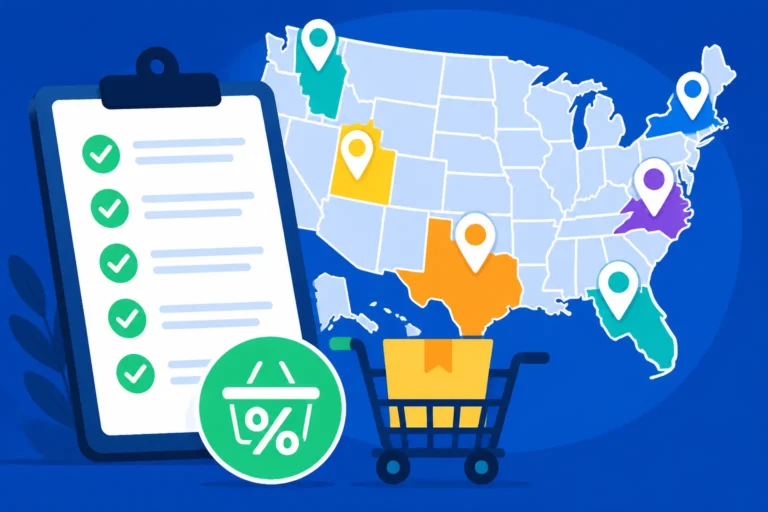
While the Wayfair decision established the principle of economic nexus, it didn't set a universal threshold. Instead, it empowered each state to define its own. This is where things get really intricate and, frankly, a bit overwhelming for many sellers. The vast majority of states that impose a sales tax quickly adopted economic nexus laws after the Wayfair ruling.
The most common economic nexus threshold adopted by states is $100,000 in gross sales OR 200 separate transactions into the state within the current or preceding calendar year. However, this is just a general guideline, and there are many variations:
- Sales Dollar Threshold Only: Some states, like California and Texas, have chosen to use only a sales dollar threshold, typically $500,000, and have eliminated the transaction count threshold. This can be a relief for businesses that have many small-dollar transactions but low overall revenue.
- Higher or Lower Dollar Thresholds: A few states have slightly different dollar amounts (e.g., some have $250,000).
- "Retroactive" Application: Some states look at sales activity from the previous calendar year to determine nexus for the current year, while others use a rolling 12-month period.
- Specific Exclusions: Some states might exclude certain types of sales (like wholesale sales made with a valid resale certificate) when calculating the threshold.
It's crucial for any business selling across state lines to not only understand that economic nexus exists but also to regularly check the specific thresholds for every state where they have customers. Missing these nuances can lead to non-compliance, penalties, and back taxes. Our comprehensive resource, Economic Nexus by State 2026: Thresholds Guide, provides a detailed breakdown of each state's specific rules, which is an invaluable tool for navigating this complex landscape.
| State Example | Sales Threshold | Transaction Threshold | Notes |
|---|---|---|---|
| South Dakota | $100,000 | 200 | The original benchmark from the Wayfair case. |
| California | $500,000 | None | High dollar threshold, no transaction count. |
| New York | $500,000 | 100 | Higher dollar threshold, but also includes a transaction count. |
| Texas | $500,000 | None | Similar to California, focused on larger revenue streams. |
| Florida | $100,000 | None | Removed the transaction threshold in 2021 when it implemented its economic nexus law. |
| Colorado | $100,000 | None | Home-rule state, but state-level threshold applies; local jurisdictions may have separate rules for their taxes. |
Note: Thresholds are subject to change. Always verify current state tax department guidelines.
Immediate Impact on Online Sellers
The Wayfair decision was a seismic event for online sellers, instantly transforming their compliance responsibilities. The days of simply setting up an online shop and only worrying about sales tax in your home state (and maybe a few others with physical nexus) were over. This ruling forced an immediate and often overwhelming re-evaluation of business operations for countless companies, big and small.
The Sudden Shift in Compliance Requirements
The most immediate impact was the sudden need for online sellers to determine if they had economic nexus in any state where they were selling. This wasn't a gradual rollout; once the decision came down, states quickly began enacting their own economic nexus laws, often with effective dates just a few months away. Businesses suddenly found themselves in a scramble to understand new obligations in potentially dozens of states simultaneously.
Consider a small business that sold handcrafted jewelry primarily through an Etsy shop. Before Wayfair, they might have only collected sales tax for customers in their home state of, say, Washington. After Wayfair, and as states rapidly adopted their own economic nexus rules, this business suddenly had to:
- Monitor sales: Keep track of total sales and transaction counts into every single state.
- Identify nexus: Determine which states' thresholds they met. If they sold $101,000 worth of jewelry to customers in Ohio, they now had economic nexus there.
- Understand taxability: Figure out if their specific products (handcrafted jewelry) were taxable in each of those states, as taxability can vary.
- Register: Apply for a sales tax permit (or seller's permit, certificate of authority, etc.) in each state where they had nexus. You can get more details on this process in our guide Registering for Sales Tax in Multiple States.
This wasn't just about collecting a little extra money; it was about completely changing business processes, which for many smaller operations felt like an impossible task. The shockwave of the Wayfair decision created a legitimate sense of panic and frustration among many online entrepreneurs.
Increased Administrative Burden
Beyond simply identifying nexus, the Wayfair decision dramatically increased the administrative burden on businesses. Imagine a company that previously filed one sales tax return per month or quarter in its home state. Now, with economic nexus in, say, ten additional states, they might have to:
- Register in multiple jurisdictions: Each state has its own registration process, requiring different forms and information. Getting a sales tax permit in Texas is different from getting one in New York. Our guide on How to Get a Sales Tax Permit by State walks you through this.
- Calculate thousands of rates: Sales tax isn't just a single state rate. It's often a combination of state, county, city, and special district taxes. Some states have "origin-based" sourcing (where the seller is located), while others have "destination-based" sourcing (where the buyer is located), which significantly impacts the rate collected. For example, understanding Origin vs Destination Sales Tax Sourcing is critical. In a state like Colorado, with its many home-rule jurisdictions, the complexity can feel overwhelming as many cities set their own sales tax rules and have their own reporting requirements. Even the combined sales tax rate can be a headache to calculate.
- Collect and remit accurately: Every sale requires collecting the correct amount of tax. An incorrect rate, even by a fraction of a percent, can lead to audit issues down the road.
- File returns regularly: Each state also has its own filing frequency (monthly, quarterly, annually) and specific due dates. Submitting returns in multiple states with differing schedules and formats adds a layer of constant vigilance.
For small businesses operating with limited resources, this sudden explosion of compliance tasks often meant diverting time and money away from core business activities like marketing, product development, or customer service. The administrative burden was, and for many, continues to be, the most significant and frustrating outcome of the Wayfair decision.
Navigating Post-Wayfair Sales Tax Compliance
The new world of sales tax, defined by economic nexus, demands a proactive and systematic approach from every business that sells across state lines. Gone are the days of blissful ignorance regarding out-of-state sales. Now, understanding your obligations and setting up robust systems for compliance isn't just good practice—it's essential for avoiding costly penalties and legal headaches.
Step-by-Step for Determining Nexus
The first and most critical step in post-Wayfair compliance is to accurately determine where your business has nexus. This isn't a one-time check; it's an ongoing process that needs regular review as your business grows and changes.
- Analyze Your Sales Data: Begin by compiling detailed sales data for both the current and previous calendar year. You need to know:
- Total Gross Sales per State: What is the total dollar amount of all sales (including tax-exempt sales) delivered into each state?
- Total Transaction Count per State: How many individual sales transactions were delivered into each state?
- Exclusions: Be sure to identify any sales that might be excluded by a state's specific threshold rules, such as wholesale sales where you received a valid resale certificate. For example, some states specify that the threshold applies only to taxable sales, while others count all gross sales.
- Compare Against State Thresholds: Once you have your data, compare your state-by-state sales volume and transaction counts against each state's economic nexus thresholds. Remember, these thresholds vary significantly. For instance, California's threshold is $500,000 in sales, while many states use the $100,000 / 200 transaction rule. It's not enough to know the general rule; you need the specific details for each state. This is where a detailed resource like Economic Nexus by State 2026: Thresholds Guide becomes indispensable.
- Review for Physical Nexus Triggers: While economic nexus is the new kid on the block, don't forget about physical nexus! Even if you don't meet an economic threshold, you still have nexus if you have:
- Employees (even remote ones)
- A physical office or store
- A warehouse or inventory (including third-party fulfillment centers like Amazon FBA)
- Affiliates
- Temporary presence at trade shows or events
- Delivery vehicles
- Installation or repair services performed in a state.
Understanding all potential triggers is crucial. A simple way to stay on top of this is to regularly review where your business has any sort of "footprint."
Registration and Collection Strategies
Once you've identified all the states where you have nexus, the next phase involves official registration and setting up your systems for correct collection.
- Register for a Sales Tax Permit: For every state where you've determined you have nexus, you must register with that state's taxing authority to obtain a sales tax permit (sometimes called a seller's permit, certificate of authority, or vendor's license). This is a legal requirement before you can begin collecting sales tax from customers in that state. Our guide on How to Get a Sales Tax Permit by State offers state-specific instructions to make this process smoother.
- Understand Taxability Rules: Sales tax isn't just about rates; it's also about what's actually taxable. The taxability of products and services can differ wildly from state to state. For example, clothing might be exempt up to a certain dollar amount in New York, while in other states it's fully taxable. Groceries are often exempt or taxed at a reduced rate, but "prepared food" or "candy" might be fully taxable. You need to know how your specific products are treated in each state where you're collecting.
- Implement Correct Rate Calculation: This is perhaps the most complex part for many sellers. Sales tax rates are not uniform across a state; they are a patchwork of state, county, city, and special district taxes.
- Sourcing Rules: You need to understand whether a state uses origin-based or destination-based sourcing. For example, in an origin-based state like Illinois, if your business is in Chicago and you sell to a customer in Springfield, you might collect Chicago's sales tax rate. In a destination-based state like California, you would collect the sales tax rate for the customer's location in Springfield. This distinction is critical and is thoroughly explained in our guide Origin vs Destination Sales Tax Sourcing.
- Rate Lookup: You'll need a reliable way to look up the correct sales tax rate for every single customer's address at the point of sale. This is where manual methods quickly become unsustainable and prone to error. Understanding the full landscape of Sales Tax Rates by State 2026: All 50 States is the first step, but then applying that to specific addresses is the real challenge.
Leveraging Sales Tax Automation Software
Given the incredible complexity introduced by Wayfair, trying to manage sales tax compliance manually is a recipe for errors, missed deadlines, and severe stress. This is where sales tax automation software becomes not just a convenience, but a near necessity for any business with multi-state nexus.
These software solutions are designed to automate the entire sales tax lifecycle, from nexus determination to rate calculation and filing. A prime example is Avalara, which offers robust solutions for businesses of all sizes. Here's how such software helps:
- Nexus Tracking: Many platforms can help you track your sales activity against state economic nexus thresholds, alerting you when you're approaching or have met a threshold.
- Real-Time Rate Calculation: This is arguably the biggest benefit. Automation software integrates with your eCommerce platform (Shopify, WooCommerce, BigCommerce, etc.) or accounting system (QuickBooks, NetSuite), automatically applying the correct sales tax rate at the point of sale based on the customer's exact shipping address. It handles the nuances of state, county, city, and district taxes, as well as origin vs. destination sourcing. This ensures you're collecting the correct amount every single time.
- Taxability Determinations: Advanced software can often help categorize your products and services to apply the correct taxability rules for each state.
- Reporting and Filing: Once taxes are collected, the software can generate accurate reports, allowing you to easily see how much tax you collected in each jurisdiction. Many solutions also offer automated filing, where they can prepare and submit your sales tax returns directly to the states on your behalf, often including required prepayments and tracking various Sales Tax Due Dates by State 2026.
- Audit Trail: Automated systems maintain a detailed record of all transactions, rates applied, and taxes collected, providing an invaluable audit trail should a state ever question your compliance.
While there's an investment involved, the time savings, accuracy, and peace of mind offered by sales tax automation tools significantly outweigh the risks and manual effort of trying to navigate post-Wayfair compliance on your own. For a deeper dive into options, check out our guide on the Best Sales Tax Compliance Software 2027.
Ongoing Challenges and Future Outlook
Even several years after the Wayfair decision, the sales tax landscape continues to evolve, presenting ongoing challenges for businesses. While the initial shock has worn off, staying compliant remains a complex and dynamic task.
The Complexity of Different State Rules
The biggest hurdle for most businesses is the sheer diversity of sales tax rules across the 45 states (and Washington D.C.) that impose a statewide sales tax, plus the multitude of local jurisdictions. It's not just about collecting tax; it's about understanding a complex web of varying regulations:
- Varying Economic Nexus Thresholds: As discussed, not all states use the same $100,000 or 200 transaction rule. Some, like Florida, only have a dollar threshold. Other states like California and Texas have higher dollar thresholds, around $500,000. These differences mean a business could have nexus in one state but not a neighboring one, despite similar sales activity.
- Product and Service Taxability: What's taxable in one state might be exempt in another. For instance, SaaS (Software-as-a-Service) and other digital products have highly inconsistent taxability rules across the country. Some states tax nearly all services, while others only tax a select few. This means your core product might be taxable in New York but exempt in Pennsylvania.
- Sourcing Rules: The distinction between origin-based and destination-based sourcing fundamentally changes how you calculate the local portion of sales tax. Understanding these subtle but critical differences is key, especially in states with many local tax jurisdictions.
- Home-Rule States: Some states, like Colorado, Alabama, and Louisiana, have "home-rule" jurisdictions where local cities and counties can administer and collect their own sales taxes completely independently of the state. This means a single business might need to register and file directly with dozens of individual cities in Colorado, each with its own rates and forms, even if they've already registered with the state. Our guide on Colorado Home-Rule Cities Sales Tax offers more insight into this particular challenge. Similarly, Alabama Local Sales Tax (200+ Jurisdictions) showcases another example of extreme local complexity.
- Filing Frequencies and Due Dates: Each state assigns a filing frequency (monthly, quarterly, annually) based on a seller's collected tax volume, and each has its own set of due dates. Managing multiple filing calendars is a logistical puzzle that demands constant attention.
The Role of Marketplace Facilitator Laws
Adding another layer of complexity (and, in some ways, simplification for certain sellers) are marketplace facilitator laws. These laws gained significant traction after Wayfair and effectively shifted the sales tax collection burden from individual sellers on a marketplace to the marketplace itself.
- What They Do: Under marketplace facilitator laws, platforms like Amazon, eBay, Etsy, and Walmart are responsible for calculating, collecting, and remitting sales tax on behalf of their third-party sellers for sales made through their platform. This is a huge relief for many small businesses who sell primarily or exclusively through these large marketplaces.
- Seller's Ongoing Responsibility: However, sellers still need to understand their own nexus. If you sell on Amazon and on your own website, the marketplace facilitator law only covers your Amazon sales. You still need to determine if your sales on your own website create economic nexus in any states. You also still have nexus if you have a physical presence in any states, even if Amazon handles collection for marketplace sales in those states. This is a critical distinction that many sellers initially misunderstand. Our resource Marketplace Facilitator Laws by State explains these rules in depth.
- Filing Requirements: Even if a marketplace collects the tax for you, some states still require sellers to report those marketplace sales on their own sales tax returns, even if no tax is due from the seller themselves. This is a reporting requirement, not a collection requirement, but it's important not to overlook.
Staying Informed and Adaptable
The sales tax landscape is not static. Rates change, new laws are passed, and thresholds can be adjusted. Consider that 2026 Sales Tax Rate Changes by State is a regular occurrence, with legislative bodies constantly evaluating their tax codes.
- Continuous Monitoring: Businesses must continuously monitor their sales activity to identify new nexus triggers. What didn't create nexus last quarter might next quarter. Regularly reviewing your sales data and comparing it against state thresholds is non-negotiable.
- Legislative Changes: Keep an eye on sales tax news and updates from state revenue departments. What might be a simple administrative change in one state could have significant implications for your business.
- Professional Guidance: For many businesses, especially those with significant multi-state sales, consulting with a sales tax expert or utilizing robust sales tax compliance software is essential. These resources can help you navigate the ever-changing rules and ensure your business remains compliant. Ultimately, a solid understanding of fundamental concepts like Sales Tax for Online Sellers: Complete Guide or How Combined Sales Tax Rates Work can provide a crucial foundation.
The Wayfair decision permanently altered sales tax compliance. While it introduced significant complexity, the tools and resources available today make navigating this intricate world much more manageable than trying to tackle it alone.
Disclaimer
The information provided in this guide is for general informational purposes only and does not constitute professional tax or legal advice. Sales tax laws are complex and constantly changing. Businesses should consult with a qualified tax professional or legal advisor to address their specific sales tax obligations and situations. Relying solely on this general information may not be appropriate for your individual circumstances.