Sales Tax on Groceries by State
It can feel like a game of chance every time you check out at the grocery store, wondering if that carton of milk or bag of apples will have sales tax tacked on. One day your fresh produce is exempt, the next your hot deli sandwich isn't, and the soda you grabbed for dinner costs a little extra. This patchwork of rules across the United States is incredibly frustrating for consumers trying to stick to a budget and a constant headache for businesses striving for compliance. This comprehensive guide is here to demystify sales tax on groceries by state, laying out exactly what's taxed, what's not, and why.
The Confusing Landscape of Grocery Sales Tax
Understanding sales tax on groceries is far from straightforward. Unlike other tangible goods that are almost universally subject to sales tax, food—especially unprepared food intended for home consumption—often occupies a special category. This isn't just about what's fair; it's steeped in economic policy, historical precedent, and often, political debate. The variations from state to state can be baffling, leading to errors for both buyers and sellers.
The Rationale Behind Food Exemptions or Lack Thereof
The primary reason many states exempt groceries from sales tax is rooted in social equity and economic impact. Sales tax is often considered a regressive tax, meaning it disproportionately affects lower-income households because they spend a larger percentage of their income on necessities like food. Exempting groceries helps alleviate this burden, making essentials more affordable for everyone. This policy aims to ensure that sales tax doesn't prevent families from accessing basic sustenance.
However, not all states adhere to this philosophy, or they implement it with various caveats. Some states argue that a broad sales tax base, including groceries, allows them to keep the overall tax rate lower or to fund essential services more effectively. For businesses, navigating these differing philosophies means constantly being aware of local and state laws, which can feel like deciphering a secret code. Even within a single state, changes can occur, like the upcoming repeal of Illinois's 1% grocery tax in 2026, which marks a significant shift for consumers and retailers there.
Defining "Grocery Food" Versus "Prepared Food"
Here's where things get really murky. What one state considers a "grocery item" might be taxed as "prepared food" in another, or even within the same state under different circumstances. Generally, "grocery food" refers to items purchased for preparation and consumption at home, like raw ingredients, packaged goods, fruits, vegetables, and meats. These are typically rung up as untaxed items in states with grocery exemptions.
"Prepared food," on the other hand, usually refers to food sold in a heated state, food sold with eating utensils, or food that's ready for immediate consumption. Think of that hot rotisserie chicken from the supermarket deli, a salad from the salad bar, or a pre-made sandwich. These items are often subject to the full sales tax rate, even in states where basic groceries are exempt. The distinction can be incredibly subtle, for example, a cold pizza might be untaxed, but a hot, ready-to-eat pizza would be taxed. It’s a level of detail that many consumers don't even realize affects their final bill until they're at the register, and it creates a significant compliance challenge for grocery stores and delis. For a deeper dive, check out our guide on Prepared Food Sales Tax Explained.
States Where Groceries Are Taxed or Partially Taxed
While most states have some form of grocery sales tax exemption, a notable number still levy sales tax on food items, either at the full state rate or a reduced one. This means that a trip to the supermarket in these states will likely include an extra charge on your staple items.
The Full Sales Tax States
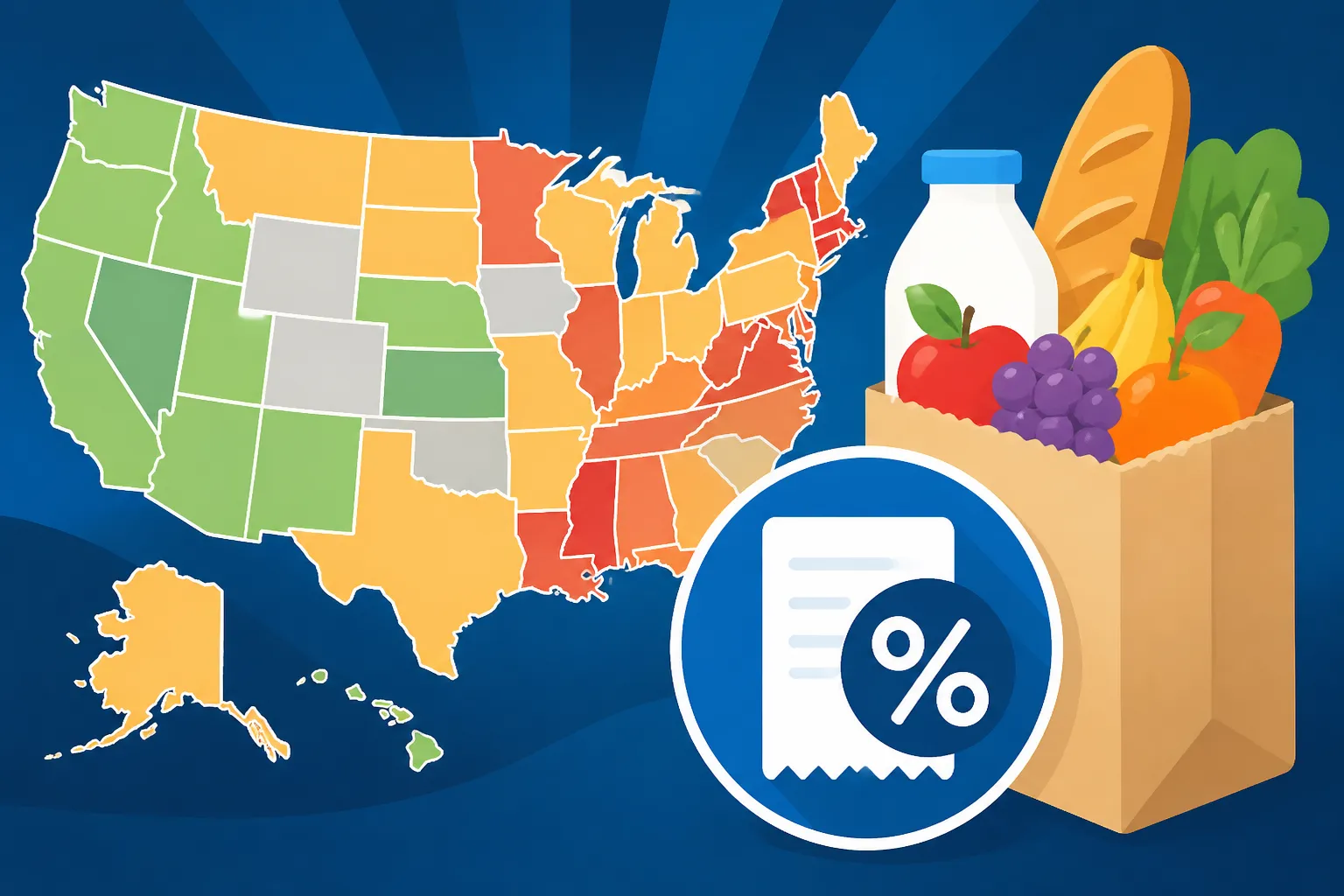
A handful of states stand out because they apply their standard sales tax rate to most grocery items, just as they would to any other tangible good. This can significantly increase the cost of living in these areas, particularly for families. These states typically include Alabama, Hawaii, Idaho, Kansas, Mississippi, Oklahoma, and South Dakota. In these states, your loaf of bread, gallon of milk, and fresh produce all contribute to the sales tax revenue.
For example, in Alabama, you'll pay the state sales tax rate of 4% on your groceries, plus any applicable local sales taxes, which can push the combined rate much higher. Mississippi similarly applies its 7% state sales tax to food items. This means that if you spend $100 on groceries in Jackson, Mississippi, you're paying an extra $7 right off the bat, before any local add-ons. It's a significant difference compared to a state where that same $100 grocery bill would be sales tax-free. Our article on States That Tax Groceries at Full Rate offers a more detailed list and explanation.
States with Reduced Sales Tax Rates on Groceries
Some states try to strike a balance between generating revenue and easing the burden on consumers by taxing groceries at a reduced rate compared to their general sales tax rate. This approach acknowledges the essential nature of food while still capturing some revenue. These states include Missouri, Tennessee, Utah, and Virginia. Illinois also had a reduced rate, but as mentioned, that's changing.
In Tennessee, for instance, the state sales tax rate on most tangible goods is 7%, but food and food ingredients are taxed at a lower state rate of 4%. However, local sales taxes often apply on top of this, which can still make a grocery bill feel substantial. Utah applies a state sales tax rate of 1.75% to food and food ingredients, again with local rates potentially adding to that. Virginia applies a reduced rate of 1.5% to food purchases. These reduced rates can still add up, especially when you consider how much a typical household spends on food each month. When you're trying to figure out your total cost, it's not just the state rate; you also have to factor in those often-overlooked local taxes. To see how these rates compare, you might find our How Much Is Sales Tax on a $100 Purchase by State guide helpful.
Here's a quick overview of states and their grocery sales tax policies:
| State | State Sales Tax on Groceries | Notes |
|---|---|---|
| Alabama | Full (4%) | Local taxes apply. |
| Arizona | Exempt | No state sales tax on groceries, but local taxes (like Transaction Privilege Tax – TPT) can apply in some cities. |
| Arkansas | Exempt | Was formerly taxed, phased out over time. |
| Hawaii | Full (4%) | General Excise Tax (GET) applies to most transactions, including groceries. |
| Idaho | Full (6%) | |
| Illinois | Reduced (1%) | State portion of grocery tax repealed as of Jan 1, 2026. Local taxes may still apply in some municipalities until then. |
| Kansas | Full (6.5%) | State portion of sales tax on groceries is phasing out, set to be 0% by January 1, 2025. Still applies now. |
| Louisiana | Exempt | No state sales tax on groceries for home consumption. Local parish and city taxes can be significant, but generally exempt groceries as well. |
| Mississippi | Full (7%) | |
| Missouri | Reduced (1.225%) | Plus local taxes. |
| Oklahoma | Full (4.5%) | State portion of sales tax on groceries is phasing out, set to be 0% by August 1, 2024. Still applies now. |
| South Dakota | Full (4.5%) | |
| Tennessee | Reduced (4%) | Plus local taxes. |
| Utah | Reduced (1.75%) | Plus local taxes. |
| Virginia | Reduced (1.5%) | Plus local taxes. |
| Most Others | Exempt | The remaining states with a state sales tax generally exempt groceries (e.g., California, Texas, Florida, New York, Washington). The five states with no statewide sales tax (Alaska, Delaware, Montana, New Hampshire, Oregon) also do not tax groceries at the state level, though Alaska has high local sales taxes that can apply to various goods. |
The Majority: States Where Basic Groceries Are Exempt
For the majority of U.S. states that levy a sales tax, basic groceries purchased for home consumption are exempt. This provides a significant break for consumers on essential items and is generally seen as a way to make sales tax less burdensome on lower and middle-income households.
States with Broad Grocery Exemptions
In these states, when you head to your local supermarket, you can expect to pay the sticker price for most of your food items without an additional sales tax charge. This includes fresh fruits and vegetables, uncooked meats, dairy products, bread, canned goods, and most packaged foods that require some form of preparation at home. States like California, Texas, Florida, and New York, despite their often complex sales tax structures for other goods, generally keep basic groceries untaxed.
This exemption streamlines things somewhat for consumers, allowing them to budget for food costs more accurately. For businesses, while it means not collecting tax on a large portion of their sales, they still need clear systems to differentiate between taxable and non-taxable items. This is particularly critical for larger retailers that sell a wide variety of goods, from raw ingredients to fully prepared meals, requiring robust point-of-sale systems that can handle these distinctions automatically.
Nuances and Exceptions within Exempt States
Even in states where groceries are broadly exempt, there are always exceptions and fine print that can trip people up. The biggest and most common exception revolves around the distinction between "food for home consumption" and "prepared food" or "food eaten on the premises." As we touched on earlier, a cold sandwich isn't taxed, but the same sandwich heated up and served in a cafe section of a grocery store usually is.
Another common area of nuance involves what specific types of food are considered "groceries." For example, dietary supplements and over-the-counter drugs are often treated differently than food. While some states exempt them, others tax them, even if they might be found in the grocery aisle. Similarly, things like bottled water might be taxed while tap water isn't (though that's a different tax category). These distinctions require businesses to train their staff and configure their systems carefully, as failing to collect tax on a taxable item means the business owes it to the state. Our articles on Are Dietary Supplements & OTC Drugs Taxable? and Is Bottled Water Taxable? dive into these specific categories.
Special Scenarios: Candy, Drinks, and Delivery
Beyond the basic grocery versus prepared food debate, there are even more specific categories that come with their own unique sales tax rules. Candy, soft drinks, and even the method of grocery delivery can all have different tax implications, adding layers of complexity to an already intricate system.
The "Flour Test" and Other Oddities for Candy and Soda
One of the most head-scratching distinctions in sales tax laws often applies to candy and soft drinks. Many states specifically exclude candy and sodas from the general grocery exemption, taxing them at the full sales tax rate even if other groceries are exempt. But what exactly counts as "candy"? This is where the infamous "flour test" comes into play.
The general rule, often adopted from federal SNAP (food stamp) guidelines, defines "candy" as a preparation of sugar, honey, or other sweeteners in combination with chocolate, fruits, nuts, or other ingredients, that does not contain flour as an ingredient in the finished product. So, a chocolate bar might be taxed as candy, but a chocolate chip cookie (which contains flour) might be exempt as a baked good. It sounds absurd, but this detail is crucial for compliance. Similarly, "soft drinks" are typically defined as non-alcoholic beverages that contain natural or artificial sweeteners, and often exclude milk, juice (with a certain percentage of natural juice), or diet drinks. This means your sugary soda might be taxed, but your 100% orange juice might not. For more on this, our Candy & Soda Sales Tax (The Flour Test) article offers an in-depth explanation.
Navigating Prepared Foods, Hot Meals, and Restaurant Rules
The line between a grocery store and a restaurant has blurred significantly, especially with the rise of extensive deli counters, hot bars, and grab-and-go meal sections in supermarkets. As a general rule, if the food is prepared and intended for immediate consumption, or if it's hot at the time of sale, it's typically taxed at the standard sales tax rate, even in states that exempt basic groceries. This often includes items like:
- Hot rotisserie chickens
- Salads from a self-serve salad bar
- Prepared sandwiches, wraps, and sushi
- Hot coffee or dispensed beverages
- Meals sold in a grocery store's seating area
The reasoning is that these items are more akin to restaurant meals than basic ingredients for home cooking. This means that a grocery store needs to have sophisticated systems to differentiate between these items at the point of sale. Imagine a customer buying a cold deli meat package (exempt) and a hot sandwich from the same deli counter (taxable) in an exempt state. The cashier or self-checkout system needs to accurately apply the correct tax status to each item. Our guide on Are Groceries Taxed Differently Than Restaurant Food? further explores these distinctions.
Sales Tax on Grocery Delivery and Online Orders
With the explosion of online grocery shopping and delivery services, another layer of complexity has emerged: how sales tax applies to these transactions. Generally, the taxability of the food items themselves doesn't change whether you buy them in person, pick them up curbside, or have them delivered. If the state exempts your fresh produce in-store, it's still exempt when delivered.
However, where it gets tricky is with additional charges like delivery fees, service fees, or membership fees for these services. The taxability of these charges varies widely by state. Some states consider delivery charges to be part of the taxable sale if the goods being delivered are taxable. Others exempt delivery fees if they are separately stated. Some states might even tax a service fee if it's related to the sale of taxable items. For businesses operating online or through third-party delivery apps like Instacart or DoorDash, understanding these nuances is critical. It's not enough to just know the item's taxability; you also need to know how the associated services are treated.
Staying Compliant: Tips for Shoppers and Businesses
Navigating the labyrinth of grocery sales tax can be daunting. Whether you're a consumer trying to understand your bill or a business owner striving for compliance, having a clear strategy is key.
Tips for Consumers to Understand Grocery Taxes
For everyday shoppers, the best defense is a good offense:
- Know Your State's Rules: Familiarize yourself with whether your state taxes groceries, and if so, at what rate. A quick search for "sales tax on groceries [your state]" can often give you the basics.
- Watch for Exceptions: Be aware of common exceptions like prepared foods, hot foods, candy, and soda. These are almost always more likely to be taxed, even in exempt states.
- Review Your Receipt: Don't just blindly pay. Take a moment to review your receipt, especially if you've bought a mix of basic groceries, deli items, and sugary drinks. If something looks off, ask the store staff for clarification.
- Budget Accordingly: If you live in a state that taxes groceries, factor that extra percentage into your weekly or monthly food budget.
Understanding these details can make a significant difference in your household budgeting and help you become a savvier shopper. If you want to understand how combined rates work in your area, our article on How Combined Sales Tax Rates Work can provide additional insights.
Essential Strategies for Businesses
For businesses, especially grocery stores, delis, and convenience stores, accurate sales tax collection is not just good practice, it's a legal requirement. Failure to collect and remit the correct sales tax can lead to hefty penalties and interest from state tax authorities.
- Comprehensive Staff Training: Ensure all employees, especially those at the point of sale, understand the difference between taxable and non-taxable food items, including the specific rules for prepared foods, candy, and beverages in your state. Regular refreshers are crucial, as rules can change (like the 2026 Sales Tax Rate Changes by State that might impact food).
- Robust Point-of-Sale (POS) Systems: Invest in a POS system that can be accurately programmed to differentiate between all the various food categories and apply the correct sales tax rate automatically. Manual overrides should be minimal to reduce errors. This is where solutions from companies like Avalara really shine, as they specialize in sales tax automation.
- Regular Audits and Updates: Periodically audit your sales tax collection data and ensure your POS system is updated with any changes in state or local tax laws. Sales tax rates and definitions of taxable items are not static.
- Leverage Sales Tax Software: For businesses operating across state lines or dealing with high volumes and complex product mixes, sales tax compliance software can be a lifesaver. Tools offered by providers like Avalara can automate rate calculations, manage exemptions, and help with filing, dramatically reducing the risk of errors and saving countless hours. Such automation is key to staying ahead of the curve, especially when dealing with nuances like the "flour test" or varying local rates. For larger operations, using a system that integrates seamlessly with your existing ERP can provide peace of mind. To explore options, check out our guide on the Best Sales Tax Compliance Software 2027.
- Understand Nexus: For online grocery sellers or those with multiple locations, understanding your sales tax nexus in different states is paramount. You only need to collect sales tax in states where you have nexus, but defining that can be complex. Our Economic Nexus by State 2026: Thresholds Guide is an excellent resource for this.
Staying compliant in the world of grocery sales tax isn't easy, but with careful attention to detail and the right tools, it is entirely manageable.
Disclaimer
The information provided in this guide is for general informational purposes only and does not constitute professional tax or legal advice. Sales tax laws are complex and subject to change. Always consult with a qualified tax professional or state tax authority for advice tailored to your specific situation.