Is Clothing Taxed in New York City?
It can be incredibly confusing to navigate sales tax, especially when you're shopping in a bustling city like New York City, where it feels like every purchase might have a different rule attached to it. You pick up a stylish new top, and then a fancy handbag, and suddenly you're wondering, "Wait, is this all taxed the same way?" The truth is, it's not always straightforward, and the rules around clothing sales tax in NYC have some unique nuances that can easily trip people up. This guide is here to untangle that knot for you, explaining exactly when and how sales tax applies to clothing and footwear in the Big Apple.
The Distinct Rules for Clothing Sales Tax in New York City
Navigating sales tax for clothing in New York City often feels like a riddle wrapped in an enigma, but it boils down to one critical number: $110. This isn't just a random figure; it's the state's way of trying to make everyday clothing more affordable for its residents. It's a rule that many other states don't have, which adds to the confusion for visitors and new residents alike.
The "$110 Rule" in New York State
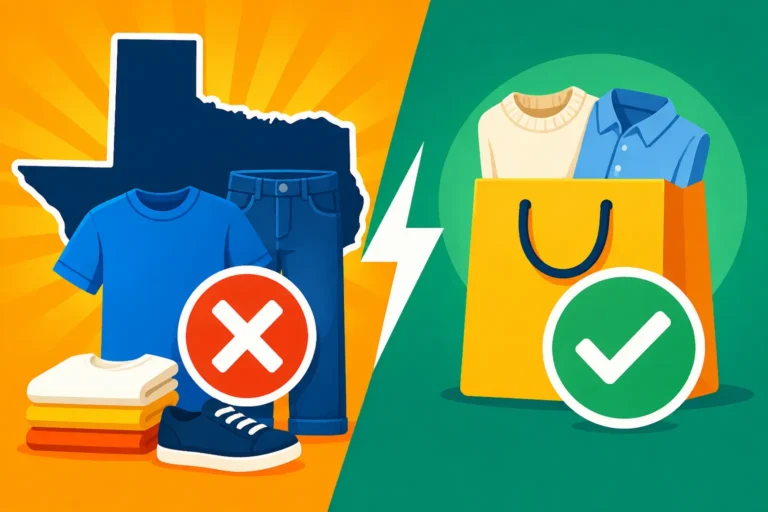
Let's start with the foundation: New York State has a specific exemption for most articles of clothing and footwear that are sold for less than $110 per item or pair. This means that if you walk into a store, whether it's a small boutique in SoHo or a department store on Fifth Avenue, and pick up a pair of sneakers priced at $109, you won't pay state sales tax on them. The same goes for that $50 dress or that $20 t-shirt. This rule is designed to provide some relief on essential items, allowing your hard-earned cash to stretch a little further for your wardrobe.
It’s important to understand that this isn't a discount; it's a complete exemption from the 4% New York State sales tax. This has been a long-standing provision, and it's something that sets New York apart from many other jurisdictions. This also means that if you're ever wondering, "Is Clothing Taxable in New York? ($110 Rule)", the answer is often "no," as long as you stay under that per-item threshold. This applies statewide, so whether you're shopping in Buffalo, Albany, or New York City, the $110 rule is consistently applied.
How New York City's Sales Tax Applies
Here's where it gets a little more localized but, thankfully, still follows the state's lead. New York City itself imposes its own local sales tax, which is 4.5%. On top of that, there's a Metropolitan Commuter Transportation District (MCTD) surcharge of 0.375%. So, when you add these together, New York City's total local sales tax component is 4.875%. When combined with the state's 4% sales tax, the full combined sales tax rate in New York City is typically 8.875%. However, this full rate only kicks in if the item is not exempt.
Because the $110 exemption for clothing and footwear is a statewide rule, it means that if your item is under $110, you are exempt from both the 4% state sales tax AND the 4.875% local New York City sales tax. In essence, for any eligible clothing or footwear item priced under $110, you pay zero sales tax. But if that item crosses the $110 threshold – say, you're buying a $120 pair of designer jeans – then the entire amount becomes subject to the full 8.875% combined sales tax rate. It's not just the amount over $110 that gets taxed; it's the whole shebang. This is why knowing the item price is so crucial when shopping for clothes in the city. You can learn more about how all these layers stack up in our guide on the NYC Sales Tax Rate (8.875%) Explained.
What "Clothing and Footwear" Really Means for Tax Purposes
So, what exactly counts as "clothing and footwear" under this magical $110 rule? It's generally what you'd expect: things worn on the body. This includes shirts, pants, dresses, coats, sweaters, socks, underwear, and, of course, all types of shoes like sneakers, boots, and sandals. Most everyday apparel fits neatly into this category.
However, the state isn't always as generous when it comes to accessories and other related items. For instance, things like jewelry (necklaces, earrings, rings), handbags, wallets, watches, and even certain sports equipment (think specialized pads or helmets) are generally not considered "clothing and footwear" for this exemption. These items, regardless of their price, are typically subject to the full 8.875% sales tax rate in New York City. Even things like hair accessories, umbrellas, and briefcases often fall outside the exemption. It's a fine line sometimes, and it requires retailers to have a robust understanding of Taxable Goods Sales Tax by State to ensure they're applying the correct tax.
Real-World Scenarios and Common Confusions
The "$110 rule" might sound simple enough on paper, but real-world shopping habits often introduce tricky situations. It’s natural to wonder how this applies when you're buying a whole outfit or making a big online purchase. Let's break down some of those common sticking points that consumers and businesses frequently encounter.
Buying Multiple Items vs. Single Item Price
One of the biggest areas of confusion revolves around multiple purchases. Imagine you're at a popular retailer like Macy's or Nordstrom, and you've found a great deal: three t-shirts, each priced at $40. Your total for these three shirts is $120. Many people mistakenly think that because the total transaction exceeds $110, they'll be charged sales tax. However, the key here is "per item or pair." Since each t-shirt individually costs $40 (which is less than $110), none of them are subject to sales tax. You'll walk out of the store having paid only $120 for the shirts, plus any non-clothing items or accessories you might have picked up.
Conversely, if you find a stunning winter coat for $150, that single item exceeds the $110 threshold. In this case, the entire $150 will be subject to the full 8.875% sales tax. It's not just the $40 difference ($150 – $110) that gets taxed; it's the full sale price. This "per item" rule is crucial and often misunderstood, leading to surprised shoppers at the register. Always check the individual price tag, not just your cart's subtotal.
Online Purchases and Out-of-State Sellers
The rise of e-commerce has added another layer of complexity. When you're buying clothing online and having it shipped to a New York City address, do the same rules apply? Generally, yes! If the online seller has a sales tax nexus in New York (meaning they have a significant presence or activity in the state, which most major online retailers do post-Wayfair decision), they are required to collect New York sales tax according to the state and local rules. So, if you order a $99 dress from an online boutique that ships to NYC, you shouldn't be charged sales tax on that item. If you order a $130 pair of boots, you should expect to see the 8.875% sales tax applied to the entire $130.
This is critical for both consumers and businesses. For online sellers, correctly identifying the sales tax rate based on the customer's shipping address and the type of item sold (especially for clothing in New York) is a complex but essential compliance step. Many businesses rely on sophisticated sales tax software, such as solutions offered by Avalara, to automate these calculations and ensure they are compliant across different jurisdictions. Understanding concepts like Origin vs Destination Sales Tax Sourcing becomes vital for businesses operating across state lines, particularly when states have unique rules like New York's clothing exemption.
Accessories and Other Exemptions
We touched on this earlier, but it's worth diving a bit deeper into the gray areas. Consider items like belts, scarves, or ties. While they are worn with clothing, the taxability can sometimes depend on how they're categorized. Generally, plain belts worn for functional purposes are often considered part of clothing, but a highly decorative, expensive belt might be seen as an accessory, similar to jewelry, and thus taxable. Scarves intended for warmth are usually exempt if under $110, but a pure fashion scarf might be taxable. Ties are typically seen as clothing and exempt if under $110.
Then there are items like athletic uniforms. A basic jersey might be exempt, but specialized protective gear (like shin guards for soccer or a padded helmet for football) often falls into the taxable sports equipment category, even if worn on the body. The definition hinges on whether the item is "designed for general everyday use" or primarily for a specific activity or fashion statement. This is where things can get truly granular, and it's why businesses need precise guidance, often from compliance experts or automated systems, to correctly categorize every product.
Navigating the Nuances for Consumers and Businesses
Understanding New York City's sales tax rules for clothing isn't just a matter of curiosity; it has practical implications for both shoppers looking to save a few bucks and businesses striving for compliance. The dynamic nature of sales tax, combined with the specific carve-outs for clothing, makes it a continuous learning process.
For Shoppers: Maximizing Your Savings
As a consumer, being aware of the $110 rule can genuinely influence your purchasing decisions and save you money.
- Price Awareness: Always check the individual price of clothing and footwear items. If an item is $112, but you could potentially find a very similar one for $109, that small price difference translates to a full sales tax exemption on the entire item.
- Separating Purchases (where applicable): While generally not needed for clothing items under $110 each, if you have a mix of taxable accessories and exempt clothing, keeping your transactions clear can help you verify the correct tax application. This is especially true for items just over the threshold.
- Know Your Definitions: Understand what generally counts as "clothing and footwear" versus what's considered an "accessory." A $100 pair of gloves is likely exempt, but a $100 watch is definitely not. This knowledge empowers you at the checkout.
- Online Shopping Vigilance: When shopping online, pay attention to the sales tax calculation before finalizing your purchase. If you believe sales tax was incorrectly applied to an exempt item, don't hesitate to reach out to the retailer.
Being an informed shopper means you can confidently enjoy the diverse shopping experiences New York City has to offer without unnecessary surprises at the register.
For Retailers: Ensuring Compliance
For businesses selling clothing and footwear in New York City, the $110 rule is a critical compliance challenge. Miscalculations can lead to under-collection (meaning the business owes the state money out of pocket later) or over-collection (leading to customer dissatisfaction and potential refunds).
- POS System Configuration: Point-of-sale (POS) systems must be accurately configured to recognize the $110 threshold for clothing and footwear. This involves coding specific product categories to automatically apply or waive sales tax based on the item's price.
- Product Categorization: Retailers must have clear internal guidelines for categorizing products. Is a fancy hair clip clothing or jewelry? Is a specific type of sports uniform exempt or taxable? Detailed product mapping is essential.
- Staff Training: Store employees, especially those on the sales floor and at the checkout, need to be thoroughly trained on the nuances of the $110 rule and how it applies to different products. They are often the first point of contact for customer questions and need to provide accurate information.
- Sales Tax Software: For businesses operating online, or those with large inventories, managing these rules manually is practically impossible. This is where sales tax compliance software truly shines. Solutions from companies like Avalara can integrate directly with e-commerce platforms and POS systems, automatically determining the correct sales tax rate based on product type, price, and customer location. This automation ensures accuracy and significantly reduces compliance risk, especially for merchants selling to customers in varying tax jurisdictions. Such tools are crucial for any business serious about Sales Tax Compliance for Shopify Sellers or other e-commerce platforms.
The Impact of Sales Tax Rate Changes
While the $110 clothing exemption has been a stable feature in New York for a long time, sales tax rates and rules are not set in stone. Tax laws can change due to legislative action, economic shifts, or new interpretations. For instance, sometimes states introduce or eliminate temporary sales tax holidays for certain items, or they might adjust the base sales tax rates. While New York State doesn't typically have the robust sales tax holidays seen in some other states for general clothing, understanding that these things can change is important.
Retailers need to stay vigilant about How Often Do Sales Tax Rates Change and be prepared to update their systems promptly. Subscribing to tax alerts from state revenue departments or utilizing a compliance partner like Avalara can help businesses stay ahead of any legislative changes that might impact the taxability of clothing and footwear. For consumers, this means occasionally double-checking official sources or keeping an eye on news from the New York State Department of Taxation and Finance.
Beyond Clothing: Related NYC Sales Tax Insights
While clothing and footwear under $110 receive special treatment in New York City, it's helpful to understand the broader sales tax landscape to truly grasp how your purchases are taxed. The city is a vibrant marketplace for all sorts of goods and services, and most of them don't get the same break as a basic t-shirt.
Other Taxable Goods in New York City
If you're not buying clothing or footwear under $110, chances are you'll be paying sales tax on your purchases in New York City. This includes a vast array of items:
- Electronics: From your new smartphone to a large-screen TV, all electronic gadgets are fully taxable.
- Furniture and Home Goods: Whether you're furnishing a new apartment or buying a coffee mug, these items incur sales tax.
- General Merchandise: This is the catch-all category for most tangible personal property – books, toys, sporting goods (unless specifically exempt, which is rare for general items), cosmetics, tools, and so forth.
- Prepared Food: While most unprepared groceries are exempt from sales tax in New York, any food or drink that's ready for immediate consumption, whether from a restaurant, deli, or even a supermarket's hot bar, is generally taxable. This includes sodas, coffee, sandwiches, and hot meals. Understanding the distinction between Prepared Food Sales Tax Explained and basic groceries is key.
- Digital Products and Software: This is a rapidly evolving area, but many digital products, including streaming services, e-books, and certain types of software, are increasingly subject to sales tax in New York and other states.
Essentially, assume something is taxable unless it's specifically listed as exempt, like the under-$110 clothing or most basic groceries.
Understanding the Full Combined Rate
When an item is taxable in New York City, you'll be charged the full combined sales tax rate. As we discussed, this is the sum of the statewide sales tax, the New York City local sales tax, and the Metropolitan Commuter Transportation District (MCTD) surcharge.
- New York State Sales Tax: 4%
- New York City Local Sales Tax: 4.5%
- MCTD Surcharge: 0.375%
- Total Combined Rate: 8.875%
So, if you buy a $500 laptop in Midtown Manhattan, your sales tax will be $500 x 0.08875 = $44.38. Your total cost will be $544.38. This combined rate is consistent across all five boroughs of New York City (Manhattan, Brooklyn, Queens, The Bronx, and Staten Island). If you're struggling to keep these numbers straight, a Sales Tax Calculator: How to Calculate Sales Tax can be a handy tool. For businesses, knowing How Combined Sales Tax Rates Work is fundamental for proper invoicing and remittance.
Resources for Staying Informed
Staying on top of sales tax rules, especially in a complex state like New York, can feel like a full-time job. Thankfully, there are resources available to help.
- Official State Websites: The New York State Department of Taxation and Finance website (tax.ny.gov) is the ultimate authoritative source for sales tax information, including publications, forms, and updates on rate changes.
- Professional Advisors: For businesses, consulting with a tax professional or an accountant specializing in sales tax can provide tailored advice and ensure full compliance.
- Sales Tax Automation Software: As mentioned earlier, for businesses with substantial sales volume, especially online, sales tax automation software is invaluable. Solutions like Avalara are specifically designed to handle the complexities of multi-jurisdictional sales tax, including unique exemptions like New York's clothing rule. They automate rate lookup, calculation, and even filing, taking a significant burden off business owners. For businesses looking for the Best Sales Tax Compliance Software 2027, these tools can be a game-changer, integrating with popular e-commerce platforms and ERP systems.
By leveraging these resources, both consumers and businesses can navigate the sales tax landscape in New York City with greater confidence and accuracy.
Disclaimer
Please remember that sales tax laws are subject to change. This guide provides general information based on current regulations but should not be considered legal or professional tax advice. Always consult with a qualified tax professional or refer to official state government resources for the most up-to-date and specific guidance regarding your individual situation or business operations.