Origin vs Destination Sales Tax Sourcing
Imagine you are sitting at your desk, looking at two different invoices for the exact same product, but the sales tax totals are completely different. It is one of the most maddening aspects of running a business in the United States. This guide untangles the mess of origin vs. destination sales tax sourcing so you can remain compliant without the constant headache.
Understanding the Core Difference between Origin and Destination
At its most basic level, sourcing refers to the location where a sale is deemed to take place for tax purposes. This determines which jurisdiction’s tax laws apply and which local rates you need to collect. If you have ever felt like you need a law degree just to sell a t-shirt online, you are not alone. The confusion usually stems from whether your state follows origin-based or destination-based rules. These rules are the "who, what, and where" of the tax world, and getting them wrong can lead to painful audits or under-collected revenue that comes out of your own pocket.
What is Origin-Based Sourcing
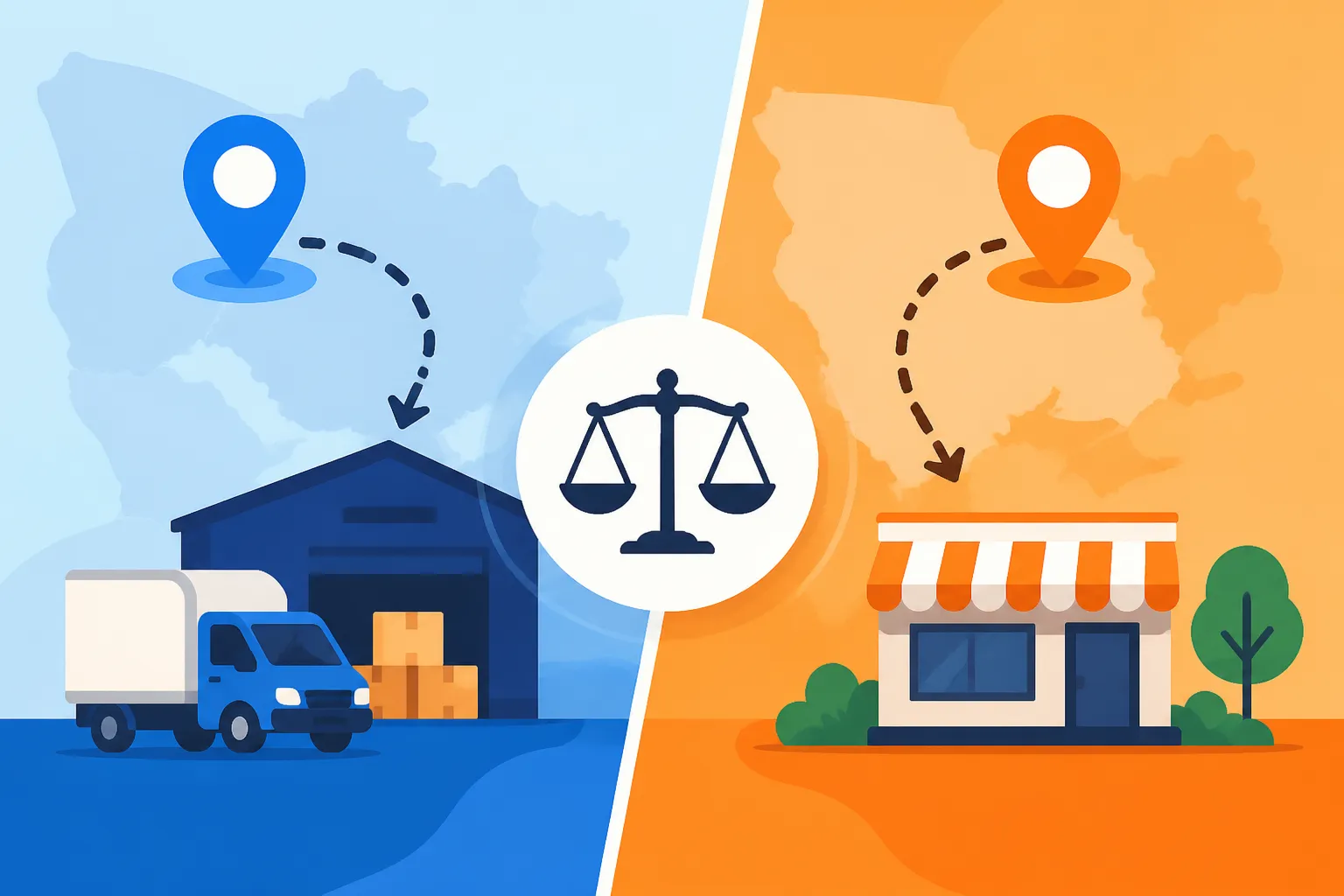
Origin-based sourcing is the "old school" way of thinking about sales tax. In this system, the sale is considered to happen at the location of the seller. If you run a business out of a warehouse in an origin-based state, you charge the sales tax rate applicable to that warehouse’s address, regardless of where your customer lives within that same state. It sounds simpler on paper because you only have to keep track of one or two rates based on your own physical locations. However, this is only true for sales made to customers within your home state.
For many small business owners, origin sourcing feels more intuitive. You are using the roads, emergency services, and infrastructure of your local town to run your business, so it feels right that the tax revenue stays there. But as e-commerce has exploded, many states have moved away from this model because it can create tax imbalances between tech-heavy urban centers and rural areas where people are actually receiving the goods. If you are using a tool like Sales Tax Calculator: How to Calculate Sales Tax, you will notice that origin-based calculations are much more static for the seller.
Origin sourcing also requires a deep understanding of your local tax landscape. For example, if you have multiple office or warehouse locations in an origin state, you might have to track different rates for each branch. It eliminates the need to look up the buyer's address for every single transaction, but it places a heavy burden on ensuring your business location's specific "combined rate" is perfectly accurate. A slight mistake in your home office's local district tax can snowball into a massive liability over several years of high-volume sales.
What is Destination-Based Sourcing
Destination-based sourcing is the dominant rule in the modern era, especially following the rise of online shopping. Under these rules, the sale is considered to take place at the location where the buyer receives the product. If you ship a package from your office to a customer three towns over, you must charge the rate applicable to the customer’s front door. This is significantly more complex because it means a single business might need to manage thousands of different tax rates across a single state.
The logic behind destination sourcing is that the tax revenue should go to the community where the product is actually being consumed. While this seems "fair" from a public policy standpoint, it is a nightmare for manual accounting. You cannot just memorize one rate; you have to know the state, county, city, and special district taxes for every single shipping address in your system. This is why many growing businesses eventually turn to automated platforms like Avalara to handle the heavy lifting of real-time rate lookups.
When you are dealing with destination sourcing, you have to be incredibly careful with Sales Tax by ZIP Code (and Why ZIP Isn't Enough). A single ZIP code can often overlap multiple tax jurisdictions with different rates. This "boundary jumping" is one of the biggest traps for DIY tax filers. You might think you are charging the correct 8% for a ZIP code, only to find out that a specific neighborhood within that ZIP has an additional 0.5% transit tax that you missed.
Why Sourcing Rules Matter for Small Businesses
If you ignore sourcing rules, you are essentially gambling with your business's future. Tax authorities do not accept "it was too confusing" as a valid excuse during an audit. If you are in a destination state but you have been charging everyone your local origin rate, you could be under-collecting in some areas and over-collecting in others. Over-collecting is just as bad as under-collecting because it can lead to class-action lawsuits or investigations for consumer fraud, even if it was an honest mistake.
For a startup, these rules dictate how you set up your point-of-sale (POS) system or your e-commerce checkout. If you don't know your state's sourcing rules, you won't know if you need to ask for a customer's full address at checkout or just their state. This impacts the user experience and your conversion rates. People are sensitive about tax; seeing a "surprise" tax amount at the very last second because of a destination-based calculation can lead to abandoned carts.
Furthermore, these rules play a massive role in your Sales Tax Filing Frequency Explained. States with complex destination sourcing often require more detailed reporting, breaking down your sales by every single local jurisdiction. If you have sales in 200 different cities in a destination state, your tax return will be 200 lines long. Understanding this early helps you decide whether you can handle the filing yourself or if you need to invest in a compliance service to avoid burning out during tax season.
Origin-Based States: Charging Where You Are
While destination sourcing is the trend, several key states still cling to origin-based rules for intrastate sales (sales where both the buyer and seller are in the same state). These states include places like Texas, Ohio, and Pennsylvania. If your business is physically located in one of these states, your life is—in theory—a little bit easier for local sales. You set your rate based on your store or warehouse, and that is what everyone in your state pays.
List of Origin States and Nuances
As of 2026, the list of states that primarily use origin sourcing for intrastate sales is relatively short but includes some heavy hitters. States like Arizona, Illinois, Mississippi, Missouri, Ohio, Pennsylvania, Tennessee, Texas, and Utah generally follow some form of origin-based logic. However, "generally" is the keyword here. Each of these states has its own quirks that can trip you up if you aren't paying close attention to the fine print.
For instance, Texas Sales Tax Rate (6.25% + Local 8.25% Max) is a classic origin-based example. If you sell a product from a shop in Austin to a customer in Dallas, you typically charge the Austin rate. However, Texas has specific rules about "orders not received at a place of business," which can sometimes push the transaction toward destination-based rules. This level of granularity is why business owners often feel overwhelmed. You aren't just learning one rule; you're learning a rule with three different "if-then" exceptions.
Arizona is another unique case. They use a system called the Transaction Privilege Tax (TPT). While it functions similarly to sales tax, the sourcing rules for TPT can be incredibly dense, often depending on the type of business activity you are engaged in. If you are an Arizona seller, understanding the Phoenix & Arizona TPT Rate Explained is crucial because the "origin" of your sale might be defined differently than in a neighboring state like Utah.
Pros and Cons of Origin Sourcing
The biggest "pro" of origin sourcing is definitely the predictability. You know exactly what to charge every customer in your state. This makes your marketing clearer; you can tell your local customers, "Tax is 8%," and it stays 8% regardless of where they live. It simplifies your internal accounting and makes it much easier to verify that your POS system is functioning correctly. You only have to audit one rate periodically rather than thousands.
The "con" is that origin sourcing can sometimes make you less competitive. If your business is located in a high-tax city like Chicago, but your competitor is in a rural area with lower local taxes, your products will appear more expensive to the same customer. In an origin-based state, you are tethered to your physical location’s tax burden. This can lead to businesses strategically moving their warehouses to "tax havens" within the state—low-tax jurisdictions that allow them to charge less than their urban competitors.
Another downside is the confusion that arises when you reach Economic Nexus by State 2026: Thresholds Guide levels in other states. If you are an origin-based seller in Pennsylvania but you sell enough into a destination-based state like New York, you now have to manage two completely different tax philosophies at once. This cognitive load is where many businesses fail. They try to apply their "home state" origin rules to their "remote" destination states, leading to massive non-compliance.
Real-World Example: A Seller in Texas
Let's look at "Sarah," who runs a custom furniture business in Houston. Because Texas is an origin-based state for intrastate sales, Sarah’s life is fairly straightforward when she sells to fellow Texans. Whether her customer is in San Antonio, El Paso, or a tiny town in the Panhandle, Sarah looks at her Houston location. She identifies the Houston & Dallas Sales Tax Rate (8.25%) and applies that 8.25% to every in-state invoice.
Sarah’s customer in a low-tax rural area might be annoyed that they are paying Houston’s higher rate, but legally, Sarah is doing everything right. She files her Texas Sales Tax Due Dates 2026 with the Comptroller, reporting all her in-state sales under her Houston location code. This simplicity allows her to focus more on her craft and less on tax tables. She doesn't have to worry about the local rates in every city where her furniture is delivered.
However, the moment Sarah sells a dining table to a customer in Oklahoma, the rules change. Since she is now an interstate seller, she has to look at Oklahoma’s rules. Most states treat interstate sales as destination-based transactions. So, while she is "origin-based" for her neighbors, she is "destination-based" for the rest of the country. This transition is the "bridge" that most sellers struggle to cross without professional help or software like Avalara.
Destination-Based States: Charging Where Your Customer Is
The vast majority of states in the U.S. use destination-based sourcing. This includes major economies like California, New York, and Florida. In these states, the "ship-to" address is the only address that matters for the tax calculation. If you are a business in one of these states, you are essentially a mini-tax collector for every single municipality you ship to.
The Dominance of Destination Sourcing
Why did so many states choose this harder path? It’s all about the money. Destination sourcing prevents "tax shopping," where people buy from low-tax areas to avoid the higher taxes in their home cities. By forcing the tax to follow the delivery, states ensure that urban centers with high service demands (like garbage pickup and road maintenance) get the revenue from the purchases their residents make.
If you are operating in a state like Florida, you must be intimately familiar with the Florida Sales Tax Rate (6% + County Surtax). Florida is a destination state, meaning you charge the 6% state rate plus whatever surtax exists at the customer's delivery point. If you ship to Miami, it’s one rate; if you ship to a rural county in the Panhandle, it’s another. This system is designed to be fair to the local governments, but it is undeniably a burden on the business owner.
This complexity is why the Best Sales Tax Compliance Software 2027 market is so robust. It is physically impossible for a human to accurately track the 11,000+ tax jurisdictions in the U.S. by hand. When you are in a destination state, you aren't just selling a product; you are managing a massive data project. Every time a customer enters their address, your system has to ping a database to find the exact latitude and longitude to determine the correct tax district.
Navigating Multiple Rates in One State
Navigating a destination-based state requires a shift in how you think about your sales data. You can no longer look at your "Total Sales" as one big bucket. Instead, you have to see them as a collection of tiny buckets. When you file your New York Sales Tax Rate (4% + Local) returns, the state doesn't just want to know how much you sold; they want to know how much you sold in Erie County vs. Westchester County vs. New York City.
This granular reporting is where the "destination" part of the name really hits home. If you miss a single city's local tax, your entire return could be flagged. Some states have "home-rule" cities, which add another layer of nightmare. In states like Colorado or Alabama, certain cities collect their own taxes separately from the state. This means you might have to file a state return for some cities and individual city returns for others.
To survive this, you need a robust system for Sales Tax Rate by Address Lookup. Relying on memory or outdated PDF charts from the Department of Revenue is a recipe for disaster. Rates change frequently—sometimes every quarter—and keeping up with those changes manually is a full-time job. Using a dynamic API or a built-in tax engine in your Shopify or BigCommerce store is the only way to ensure that you are charging the 2026 rates accurately.
Real-World Example: Shipping to New York
Consider a seller named "Mike" who sells high-end electronics from a shop in Albany. New York is a destination-based state. When Mike sells a laptop to a customer in Brooklyn, he cannot charge his local Albany rate. Instead, he must calculate the NYC Sales Tax Rate (8.875%) Explained and apply that to the sale. If he then sells a laptop to someone in a different county with no local tax, he only charges the base 4% state rate.
Mike has to be extremely careful with his shipping labels. If he gets the address slightly wrong—say, he puts a customer in the wrong borough—he could be collecting the wrong amount of tax. Because New York is so aggressive with its audits, Mike uses Avalara to verify every address at the point of sale. This ensures that the tax collected matches the local requirements of the "destination" perfectly.
At the end of the quarter, Mike’s tax return is a complex document. He has to list his sales for every single jurisdiction in New York where he had a "destination" delivery. If he sold to 50 different counties, his return has 50 different sections. This is the reality of destination sourcing: it provides local communities with their fair share of revenue, but it forces the business owner to become a part-time data scientist.
The Impact of Nexus and the Wayfair Decision
You cannot talk about sourcing without talking about "nexus." Nexus is the legal term for the connection between your business and a state that allows that state to force you to collect sales tax. Before 2018, you usually needed a physical presence (like an office or a warehouse) to have nexus. After the Supreme Court's Wayfair decision, everything changed.
Physical Nexus vs. Economic Nexus
Physical nexus is straightforward: if you have a desk, a person, or a pile of inventory in a state, you have nexus there. Even if you are an origin-based business, having physical nexus in a destination state means you must follow that state's sourcing rules for any sales you make to their residents. For example, if you have a small satellite office in California, you now have physical nexus there and must collect tax based on the California Sales Tax Rate (7.25% Base + Districts) for every California customer.
Economic nexus is the new frontier. This is based on your volume of sales or the number of transactions you have in a state, even if you never step foot there. If you sell $100,000 worth of goods to people in Georgia, you likely have Economic Nexus Threshold in Georgia and must register to collect tax. The catch? Once you have economic nexus in a state, you almost always follow destination-based sourcing for those sales, regardless of what your home state does.
This is a massive point of confusion for small sellers. They think, "I'm in an origin state, so I'll just charge my local rate to everyone." But the moment you cross an economic nexus threshold in another state, you are playing by their rules. If that state is a destination state, you must start collecting based on your customers' addresses. Understanding How to Know If You Have Sales Tax Nexus is the first step in realizing that your sourcing strategy must be multi-faceted.
How Out-of-State Sellers Are Treated
When you are an "out-of-state" or remote seller, states almost universally require you to use destination sourcing. They don't care about your origin; they only care about their residents receiving the goods. This is why a business in a state with no sales tax, like Oregon, still has to collect sales tax for a customer in Minnesota once they hit the nexus threshold.
For these remote sellers, the "destination" is the only thing that matters. You must determine the Average Sales Tax Rate by State for your remote sales, but then drill down into the specific local rates. Some states try to make this easier for remote sellers by offering a "Simplified Sellers Use Tax" (like in Alabama), which is a flat rate you can charge instead of looking up every local district. However, these programs are the exception, not the rule.
If you are selling nationwide, you are essentially a destination-based seller for 45+ states. This is the "hidden" burden of e-commerce. You might have started as a local shop with one tax rate, but success means you are now responsible for thousands of rates. This transition is usually when businesses realize they need to Registering for Sales Tax in Multiple States, a process that involves different forms and requirements for every jurisdiction.
When Sourcing Rules Flip
There are specific scenarios where sourcing rules can "flip." For example, some states are origin-based for sales made within the state (intrastate) but destination-based for sales made from another state into their state (interstate). This means your tax obligations depend entirely on where your business is standing when the sale happens.
Take a state like Illinois. It has historically had very complex sourcing rules that vary depending on whether you are a local retailer or a remote seller. Understanding the Illinois Sales Tax Rate 2026 involves knowing these distinctions. If you are an Illinois business, you might use origin sourcing for your local customers, but if you are a New York business selling into Illinois, you are strictly using destination sourcing.
This "flipping" is why you cannot just look at a map and think you have it figured out. You have to look at the relationship between your location and the customer's location. If you cross a state line, the "origin" rule almost always dies, and the "destination" rule takes over. This is a universal truth of the South Dakota v. Wayfair: What It Means for Sellers era of commerce.
Intrastate vs. Interstate Transactions
To keep your sanity, you must distinguish between sales within your own state (intrastate) and sales across state lines (interstate). The rules for these two types of transactions are often different, even within the same state.
Selling Within Your Own State
When you sell to a customer in your own state, you are bound by your state’s primary sourcing law. If you are in a destination state like North Carolina, you always use the customer’s address. If you are in an origin state like Ohio, you typically use your own business's address. This is the simplest form of tax collection because you are dealing with a single Department of Revenue that you are already registered with.
The challenge comes when you have multiple locations. If you have three stores in an origin-based state, which "origin" do you use for an online order? Usually, it’s the location where the order is fulfilled. If Store A ships it, you use Store A’s rate. If Store B ships it, you use Store B’s. This is why inventory management and tax compliance are so closely linked. You can't just ship from the closest warehouse without considering how it changes the Sales Tax Calculator: How to Calculate Sales Tax result.
For intrastate sales, you also have to be aware of local "district" taxes. Even in origin states, there might be specific districts that only apply if the customer is also within that district. This is especially true in states like California, where California District Taxes Explained can add layers of complexity even if you think you’ve nailed the base rate.
Selling Across State Lines (Remote Selling)
Interstate transactions are almost always destination-based. There are very few exceptions to this rule. When you ship a product from State A to State B, State B wants its tax revenue. Because you are not located in State B, the only logical place to "source" the sale is at the customer's doorstep in State B.
This is where the concept of "Use Tax" often enters the conversation. If a seller doesn't have nexus in a state and doesn't collect sales tax, the buyer is technically supposed to pay "Consumer Use Tax" to their own state. However, because consumers rarely do this, states have pushed hard for Marketplace Facilitator Laws by State. These laws force platforms like Amazon, eBay, and Etsy to collect the tax on your behalf, using destination-based rules.
If you are selling through your own website (like a Shopify store), the burden of interstate destination sourcing falls entirely on you. You have to monitor your sales volume in every state to know when you've hit the What Is the Sales Tax Nexus Threshold? for each one. Once you hit that mark, you are no longer just a "remote seller"—you are a registered tax collector for that state, and you must use their destination rates.
Marketplace Facilitators and Sourcing
If you sell on a marketplace, you might think you can ignore all of this. While it’s true that Amazon or Etsy will calculate and collect the tax using destination sourcing, you aren't always off the hook. Many states still require you to register for a permit and file "zero-tax" returns even if the marketplace is doing the heavy lifting.
Furthermore, marketplace laws are based on destination sourcing. The marketplace looks at where the buyer is and applies the correct local rate. This is great for you because it automates the process, but you still need to understand Do I Still Need a Permit If Amazon Collects? for your specific state. In some cases, if you sell on both your own site and Amazon, your Amazon sales might count toward your nexus threshold, forcing you to collect destination-based tax on your website sales as well.
Marketplace facilitator rules have made destination sourcing the "standard" for the average consumer. Most people now expect to see their specific local tax at checkout. If your own website isn't doing this correctly, it can look unprofessional or even suspicious to a savvy shopper. This is why integrating a tool like Avalara into your tech stack is so important; it keeps your own site's tax logic in sync with the "gold standard" used by the big marketplaces.
Specialized Rules and Complex Scenarios
Just when you think you’ve mastered origin and destination, the tax world throws a curveball. Some states don't fit neatly into either category, or they change the rules based on what you are selling.
Hybrid States and Unique Sourcing Rules
Some states, like California, are often called "hybrid" states. California generally uses a mix of origin and destination rules for its local and district taxes. For example, the base state tax might be sourced to the origin, while the specific district taxes are sourced to the destination. This is the ultimate "final boss" of sales tax complexity.
Navigating What Is a District Tax in California? requires knowing exactly which parts of the 7.25% (or higher) rate belong to which jurisdiction and how they are sourced. If you are a California seller, you might find that you are an origin seller for some of the tax and a destination seller for the rest of the same transaction. This is not something a human can do accurately on a spreadsheet; it requires specialized software.
Other states have "status-based" rules. For example, some jurisdictions might change their sourcing logic if the product is a "luxury" item or if it’s a specific type of machinery. Staying on top of these 2026 Sales Tax Rate Changes by State is a constant battle. A state could vote to change from origin to destination during an election cycle, and you would have to update your entire system overnight.
Sourcing for Services vs. Tangible Goods
Most of the discussion around origin and destination focuses on physical products (tangible personal property). However, if you sell services, the rules are even more fragmented. Some states source services to where the service is performed (origin), while others source them to where the benefit is received (destination).
If you are a graphic designer in Texas (origin) working for a client in New York (destination), whose rules apply? This depends on whether the state taxes services at all and how they define the "situs" or location of the service. You should consult Sales Tax on Services: What's Taxable by State to see if your specific offering even falls under the tax code. In many cases, digital services follow their own unique "sourcing" logic based on the user's IP address or billing address.
Digital goods, like software or e-books, add another layer. Is an e-book delivered to an IP address in Ohio "sourced" to the server location or the customer's house? Most states have moved toward destination sourcing for digital products, using the billing address as a proxy for the destination. This is why Is SaaS Taxable? Software-as-a-Service by State is such a hot topic; the "location" of a cloud-based software is inherently difficult to pin down.
The Role of Local Jurisdictions and District Taxes
We’ve talked a lot about states, but the real "destination" complexity often lies at the local level. There are over 3,000 counties and thousands more cities and special districts (like school districts or transit authorities) that have their own tax-levying power.
When a state says it is destination-based, it is giving power to these thousands of tiny jurisdictions. This is Why Is Sales Tax Different in Every City? is the question most asked by frustrated business owners. A city can decide to build a new stadium and fund it with a 0.25% sales tax. If that city is in a destination state, every single person shipping a package to that city—anywhere in the world—is now responsible for collecting that 0.25% stadium tax.
The sheer volume of these local changes is staggering. In a typical year, there are hundreds of local rate changes across the country. If you are not using a real-time lookup service like Avalara, you are almost certainly charging the wrong rate in at least a few locations. The cost of a small error multiplied by thousands of transactions is exactly what tax auditors look for when they want to pad the state's coffers.
Managing Compliance Without Losing Your Mind
If this sounds like a lot, it’s because it is. But you don’t have to do it alone. The goal is to move from a state of "reactive panic" to "automated compliance."
| Feature | Origin-Based Sourcing | Destination-Based Sourcing |
|---|---|---|
| Tax Rate Basis | Seller's location (warehouse/store) | Buyer's location (delivery address) |
| Simplicity | High (fewer rates to track) | Low (thousands of possible rates) |
| Audit Risk | Medium (errors usually localized) | High (easy to miss local districts) |
| E-commerce Standard | Rare (only a few states) | Common (the standard for 2026) |
| Interstate Sales | Almost never applies | Nearly always applies |
Automated Solutions and Tax Software
The only real way to manage destination-based sourcing at scale is through automation. Tax software like Avalara integrates directly into your checkout process. When a customer enters their address, the software calculates the exact tax in milliseconds. It knows if the house is inside or outside city limits, which special districts apply, and whether the specific item (like clothing or groceries) is exempt in that jurisdiction.
Using Sales Tax Compliance for Shopify Sellers or similar integrations for other platforms takes the "guesswork" out of the equation. You no longer have to wonder if you should be an origin or destination seller; the software has the rules for all 50 states programmed in. This not only protects you from audits but also ensures you aren't overcharging your customers, which can hurt your brand's reputation.
Automation also helps with the "backend" of compliance. When it comes time to file, the software generates reports that are already broken down by jurisdiction. Instead of spending three days on a New York return, you can do it in minutes. For a growing business, the time saved is often worth far more than the cost of the software subscription.
Best Practices for Records and Audits
Even with automation, you need to keep good records. An auditor will want to see the "source data" for your tax calculations. This means keeping track of the full shipping address for every order, not just the ZIP code. As we’ve discussed, Sales Tax by ZIP Code (and Why ZIP Isn't Enough), so having the full street address is your best defense in an audit.
You should also keep copies of Resale Certificate by State: Complete Guide forms for any tax-exempt sales. If you don't collect tax because a customer says they are a reseller, you must have the paperwork to prove it. In a destination state, you technically need to ensure the resale certificate is valid for the state where the product is being delivered.
Regularly auditing your own system is also a good habit. Once a quarter, pick ten random invoices and manually verify the tax rate using a Sales Tax Rate Lookup Tools Compared guide. If you find a discrepancy, you can fix the settings in your software before it becomes a multi-year liability. Proactive compliance is always cheaper than reactive defense.
Using Look-up Tools and Accurate Data
If you are not ready for full automation, you must at least use the official look-up tools provided by state Departments of Revenue. Most states have a website where you can plug in an address and get the current rate. While this is tedious for 100 orders a day, it’s essential if you are just starting out.
Avoid using third-party "tax maps" that aren't updated in real-time. Sales tax rates for 2026 can change with very little notice. Always check the "effective date" of any rate table you are using. If you are shipping a large order, it is worth the two minutes to double-check the Combined State + Local Sales Tax Rates Explained for that specific destination.
Finally, remember that sourcing is just one piece of the puzzle. You also need to know How to Get a Sales Tax Permit by State before you even start collecting. Collecting tax without a permit is illegal in most states, even if you are doing it "for the destination." Start with the permit, understand your sourcing, and then use the best tools available to keep the math accurate.
Disclaimer
This guide is provided for informational purposes only and does not constitute legal, tax, or financial advice. Sales tax laws, including sourcing rules and nexus thresholds, are subject to frequent change and vary significantly by jurisdiction. You should consult with a qualified tax professional or CPA to ensure your business remains compliant with all local, state, and federal regulations.