Sales Tax on Groceries in Hawaii
It can be incredibly frustrating to navigate the world of sales tax, especially when you're trying to figure out something as fundamental as whether your everyday groceries are subject to it. Many states have complicated rules, offering exemptions or reduced rates for food items, but Hawaii operates under a different system entirely. This guide will help you understand how Hawaii's unique General Excise Tax (GET) applies to groceries and what it means for shoppers and businesses alike.
Understanding Hawaii's General Excise Tax (GET) System
One of the biggest sources of confusion for newcomers to Hawaii, or even long-time residents who haven't delved into the specifics, is the state's tax system. Unlike most other states that impose a sales tax directly on the final sale of goods to consumers, Hawaii instead implements a General Excise Tax (GET). This isn't just a semantic difference; it's a fundamental shift in how transactions are taxed throughout the supply chain.
How GET Differs from Traditional Sales Tax
Imagine a traditional sales tax. You go to the store, buy a new gadget, and at the register, a percentage is added to your total as "sales tax." That tax is typically collected by the retailer and remitted to the state. Simple, right? Hawaii's GET, however, isn't a sales tax in that sense. It's a tax on the privilege of doing business in Hawaii. This means that businesses, at various stages of the economic process – from manufacturing to wholesaling to retailing – are all subject to the GET on their gross income.
For most retail sales, including the sale of groceries, the state GET rate is 4%. However, in some counties, like Honolulu (Oahu), there's a county surcharge of 0.5%, bringing the effective rate that businesses often pass on to consumers to 4.5%. This cascading nature is what truly sets it apart. While a traditional sales tax is typically imposed only once at the point of sale to the final consumer, the GET can be imposed multiple times as a product moves through different businesses before it reaches your shopping cart. Most businesses, understandably, pass this cost along to the consumer, often by adding it as a separate line item on your receipt or factoring it into the shelf price. This often makes it feel exactly like a sales tax to the end customer, even though legally it functions differently.
The Broad Application of GET
The General Excise Tax is famously broad, applying to virtually all business activities within Hawaii. This includes everything from the sale of tangible goods to services, rentals, and even professional fees. Because it taxes gross income, rather than just the final retail price, it covers a much wider range of transactions than a typical sales tax. This comprehensive reach is why understanding its nuances is so critical, especially when you're looking at everyday purchases like food. You can learn more about how the system works in general by exploring our guide on Sales Tax Rates by State 2026: All 50 States, which provides a broader context for different state approaches.
Sales Tax on Groceries in Hawaii: The Nitty-Gritty
When it comes to groceries, the fundamental question for many is whether they'll find an exemption or a reduced rate, as is common in many other parts of the U.S. Unfortunately, Hawaii largely keeps things consistent with its broad application of the GET.
No General Exemption for Food
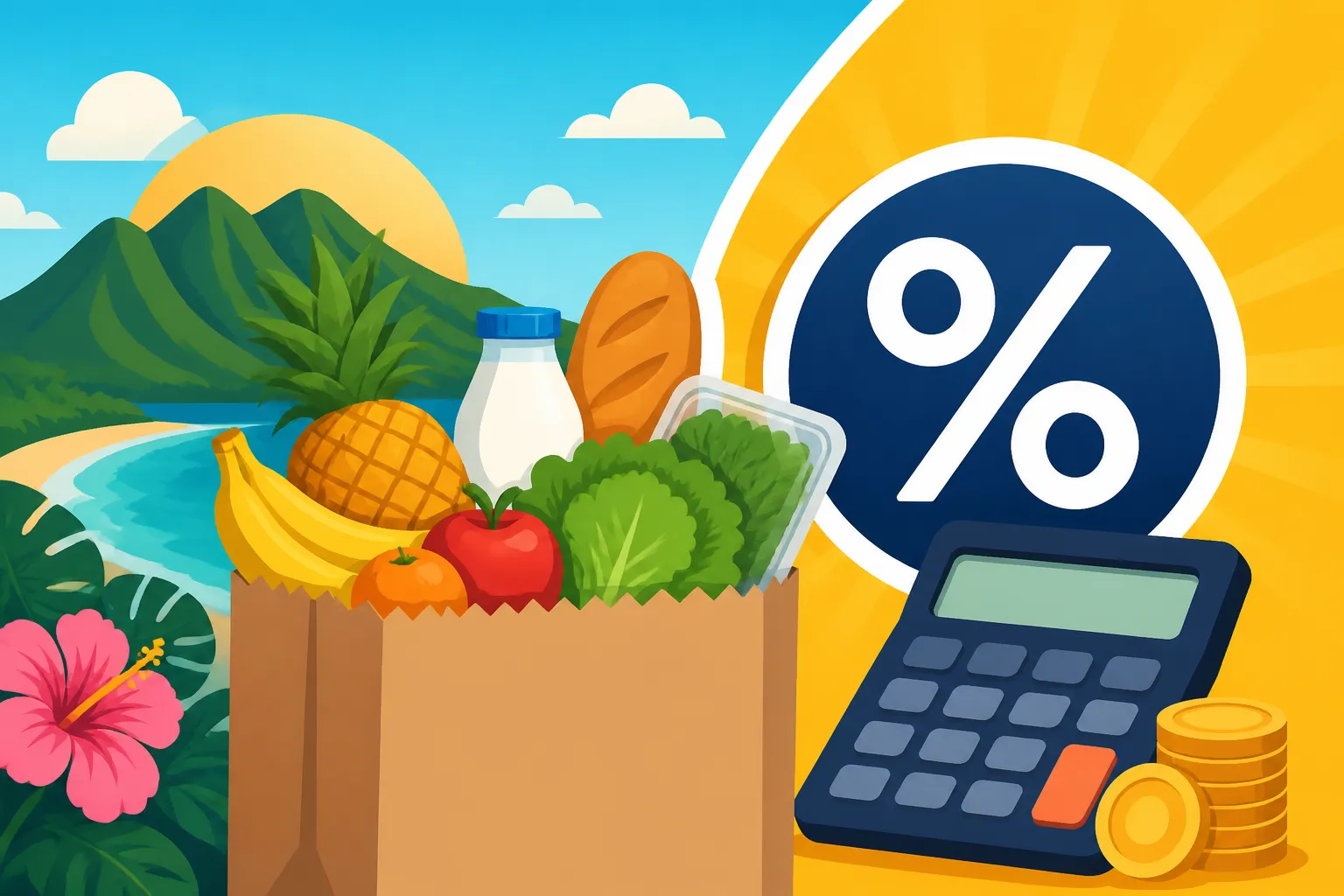
Here's the stark reality: Hawaii does not offer a general exemption for most food items, including unprepared groceries. This means that whether you're buying fresh produce, meats, dairy, or pantry staples at your local Foodland, Safeway, or even a smaller market, the sale is subject to the GET. If the business chooses to itemize the tax on your receipt, you'll see that 4% (or 4.5% if in a county with a surcharge) applied to your food purchases, just as it would be for a new t-shirt or a household appliance.
This can be a bit of a shock, especially for those moving from states like Pennsylvania or New Jersey where clothing and many food items are entirely exempt from sales tax. Hawaii's philosophy is to apply its excise tax system broadly and uniformly, rather than creating a complex web of exemptions for various goods and services. So, that carton of milk or loaf of bread is generally treated the same as any other taxable good under the GET. For a deeper dive into how different states handle food, our article on Sales Tax on Groceries & Food by State offers some helpful comparisons.
Prepared Foods vs. Unprepared Foods
In many states, there's a clear distinction between how "prepared food" (like a hot meal from a restaurant, or deli items ready for immediate consumption) and "unprepared food" (groceries you cook at home) are taxed. Often, prepared foods face the full sales tax rate, while unprepared groceries might be exempt or taxed at a reduced rate.
In Hawaii, this distinction is less about an exemption and more about how the GET is already applied. Since the GET applies to most retail sales anyway, both prepared and unprepared foods generally fall under the same GET rate (4% statewide, plus any county surcharge). So, whether you're picking up a ready-made poke bowl from Tamura's Fine Wine & Liquors or a bag of rice and fresh fish to cook yourself, both transactions are typically subject to the same GET rate that the retailer will pass on to you. There aren't special, lower rates or exemptions for groceries in the way some states implement them. Our detailed piece on Prepared Food Sales Tax Explained provides more context on this common distinction in other jurisdictions.
Specific Programs and Exemptions
While there isn't a broad sales tax exemption for groceries themselves, it's worth noting that federal programs like the Supplemental Nutrition Assistance Program (SNAP, formerly food stamps) are designed to help low-income individuals and families afford food. Purchases made with SNAP benefits are generally exempt from sales tax nationwide, and this holds true for the GET as well. The GET is applied to the gross income of the business, but when a purchase is made via SNAP, the amount isn't considered "gross income" subject to the GET from the consumer. This ensures that the program's intent to provide food assistance isn't undermined by state or local taxes. However, this is an exemption based on the payment method and consumer's eligibility, not an inherent exemption of the food item itself from the GET system for the business.
The Financial Impact of Hawaii's GET on Groceries
The consistent application of the GET, even to groceries, has distinct financial implications for both residents and businesses in Hawaii. It's not just a theoretical difference; it affects your wallet and how businesses operate.
How Consumers Experience the GET
For the average consumer, the lack of a grocery tax exemption means that the cost of living, already notoriously high in Hawaii, is further impacted by the GET on essential food items. While 4% or 4.5% might not sound like a huge amount, it adds up quickly on a weekly grocery bill. Let's say your family spends $200 on groceries each week. Over a year, that's roughly an additional $416 to $468 in GET charges just on food, depending on your county. This is a significant consideration, especially for families on tight budgets.
Many residents will find that prices on the shelves already reflect the GET, or they'll see it clearly itemized. This differs from some other states where the listed price is the final price for tax-exempt items. It's a constant reminder that practically everything you buy in Hawaii carries that tax burden. This is part of why understanding How to Calculate Sales Tax (Step by Step) is so useful, even when dealing with an excise tax like Hawaii's.
Challenges for Businesses
For grocery stores and other food retailers in Hawaii, the GET system presents a different set of challenges. They must collect and remit the GET on their gross receipts, including those from grocery sales. This means meticulous record-keeping and accurate calculations. While the GET applies broadly, businesses still need robust systems to track sales and ensure compliance. This is where tools from companies like Avalara can be incredibly valuable, helping businesses automate their GET calculations and filings, preventing errors that could lead to penalties.
Consider a small mom-and-pop grocery store in Kaimuki. They're not just selling to locals; they might also be selling to tourists or out-of-state visitors. Ensuring that the correct GET is applied to all their sales, across a vast inventory of food and non-food items, requires careful attention. They don't have to worry about applying different tax rates to different food categories (like reduced rates for unprepared food), which simplifies that aspect compared to some states, but they still have to factor the GET into their pricing and reporting. Businesses also need to be aware of the specific Hawaii GET License Explained requirements to operate legally.
Comparing Hawaii's Approach to Other States
Hawaii's decision to apply its GET broadly to groceries stands in contrast to many other states across the U.S. Understanding these differences can highlight why Hawaii's system sometimes feels so unique.
States with No Sales Tax on Groceries
Many states understand the essential nature of food and choose to exempt groceries entirely from sales tax. States like California, New York, Pennsylvania, Massachusetts, and Vermont, for instance, generally do not tax unprepared food items. This policy is often implemented to alleviate the tax burden on lower-income households, ensuring that basic necessities remain more affordable. If you're coming from one of these states, the application of GET to your grocery bill in Hawaii can feel like an unexpected additional expense. For more details on these contrasting tax landscapes, check out our guide on Sales Tax on Groceries by State.
States with Reduced Rates or Specific Exemptions
Even among states that do tax groceries, some offer reduced rates or very specific exemptions. For example, Virginia taxes groceries at a reduced rate compared to its general sales tax rate. Other states might exempt specific categories, such as fresh produce or items purchased with food assistance benefits, while still taxing others like candy and soda at the full rate.
Hawaii's system, with its blanket application of the GET to most sales, including food, means there are fewer of these complex carve-outs and exceptions to track. While this might simplify the rules for the state, it doesn't necessarily make groceries cheaper for the consumer. The trade-off is often between a simpler, broader tax base (Hawaii) versus a more targeted, potentially fairer tax system with more exemptions (many other states).
| State (Example) | Sales Tax on Unprepared Groceries | General State Sales Tax Rate |
|---|---|---|
| Hawaii | Taxable (GET) | 4.0% (plus county surcharges) |
| California | Exempt | 7.25% |
| New York | Exempt | 4.0% (plus local rates) |
| Illinois | Reduced Rate (1%) | 6.25% (plus local rates) |
| Alabama | Full Rate | 4.0% (plus local rates) |
| Tennessee | Reduced Rate (4%) | 7.0% (plus local rates) |
| Pennsylvania | Exempt | 6.0% |
Note: Rates are general state rates and do not include local additions unless specified. Hawaii's GET functions differently from a typical sales tax but is passed on to consumers.
Staying Compliant with Hawaii's GET
For businesses operating in Hawaii, especially those selling food products, maintaining compliance with the GET is non-negotiable. The broad nature of the tax means almost all revenue streams are impacted.
Registering and Reporting
Any business conducting activity in Hawaii that falls under the GET purview needs to register with the Hawaii Department of Taxation. This involves obtaining a Hawaii Tax ID number, which is essential for reporting and remitting the GET. The frequency of filing depends on the volume of taxable gross income a business generates. Smaller businesses might file quarterly or annually, while larger ones may be required to file monthly.
It's crucial to understand these requirements, as failure to register or file accurately can lead to penalties. Even if you're a small online seller based outside Hawaii but have established Economic Nexus by State 2026: Thresholds Guide due to sales volume in the state, you might find yourself needing to register and collect Hawaii's GET. The Department of Taxation provides clear guidelines, but navigating them can still be complex, especially for businesses with operations in multiple states.
Leveraging Technology for Accuracy
Given the intricacies of the GET, many businesses, from small local shops to larger chains, turn to sales tax compliance software. Solutions like Avalara are designed to simplify the calculation, collection, and remittance process for complex tax systems like Hawaii's GET. These platforms can accurately determine the applicable GET rate for specific locations (considering county surcharges), track sales, and generate the necessary reports for filing.
For instance, a business might need to track its gross receipts for different types of activities if they fall under various GET rates (e.g., wholesaling has a lower rate than retailing). A robust system can handle these distinctions, ensuring that a business operating both a retail grocery store and a wholesale distribution arm for specialty foods remains compliant without excessive manual effort. This type of automation becomes increasingly important as a business grows or expands its offerings.
Key Takeaways for Shoppers and Sellers
Navigating sales tax, or in Hawaii's case, the General Excise Tax, can be a headache. But understanding its core principles is the first step toward clarity and compliance.
For Hawaii Residents and Visitors
If you're a consumer in Hawaii, expect that most items you purchase, including groceries, will have the GET either built into the price or added as a separate line item. There isn't a widespread tax-free grocery benefit like in many other states. Budgeting for your food expenses should account for this additional cost. Knowing that Hawaii doesn't differentiate much between prepared and unprepared food, in terms of GET application, means you likely won't see significant tax savings by opting to cook at home versus eating out, solely from a tax perspective.
For Businesses in the Aloha State
For businesses, the GET is a critical component of your operations. Every sale, including groceries, contributes to your gross receipts that are subject to this tax. Accurate record-keeping, understanding your filing frequency, and timely remittance are paramount. Don't assume that because other states exempt groceries, Hawaii does too; it's quite the opposite. Implementing a reliable system for managing your GET obligations, perhaps with the help of a compliance solution from a provider like Avalara, can save you a lot of stress and potential penalties down the line. It's not just about the state GET rate; it's also about understanding county surcharges and ensuring all aspects of your business operations are correctly categorized for tax purposes. If you're unsure, consulting with a tax professional experienced in Hawaii's GET is always a smart move.
Disclaimer
The information provided in this guide is for general informational purposes only and does not constitute tax advice. Sales tax laws and rates, including Hawaii's General Excise Tax, are subject to change. Always consult with a qualified tax professional or the Hawaii Department of Taxation for advice tailored to your specific situation.