Sales Tax Software for Small Business: Do You Need It?
Navigating the world of sales tax can feel like trying to solve a Rubik's Cube blindfolded, especially when you’re running a small business. You’re juggling inventory, customer service, marketing, and then suddenly, you're faced with an alphabet soup of state tax codes, local rates, and filing deadlines. It's a source of immense frustration for many entrepreneurs. This guide is here to help you cut through the confusion and determine if investing in sales tax software is truly a necessary step for your small business.
Understanding Sales Tax for Small Businesses It's More Than Just a Rate
For many small business owners, sales tax seems straightforward at first: you sell something, you add a percentage, and you send it to the state. But oh, how quickly that perception can change! The reality is a labyrinth of rules that vary not just from state to state, but often from city to city, and even down to specific districts. It's not just about knowing the rate, it's about knowing which rate applies, when it applies, and where to send it.
The Weight of Compliance: Why Sales Tax Is a Big Deal
The sheer administrative burden of sales tax compliance can be overwhelming. Imagine you're a small online boutique selling handmade jewelry. You start in Oregon, where there's no state sales tax, so life is simple. Then, your unique designs catch fire, and you start shipping across the country. Suddenly, you're dealing with customers in California, Texas, Florida, and New York. Each of these states, and sometimes even their specific cities or counties, might have different rates, rules for what's taxable, and filing schedules.
It's not just about collecting the right amount; it's about ensuring you're collecting anything at all when you should be, and then remitting it accurately and on time. Errors can lead to penalties, interest, and audits – nightmares for any small business owner who's already stretched thin. Understanding the full landscape of Sales Tax Rates by State 2026: All 50 States is a monumental task when done manually.
Navigating Nexus: When You Have to Collect
Before you even worry about the rates, you have to determine if you have "nexus" in a state. Nexus is essentially a fancy legal term for a significant enough connection to a state that obligates you to collect and remit sales tax there. For years, this primarily meant having a physical presence – an office, a warehouse, employees, or even just regularly visiting to sell goods.
However, the game changed dramatically with the 2018 Supreme Court decision in South Dakota v. Wayfair. This ruling introduced the concept of "economic nexus," meaning that even if you don't have a physical presence, you can establish nexus simply by exceeding a certain threshold of sales or transactions into a state. For example, the Economic Nexus Threshold in California ($500k) is a prime example of how states define this. Suddenly, that online jewelry boutique in Oregon might have nexus in California because they sold over $500,000 worth of jewelry there in a calendar year. This new landscape made understanding Sales Tax Nexus Explained (Physical vs Economic) critical for virtually every online seller.
The Ever-Changing Landscape of Rates and Rules
It’s not enough to figure out nexus and rates once. Sales tax laws are dynamic. States, counties, and cities frequently adjust their rates, add new district taxes, or change what goods and services are considered taxable. What was exempt last year might be taxable this year. For instance, some states have begun to tax Software-as-a-Service (SaaS), while others still consider it a non-taxable service.
Keeping up with these changes manually is a full-time job. Imagine the headache of tracking the myriad of different tax rates across the country, like the variable Louisiana Parish Sales Tax Complexity or the specific district taxes in California. A change in a single ZIP code's rate, or a new tax on a specific product category, can throw off your entire calculation system if you're not using up-to-date resources.
When Manual Management Just Doesn't Cut It Anymore
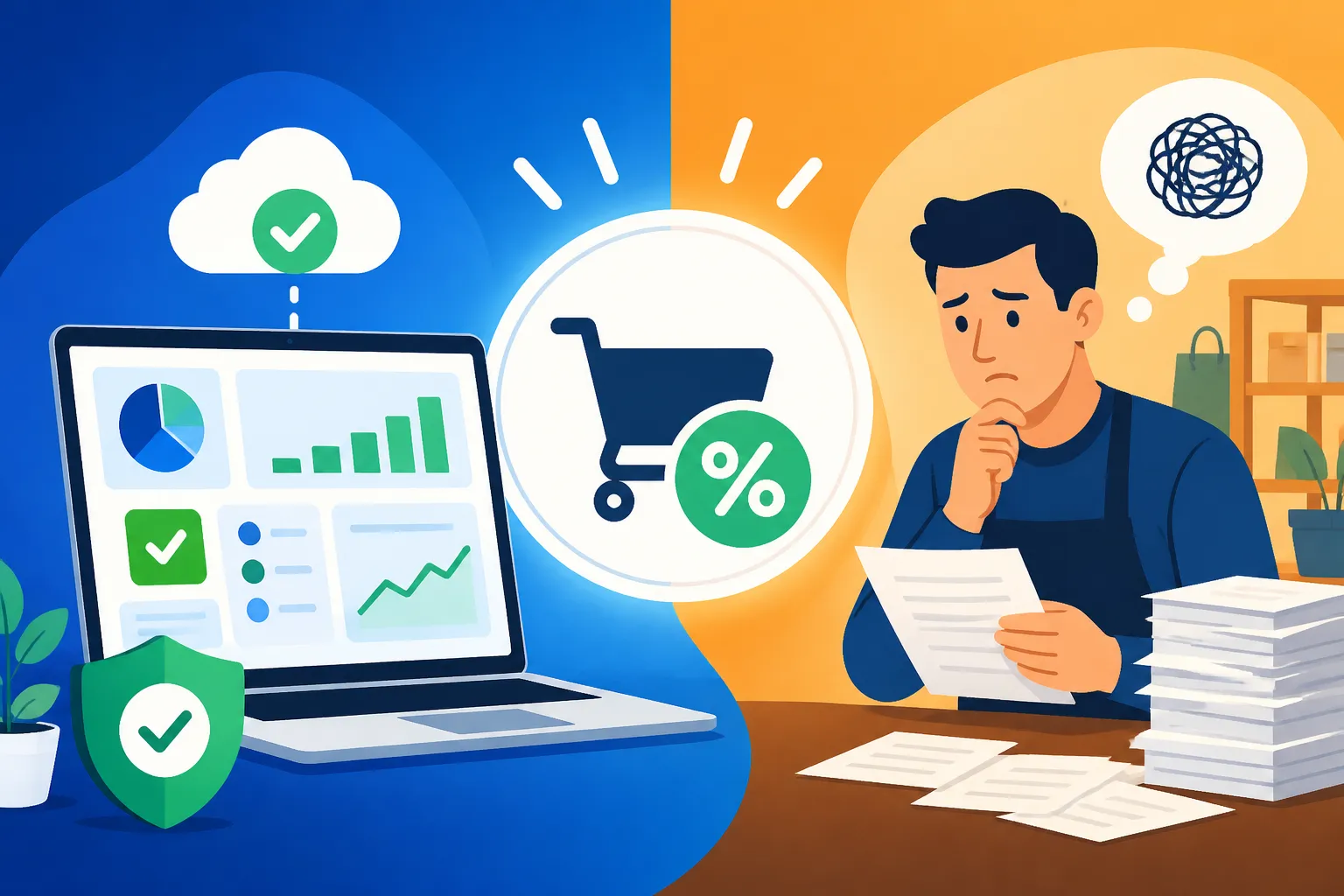
Many small businesses start out managing sales tax with spreadsheets, a calculator, and a good dose of optimism. For a time, especially if you only sell locally or within a state with a simple, flat tax, this approach might work. But as your business grows, and particularly as you expand your customer base geographically, manual management quickly becomes a recipe for errors and lost time.
Common Mistakes Small Businesses Make
The road to sales tax compliance is paved with good intentions, but also common pitfalls for small businesses.
- Incorrect Rate Application: This is probably the most frequent mistake. A business might charge the state-wide rate when a specific local rate, based on the customer's shipping address or origin, should have been applied. For example, if you're selling from an origin-based state, you apply your local rate, but if you're selling into a destination-based state, you apply the rate at the buyer's location. This distinction, often tied to Origin vs Destination Sales Tax Sourcing, can be incredibly confusing.
- Missing Nexus: Not realizing you've crossed an economic nexus threshold in a new state is a huge risk. If you've been selling into Texas and exceed their $500,000 threshold without registering, you could be on the hook for uncollected taxes, penalties, and interest.
- Incorrect Taxability: What's taxable in one state might not be in another. Is clothing taxable? Only above a certain amount in some places, like New York. Are digital products taxable? It varies wildly. Failing to correctly classify products can lead to under-collection or over-collection, both of which are problems.
- Late Filing or Payment: Every state has its own Sales Tax Due Dates by State 2026. Missing these deadlines, even by a day, can trigger Sales Tax Penalties & Late Filing by State. It's a quick way to chip away at your hard-earned profits.
- Inaccurate Record Keeping: If you ever face an audit, having meticulous records of what you collected, when, from whom, and what you remitted is crucial. Manual systems are prone to human error and can make auditing a nightmare.
The Time vs. Money Dilemma
Think about how much time you currently spend each month or quarter on sales tax. Are you manually looking up rates for every order? Are you spending hours preparing your returns for multiple states? For some businesses, this might be 1-2 hours a month. For others, particularly those with a broad customer base, it could easily be a full day or more.
Let's say you're spending 8 hours a month on sales tax. If your time is worth even $50 an hour, that's $400 a month, or $4,800 a year, just in labor costs. What could you be doing with that time instead? Focusing on marketing, product development, or customer engagement – activities that actually grow your business. Many small business owners reach a point where the time saved by automation far outweighs the cost of a software solution. It's a common dilemma, and the answer often leans towards automation as the business expands.
The Benefits of Sales Tax Software for Small Businesses
This is where sales tax software truly shines. It’s designed to take the guesswork and grunt work out of compliance, allowing you to focus on what you do best. While no software makes sales tax "fun," it certainly makes it manageable and less stressful.
Accuracy and Automation to the Rescue
Imagine selling to a customer in Seattle, Washington. Not only do you have the state sales tax, but also county and city taxes, and potentially special district taxes. The combined rate can be quite high, like the Seattle Sales Tax Rate 2026 (10.55%). Trying to manually identify and apply that precise rate for every single transaction across various jurisdictions is virtually impossible without mistakes.
Sales tax software automates this process. It integrates with your e-commerce platform (like Shopify or WooCommerce) or point-of-sale system, using the customer's shipping address to instantly calculate the correct, up-to-date sales tax rate at the exact moment of sale. This isn't just about applying a single rate; it's about drilling down to the specific taxing jurisdiction – often down to the street address or nine-digit ZIP code – to ensure precision. This level of detail is critical for states with complex local taxation, such as Colorado with its Colorado Home-Rule Cities Sales Tax. Companies like Avalara are renowned for their robust address validation and rate lookup capabilities, ensuring you're always charging the right amount.
Streamlining Filing and Remittance
Collecting the sales tax is only half the battle. The other half is filing your returns and remitting the money to the correct state and local authorities. Each state has its own forms, its own filing frequency (monthly, quarterly, annually), and its own due dates. If you have nexus in multiple states, this means preparing several different returns, each with potentially different data requirements.
Sales tax software collects all your transaction data, categorizes it by jurisdiction, and often auto-populates the necessary forms. This dramatically reduces the time and effort involved in preparing your returns. Instead of manually tallying sales for How to File a Sales Tax Return: Step by Step for each state, the software can generate ready-to-file reports or even, in many cases, file directly on your behalf. This frees you from the tedious data entry and the anxiety of wondering if you missed a deadline or made a calculation error.
Peace of Mind for Growth and Expansion
The biggest, yet often overlooked, benefit of sales tax software is the peace of mind it offers. When you're confident that your sales tax calculations are accurate and your filings are timely, you can focus on growing your business without the constant worry of compliance issues looming over your head.
Consider a business that wants to expand its reach. Without automated software, entering a new state means a deep dive into that state's unique nexus rules, taxability laws, registration process, and filing requirements. With software, much of this burden is alleviated. As you expand your Economic Nexus by State 2026: Thresholds Guide footprint, the software simply adapts, continuing to calculate and track accurately. This allows you to seize new market opportunities without being bogged down by administrative fears. It truly simplifies the process of Registering for Sales Tax in Multiple States when your backend is solid.
Is Sales Tax Software Right for Your Small Business? Factors to Consider
Deciding whether to invest in sales tax software isn't a one-size-fits-all answer. It depends heavily on the specifics of your business. There's a tipping point where the benefits of automation clearly outweigh the costs.
Your Business Volume and Complexity
If you run a very small business with minimal sales, sell exclusively locally, or only within one of the States With No Sales Tax (NOMAD Explained) (like Oregon, Delaware, or Montana), you might not need sales tax software just yet. A simple spreadsheet and diligent monitoring of your state's tax website could suffice.
However, if your sales volume is increasing, you're selling online to customers in many different states, or your product catalog includes items with varying taxability rules (e.g., food, clothing, digital goods, services), then complexity rises exponentially. For example, if you're a burgeoning e-commerce store with orders shipping nationwide, attempting to manually calculate the correct local sales tax for every order, as well as tracking nexus thresholds for Sales Tax for Online Sellers: Complete Guide in potentially dozens of states, quickly becomes unsustainable. At this point, the administrative overhead and risk of error become substantial, making software a wise investment.
Geographic Reach and Nexus Footprint
The number of states where you have sales tax nexus is a critical factor. If you only have nexus in one or two states, manual calculations and filings might be manageable. But as your business grows and expands its reach, particularly if you use third-party fulfillment services like Amazon FBA (which can create Amazon FBA Sales Tax Nexus Explained), your nexus footprint can grow rapidly.
The more states you have nexus in, the more complex your sales tax obligations become. Each state represents a new set of rules, rates, forms, and deadlines. A business with nexus in 5 states, let alone 20 or 30, would spend an inordinate amount of time on sales tax compliance without automation. In such scenarios, a comprehensive solution that handles the complexities of Combined State + Local Sales Tax Rates Explained across various jurisdictions is almost essential.
Cost-Benefit Analysis and Scalability
Of course, sales tax software comes with a cost. This cost can vary significantly depending on the provider, your sales volume, and the features you need. Some providers, like TaxJar or Avalara, offer different tiers of service. It's crucial to perform a cost-benefit analysis.
Manual vs. Automated Sales Tax Management
| Feature/Aspect | Manual Management | Automated Sales Tax Software (e.g., Avalara, TaxJar) |
|---|---|---|
| Rate Calculation | Prone to errors, requires constant lookup | Accurate, real-time, jurisdiction-specific rates |
| Nexus Tracking | Manual monitoring of sales thresholds, easily missed | Automatically monitors sales volume per state |
| Taxability Rules | Requires manual research for each product/state | Built-in rules engine for product taxability |
| Filing & Remittance | Time-consuming data entry, separate forms per state | Generates reports, auto-populates forms, or auto-files |
| Audit Risk | Higher due to potential errors and poor record-keeping | Lower due to accuracy and detailed reporting |
| Time Investment | Significant, scales with sales volume/jurisdictions | Minimal, largely fixed regardless of complexity |
| Cost | Primarily labor cost (your time) | Subscription fees |
| Scalability | Poor, becomes unmanageable with growth | Excellent, handles increased volume/jurisdictions |
| Peace of Mind | Low, constant worry about compliance | High, confidence in compliance |
If the cost of the software is less than the value of the time you or your employees spend on sales tax, plus the potential cost of penalties from errors, then it’s a clear win. Furthermore, consider scalability. As your business grows, sales tax complexity will only increase. Investing in a solution now that can handle future growth means you won't have to overhaul your system during a critical expansion phase. Many small businesses find that even basic versions of sales tax software pay for themselves relatively quickly, allowing them to focus on the things that truly matter for their bottom line. For more options, you might want to explore a guide on the Best Sales Tax Compliance Software 2027.
Disclaimer
The information provided in this guide is for general informational purposes only and does not constitute professional tax or legal advice. Sales tax laws are complex and constantly changing. It is essential to consult with a qualified tax professional or legal advisor for advice tailored to your specific business situation.