Sales Tax Rates by State 2026: All 50 States
Navigating the labyrinth of American tax law can feel like trying to solve a Rubik's Cube in the dark, especially when you realize that a $50 pair of jeans can cost a different amount in three different towns within the same county. Between shifting state mandates and aggressive local surcharges, the burden of staying compliant or simply budgeting for a purchase is overwhelming. This guide breaks down every state's 2026 sales tax rate, helping you master the complex web of compliance and consumer costs.
Understanding the Landscape of US Sales Tax
The first thing any veteran of the retail or e-commerce world will tell you is that there is no such thing as a "simple" sales tax rate. While we often talk about a state's base rate, that number is rarely what you actually pay at the register. In 2026, the gap between a state's base rate and the final combined rate is wider than ever, driven by local municipalities seeking to fund infrastructure projects or emergency services.
The Difference Between State and Local Rates
Most people look up a state rate and think they have the answer. For example, you might see that Alabama has a state rate of 4.00%. However, when you go to pay, you might see a total of 10% or more. This happens because counties, cities, and special districts—like school boards or transportation authorities—each tack on their own percentage. This is why Combined State + Local Sales Tax Rates Explained is such a critical concept for both shoppers and business owners.
Imagine you are a small business owner in Birmingham. You aren't just responsible for that 4% state tax; you are the middleman for a complex hierarchy of local authorities. If you fail to collect even a fraction of a percent for a specific library district, you could face audits that eat up months of your time and thousands of your dollars. It is this "stacking" effect that makes the US system one of the most complicated in the world.
Why Rates Change So Frequently
Legislative shifts are constant. Every November and April, local referendums appear on ballots across the country asking voters to approve a 0.25% increase for a new stadium or a 0.1% decrease because of a budget surplus. Today, we are seeing a trend where states are trying to lower their base rates to remain competitive, but local cities are raising theirs to cover rising local costs.
For a business, this means your POS system or tax software needs to be updated constantly. If you aren't using a robust tool like Avalara to manage these shifts, you might find yourself collecting last year's rates for six months before the Department of Revenue sends you a polite—but expensive—letter. These changes aren't just numbers; they represent the shifting priorities of local communities.
The Impact of Nexus on Your Final Cost
Since the landmark Wayfair decision, the concept of "nexus" has governed how taxes are collected online. Physical nexus is easy: you have a store, you pay tax. Economic nexus is the tricky part. If you sell a certain amount into a state—even if you've never stepped foot there—you are required to register and collect.
This creates a scenario where a boutique in Maine might suddenly owe taxes in California because their TikTok went viral and they sold $500,000 worth of handmade candles to Los Angeles residents. Understanding the Economic Nexus by State 2026: Thresholds Guide is no longer optional for anyone selling online; it is a fundamental survival skill in the modern economy.
The 2026 State-by-State Sales Tax Breakdown
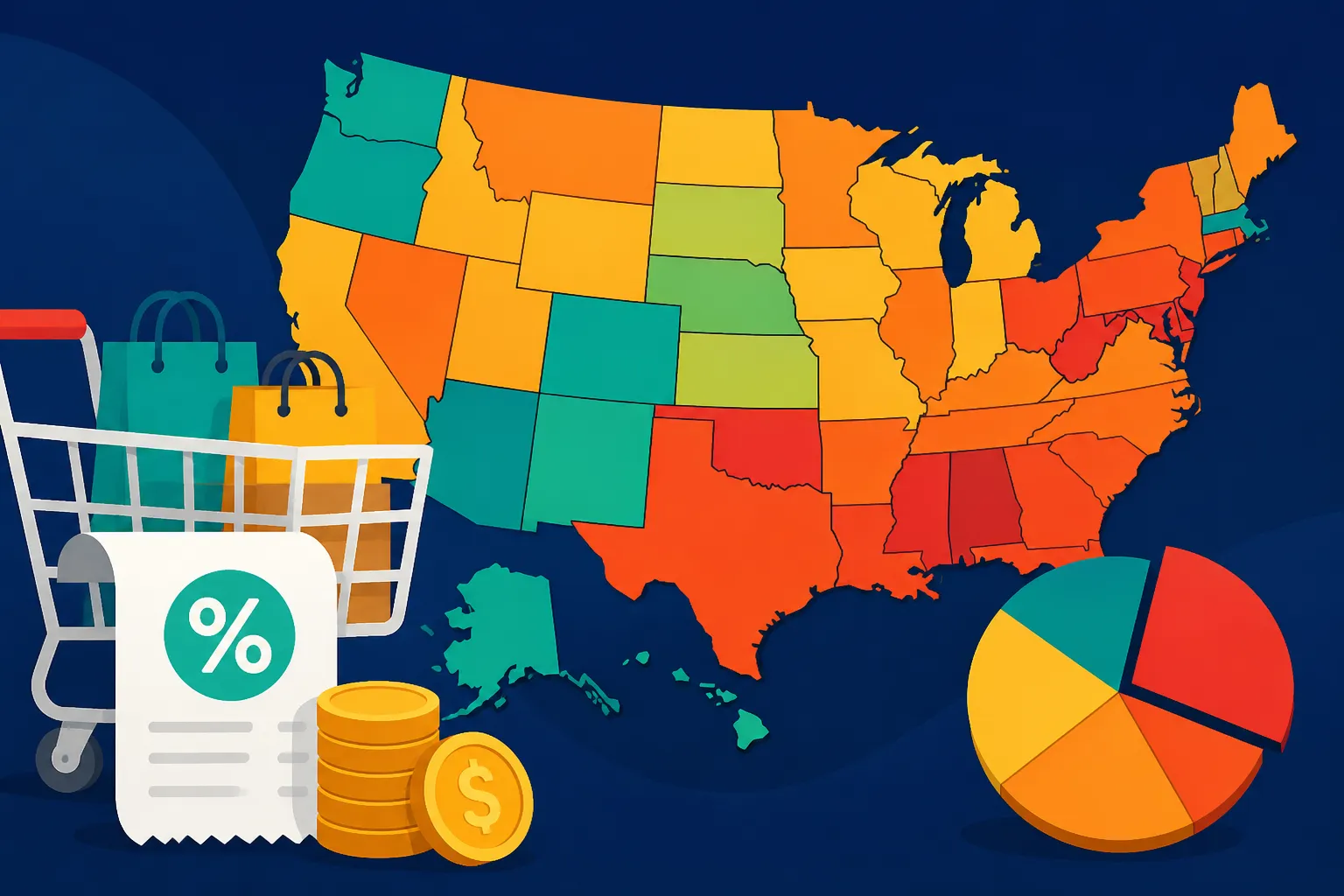
To help you visualize the current environment, we have compiled the base state rates and the average combined rates for 2026. Keep in mind that "Max Combined" refers to the highest possible rate you might encounter in a specific jurisdiction within that state, which is often much higher than the average.
| State | State Base Rate | Average Combined Rate | Max Combined Rate |
|---|---|---|---|
| Alabama | 4.00% | 9.25% | 12.50% |
| Alaska | 0.00% | 1.82% | 7.50% |
| Arizona | 5.60% | 8.40% | 11.20% |
| Arkansas | 6.50% | 9.45% | 11.50% |
| California | 7.25% | 8.85% | 10.75% |
| Colorado | 2.90% | 7.78% | 11.20% |
| Connecticut | 6.35% | 6.35% | 6.35% |
| Florida | 6.00% | 7.02% | 8.00% |
| Georgia | 4.00% | 7.38% | 9.00% |
| Illinois | 6.25% | 8.82% | 11.50% |
| Indiana | 7.00% | 7.00% | 7.00% |
| Kansas | 6.50% | 8.70% | 11.50% |
| Louisiana | 4.45% | 9.56% | 12.95% |
| Michigan | 6.00% | 6.00% | 6.00% |
| New York | 4.00% | 8.52% | 8.875% |
| Tennessee | 7.00% | 9.55% | 9.75% |
| Texas | 6.25% | 8.20% | 8.25% |
| Washington | 6.50% | 9.38% | 10.60% |
States with the Highest Base Rates
California currently holds the title for the highest state-level base rate at 7.25%. When you walk into a store in Los Angeles, you are starting at 7.25% before the city and county even get their hands on the transaction. This high base rate is often used to fund massive statewide social programs and infrastructure. However, Tennessee and Indiana aren't far behind with 7.00% base rates.
The strategy in Tennessee is particularly interesting. Because the state has no personal income tax, they rely heavily on the "consumption tax" model. This means that while your paycheck stays whole, your trips to the grocery store or the mall are more expensive. For residents, it's a trade-off that requires careful monthly budgeting.
States with No Statewide Sales Tax
Five states—New Hampshire, Oregon, Montana, Alaska, and Delaware—make up the "NOMAD" group. These states do not have a statewide sales tax. This sounds like a dream for shoppers, but as we detail in States With No Sales Tax (NOMAD Explained), there is usually a catch. Alaska, for example, allows local municipalities to levy their own taxes. You might pay 0% in Anchorage, but if you drive to a smaller town like Juneau or Kenai, you could find a local tax waiting for you at the register.
In Oregon, the lack of sales tax is a major draw for residents of neighboring Washington. It’s a common sight to see cars with Washington plates parked at Oregon malls, with shoppers trying to save 10% on a new MacBook or a set of tires. However, Oregon makes up for this lost revenue through some of the highest income tax rates in the country. It’s a classic case of the tax man getting his due one way or another.
Mid-Range States and Their Economic Strategies
States like Florida and Texas occupy the mid-range with base rates around 6.00% to 6.25%. These states are often viewed as "business-friendly" because they lack state income taxes and keep sales taxes relatively predictable. Texas, for instance, has a very strict cap on local taxes. The state takes 6.25%, and local jurisdictions can take no more than 2.00%, leading to a very common Texas Sales Tax Rate (6.25% + Local 8.25% Max) that you see in major hubs like Austin, Dallas, and Houston.
This predictability is a massive relief for retailers. When a state caps the combined rate, it prevents the "12% surprise" that shoppers might encounter in places like Alabama or Louisiana. For a business owner, it means less time spent configuring complex tax tables and more time focusing on customer service.
The Hidden Trap of Local and District Taxes
If you think you can just memorize 50 numbers and be done with it, I have some bad news. There are over 13,000 tax jurisdictions in the United States. A single street could be the dividing line between two different tax rates. This is why Sales Tax by ZIP Code (and Why ZIP Isn't Enough) is one of the most important lessons for any modern entrepreneur.
Home-Rule Cities and Independent Jurisdictions
In most states, the Department of Revenue collects all the sales tax and then distributes it back to the cities and counties. But in "home-rule" states like Colorado and Alabama, cities have the right to administer their own taxes. This is a logistical nightmare. If you are a plumber based in Denver but you take a job in a neighboring home-rule suburb, you might have to register with that specific city, file a separate return, and follow their specific rules on what is and isn't taxable.
We dive deep into this in our guide on Colorado Home-Rule Cities Sales Tax. For a small business, this often means that the cost of compliance—hiring an accountant or paying for software like Avalara—can actually exceed the amount of tax you are even collecting. It’s an empathetic frustration we hear from business owners every day who just want to do the right thing without being buried in paperwork.
The Complexity of ZIP Code Sourcing
Many people use a ZIP code to look up a tax rate. However, ZIP codes are for mail delivery, not for tax boundaries. A single ZIP code can span multiple counties and cities, each with different rates. If you rely solely on a 5-digit ZIP code to calculate your taxes, you are almost guaranteed to be wrong at least 10% of the time.
The industry standard is now moving toward "rooftop-level" accuracy, which uses the exact latitude and longitude of an address to determine the tax. This is especially important for high-ticket items. If you are calculating How Much Is Sales Tax on a Car by State, being off by 0.5% because of a ZIP code error could result in a $200 mistake that the DMV will catch when you go to register the vehicle.
Destination vs. Origin Sourcing
To make matters even more confusing, states decide whether the tax rate is based on where the seller is located (Origin) or where the buyer receives the goods (Destination). Most states have moved to destination-based sourcing to ensure they get their fair share of the online shopping boom.
If you are shipping a package from a warehouse in Ohio to a customer in New York, you generally charge the rate based on the customer’s front door. This is why the question Is Sales Tax Based on Billing or Shipping Address? is so frequently asked. In almost every case today, the shipping address is the king of the transaction.
Special Categories and Exemptions to Watch
Not everything you buy is taxed at the same rate. In fact, some of the most heated political debates in state capitals revolve around what should be exempt. From "tampon taxes" to grocery exemptions, the rules are a moving target.
Grocery Taxes: A State-by-State Patchwork
Most states believe that food is a necessity and should not be taxed, or at least should be taxed at a lower rate. However, about 13 states still tax groceries to some degree. In 2026, we saw a major shift as the Illinois Grocery Tax Eliminated 2026 policy finally went into effect, providing relief to millions of families.
Compare this to a state like Alabama or Mississippi, where you might pay the full 9% or 10% combined rate on a gallon of milk. For a low-income family, this can add $50 to $100 a month in extra costs just to eat. On the flip side, many states distinguish between "grocery food" and "prepared food." If you buy a cold rotisserie chicken, it might be tax-free. If that same chicken is hot under a heat lamp, the state considers it a "restaurant meal" and hits you with the full tax.
Digital Goods and SaaS
As our economy moves online, states are scrambling to figure out how to tax things you can’t touch. Software-as-a-Service (SaaS) is a primary target. Some states tax it as a tangible good, some as a service, and some don't tax it at all.
For example, in Texas, SaaS is generally 80% taxable. Why 80%? It’s a legislative compromise that assumes a portion of the software is "service" and a portion is "product." It is these kinds of arbitrary rules that make manual tax calculation nearly impossible. If you are a developer selling a subscription, you need to know the specific stance of every state your customers live in, or you could end up with a massive tax bill you never collected from your users.
Clothing and Apparel Thresholds
Clothing is another area where the rules are bizarre. In Pennsylvania and New Jersey, most clothing is exempt from sales tax. This has made Philadelphia a major shopping destination for people from New York and Maryland.
However, New York has a famous "threshold" rule. Clothing and footwear sold for less than $110 per item are exempt from the state's 4% tax (though local taxes may still apply). If you buy a pair of shoes for $109, you pay very little tax. If those shoes are $111, you pay tax on the entire amount. It’s a "cliff" that savvy shoppers—and clever retailers—constantly try to navigate.
Planning for 2026 Sales Tax Holidays
One of the few times the tax system works in the consumer's favor is during a sales tax holiday. These are specific windows where states waive the sales tax on certain items, usually to encourage economic activity or help families prepare for the school year.
Back-to-School and Emergency Prep Windows
Most tax holidays happen in August. States like Florida, Texas, and Tennessee offer "tax-free weekends" where clothing, school supplies, and even computers are exempt from tax. For a parent with three kids, shopping during this window can save hundreds of dollars.
Some states are also introducing "Emergency Preparedness" holidays. In Florida and Alabama, you might find a week in May or June where portable generators, batteries, and flashlights are tax-free to encourage hurricane readiness. If you've been eyeing a $1,000 generator, waiting for that tax-free window can save you $70 to $100 instantly.
Technology and Energy Star Exemptions
A few states extend these holidays to high-efficiency appliances. If you are buying a refrigerator or a dishwasher with an Energy Star rating, states like Maryland or Missouri might offer a tax-free window. Because these items are expensive, the tax savings are significant.
However, be warned: these holidays often have strict price caps. A state might say "computers are tax-free," but only if they cost less than $1,500. If you buy a high-end gaming rig for $2,000, you pay the full tax on the whole amount. Always check the specific 2026 limits before you head to the store.
Tools and Resources for Accurate Calculation
If reading this has made your head spin, you aren't alone. Even professional accountants struggle with the 13,000+ jurisdictions and the constant rate changes. Fortunately, we live in an era of automation.
Choosing the Right Sales Tax Calculator
For a quick check, using a Sales Tax Calculator: How to Calculate Sales Tax can help you estimate your costs. These tools are great for one-off purchases or for a consumer trying to verify a receipt. But for a business, an "estimator" isn't enough. You need precision.
State Department of Revenue Lookups
Every state provides a lookup tool on their Department of Revenue website. These are the "source of truth." If you have a dispute with a vendor or a customer, the state's official website is the final word. However, these tools are often clunky and don't play well with e-commerce platforms like Shopify or WooCommerce.
Professional Compliance Software Options
For any business doing more than a few thousand dollars a month in out-of-state sales, manual tracking is a recipe for disaster. Using a service like Avalara allows you to integrate real-time tax calculation directly into your checkout process.
Avalara handles the "rooftop-level" mapping, manages your exemption certificates, and can even file your returns for you. While there is a cost to these services, it is almost always cheaper than the penalties, interest, and stress of a sales tax audit. In 2026, automation isn't a luxury; it's the cost of doing business.
Frequently Asked Questions About 2026 Sales Tax
How do I know if I have nexus in a state?
Nexus is triggered by either a physical presence (office, warehouse, or even a remote employee) or an economic presence (usually $100,000 in sales or 200 transactions, though many states are doing away with the transaction count).
What happens if I forget to collect sales tax?
The state doesn't care that you forgot; they still want their money. You will be required to pay the tax out of your own pocket, plus penalties and interest which can often double the original amount owed.
Do I need a permit for every state?
Yes, if you have nexus. You cannot legally collect sales tax unless you have a permit from that state's Department of Revenue. Collecting tax without a permit is considered tax fraud in many jurisdictions.
Is there sales tax on used items?
Generally, yes. Sales tax applies to the transaction, not the item. If you buy a used car from a dealer, you will pay sales tax. If you buy it from a private individual, you will usually pay "use tax" when you register the title at the DMV.
Disclaimer
This guide is for informational purposes only and does not constitute legal or professional tax advice. Sales tax laws and rates are subject to frequent change by state and local authorities. Always consult with a qualified tax professional or your state's Department of Revenue to ensure compliance with current regulations.