Amazon FBA Sales Tax Nexus Explained
Oh, the labyrinthine world of sales tax! For Amazon FBA sellers, it often feels like navigating a dense fog, especially when it comes to understanding how simply storing your products in an Amazon warehouse can trigger sales tax obligations in states you've never even visited. Many small business owners jump into FBA with the promise of streamlined logistics, only to later discover the hidden complexity of sales tax nexus. This comprehensive guide will demystify Amazon FBA sales tax nexus, explain its nuances, and provide actionable insights to help you stay compliant without pulling your hair out.
Understanding Sales Tax Nexus: The Foundation for FBA Sellers
Before we dive specifically into Amazon FBA, it’s crucial to grasp the fundamental concept of sales tax nexus. This isn't just some abstract accounting term; it's the legal requirement that dictates whether your business needs to collect and remit sales tax in a particular state. Without understanding nexus, you're essentially flying blind in the complex world of state tax laws. It’s no wonder so many sellers feel overwhelmed – the rules constantly evolve, and what applies in one state might be completely different in another.
What Exactly is Sales Tax Nexus?
At its core, sales tax nexus means having a "sufficient physical presence" or "economic connection" with a state, which then grants that state the legal authority to require you to collect sales tax from your customers there. For years, this was largely straightforward: if you had a physical office, employees, or a warehouse in a state, you had nexus. Simple enough, right? But then the internet happened, and with it, the rise of online selling and fulfillment models like Amazon FBA, which totally changed the game.
The frustration often stems from this historical context. Many entrepreneurs started their online businesses with the understanding that sales tax only applied if they had a storefront in a customer's state. Now, the rules are far more intricate, demanding a much deeper understanding of your business operations across state lines. Missing this fundamental understanding can lead to unexpected tax liabilities and penalties down the road, which is certainly not what any business owner wants.
The Critical Impact of the Wayfair Decision
The landscape of sales tax nexus shifted dramatically after the 2018 Supreme Court ruling in South Dakota v. Wayfair. This landmark decision fundamentally altered how states could impose sales tax obligations on out-of-state businesses. Before Wayfair, the prevailing standard was primarily physical presence. After the ruling, states gained the power to mandate sales tax collection based on a business's economic activity within their borders, even without a physical presence. If you're looking for a deeper dive into this pivotal moment, our article on South Dakota v. Wayfair: What It Means for Sellers breaks down all the implications.
This change sent shockwaves through the e-commerce world, leaving many small and medium-sized businesses scrambling to understand their new obligations. Suddenly, sellers who previously only had to worry about sales tax in their home state found themselves potentially liable in dozens of states where they had significant sales volume. For Amazon FBA sellers, this added another layer of complexity to an already challenging situation, requiring a complete re-evaluation of their compliance strategies.
Why FBA Sellers Face Unique Nexus Challenges
Amazon FBA sellers face a particularly thorny sales tax situation because their inventory isn't static. Unlike a traditional retailer who ships all products from a single warehouse, FBA sellers hand over their inventory to Amazon, who then strategically distributes it across its vast network of fulfillment centers throughout the United States. This means your products, which are legally your property, could be sitting in warehouses in California, Arizona, Kentucky, Pennsylvania, or any other state where Amazon has a facility.
Each of these locations where your inventory is stored creates a physical presence, and therefore, sales tax nexus, for your business in that state. This is a critical distinction that often catches sellers off guard. You might live in Florida and sell primarily to Florida customers, but if Amazon stores your items in a Texas warehouse to optimize shipping, you've just established physical nexus in Texas. This constant movement and storage across state lines make FBA sales tax compliance significantly more challenging than for sellers using a single-location fulfillment model.
How Amazon FBA Creates Physical Nexus: The Inventory Problem
The very convenience that makes Amazon FBA so attractive – Amazon handles storage, packing, shipping, and customer service – is precisely what complicates sales tax nexus. When you send your products to Amazon, you're essentially delegating control over where your inventory is stored. And where your inventory is stored directly impacts where your business has a physical presence for sales tax purposes. It's like having silent business partners in every state Amazon decides to stash your goods, and each of those partners comes with its own set of tax rules.
Amazon's Network of Fulfillment Centers
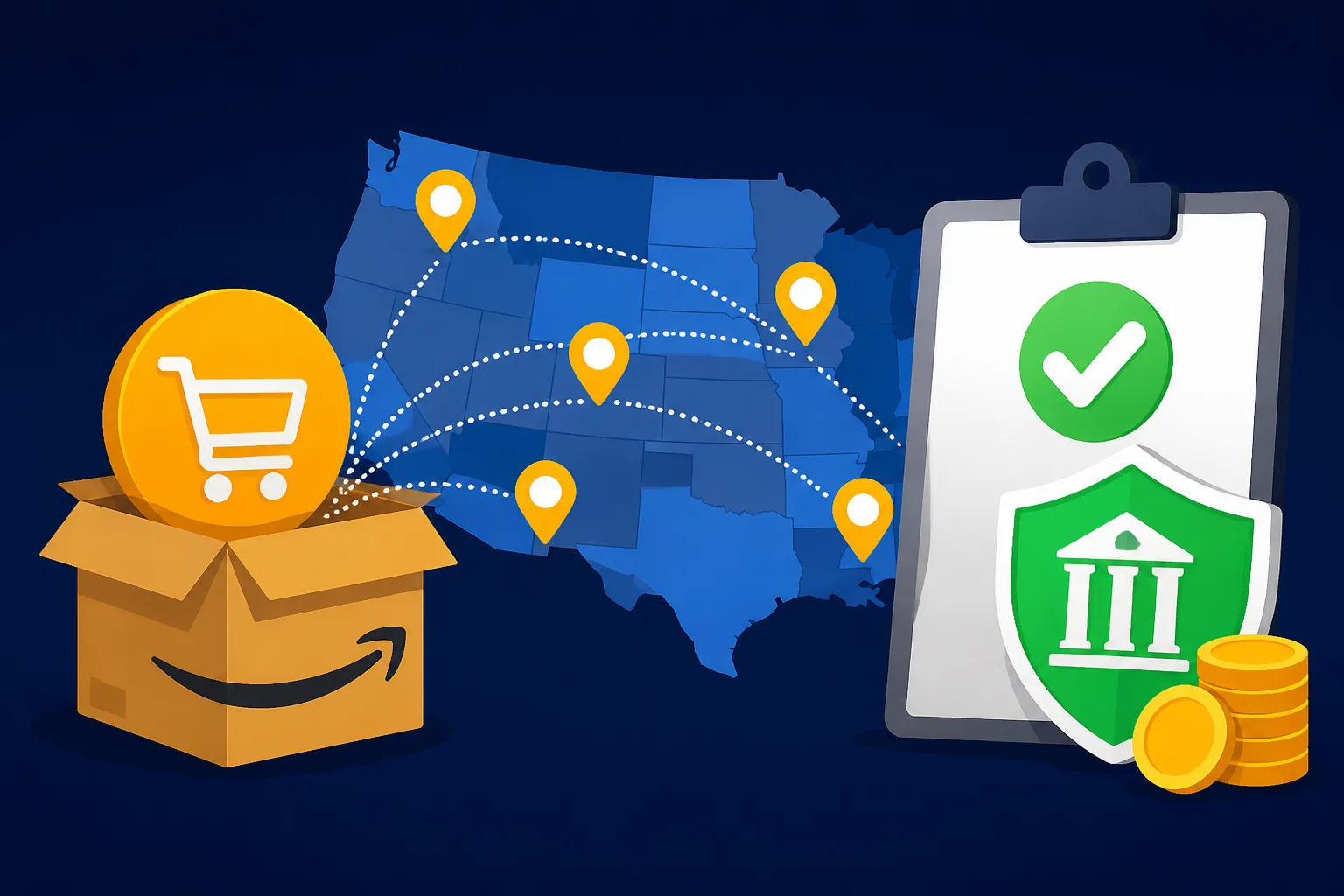
Amazon operates an extensive network of fulfillment centers, sorting centers, and delivery stations across nearly every state in the U.S. These facilities are strategically located to ensure rapid delivery to customers. When you send your inventory to Amazon, their sophisticated algorithms decide where to store it based on anticipated demand, proximity to customers, and logistics efficiency. This means your products might not stay in one place; they could be moved between multiple fulfillment centers in different states over time. For example, if you ship all your units to an Amazon warehouse in New Jersey, Amazon might then decide to transfer some of those units to facilities in Georgia or California, instantly creating nexus for you in those new states.
The sheer scale and dynamic nature of Amazon's logistics make it nearly impossible for individual sellers to manually track their inventory's exact location at all times. This lack of transparency can be incredibly frustrating, as knowing where your inventory resides is key to understanding your sales tax obligations. It's a game of constantly moving pieces, and if you don't have the right tools, you're always playing catch-up.
Your Inventory, Their Warehouse: A Legal Quagmire
The crucial point here is that even though the warehouse belongs to Amazon, the inventory inside it belongs to you. From a legal standpoint, having your property stored in a state, even temporarily, is generally considered a physical presence for sales tax nexus purposes. This concept is often referred to as "inventory nexus" or "warehouse nexus." It’s a huge source of anxiety for sellers because it means they can establish nexus in states they’ve never set foot in, purely by virtue of Amazon’s logistical decisions.
Consider a scenario: you're a small business owner based in Oregon, one of the states with no statewide sales tax. You sell handmade jewelry through Amazon FBA. Amazon decides to store some of your best-selling necklaces in their fulfillment center in Phoenix, Arizona, and others in Dallas, Texas. Boom! Just like that, you now have physical sales tax nexus in Arizona and Texas, even though your entire operation is based tax-free Oregon. This reality often comes as a shock and highlights the need for a proactive approach to sales tax compliance from the get-go.
Tracking Your Inventory Locations: A Herculean Task
Given the constant movement and distribution of FBA inventory, tracking your exact nexus footprint can feel like a Herculean task. Amazon provides various reports, such as the "Inventory Event Detail Report" and the "Daily Inventory History Report," which can show where your inventory has been or currently is. However, these reports are often complex, require significant manual analysis, and can be overwhelming to parse regularly for nexus purposes.
Many sellers find themselves spending countless hours trying to stitch together data from different reports, only to feel uncertain if they've captured every single location. This time could be better spent on growing their business. This is where automation really shines, as trying to manually keep up with the shifting locations of your FBA inventory across potentially dozens of states is simply not sustainable for most businesses. For more on navigating this, our guide on Amazon FBA Inventory Nexus: The Hidden Trap offers further insights.
Beyond Physical Presence: Economic Nexus and FBA
While physical presence (like having inventory in an FBA warehouse) is a primary driver of sales tax nexus for FBA sellers, it's not the only one. Thanks to the Wayfair decision, every state that levies sales tax now also has "economic nexus" laws. This means your business can establish nexus based purely on your sales activity within a state, regardless of whether you have any physical property there. For FBA sellers, understanding the interplay between these two types of nexus is absolutely crucial.
Economic Nexus Thresholds: The Other Side of the Coin
Economic nexus laws dictate that if your sales into a state meet certain thresholds, you've established nexus. These thresholds vary by state but commonly involve a certain dollar amount of sales (e.g., $100,000) or a specific number of transactions (e.g., 200 separate sales), or sometimes a combination of both, within a calendar year. It's vital to remember that these thresholds apply to your total sales into a state, not just FBA sales, but all sales your business makes. Many states initially included the transaction count, but a growing number have since dropped it, simplifying things slightly for high-volume, low-value sellers.
The variability of these thresholds is another source of frustration. You can't just memorize one rule; you need to be aware of the specific requirements for every state where you potentially sell goods. For a detailed breakdown of what each state requires, our comprehensive Economic Nexus by State 2026: Thresholds Guide is an invaluable resource. Keeping track of these evolving thresholds across all 45+ sales tax states can feel like a full-time job in itself.
How FBA Sales Contribute to Economic Nexus
Every sale you make through Amazon FBA to a customer in a specific state contributes directly to your economic nexus threshold in that state. Let's say you're based in North Carolina, and you sell a lot of items via FBA to customers in California. Even if Amazon moves your inventory out of California's warehouses for a period, if your total FBA sales into California exceed their economic nexus threshold ($500,000 in gross sales for California), you would still have nexus there due to your economic activity.
This means that even if you somehow managed to ensure Amazon never stored your products in a particular state, you could still trigger nexus simply by having a high volume of sales to customers within that state. It's a double-whammy for FBA sellers: physical nexus from inventory and economic nexus from sales volume. The good news is that for many smaller sellers, hitting the economic nexus thresholds might take longer than triggering physical nexus via inventory storage.
The Interplay of Physical and Economic Nexus
It's entirely possible, and quite common, for an Amazon FBA seller to have both physical nexus (due to inventory storage) and economic nexus (due to sales volume) in the same state. For example, your inventory might be stored in a Texas fulfillment center, giving you physical nexus. If your sales to Texas customers also exceed the state's $500,000 economic nexus threshold, you simultaneously have economic nexus. In these scenarios, the presence of one form of nexus reinforces the obligation, but fundamentally, either one is sufficient to create the requirement to collect sales tax.
The key takeaway is that you need to be monitoring both your inventory locations and your sales volume in each state. You can't just rely on one metric. The complexities here are why tools designed specifically for sales tax compliance are so beneficial. They can help you track both aspects, giving you a clearer picture of where you have nexus and ensuring you don't overlook any obligations. Ignoring these intricate rules can lead to serious compliance issues down the line.
Registering for Sales Tax Permits: What FBA Sellers Need to Do
Once you've determined where you have sales tax nexus – whether through FBA inventory or economic activity – the next critical step is to register for a sales tax permit (sometimes called a seller's permit, reseller's license, or certificate of authority) in each of those states. This isn't optional; it's a legal requirement before you can lawfully collect sales tax from customers in that jurisdiction. Many sellers find this process daunting, especially when dealing with multiple states, each with its own unique registration portal and requirements.
Identifying Your Nexus States
Before you can register, you need a clear, up-to-date picture of your nexus footprint. For Amazon FBA sellers, this primarily involves:
- Reviewing Amazon's Inventory Reports: As mentioned earlier, delve into Amazon's "Inventory Event Detail" or "Daily Inventory History" reports. While these can be cumbersome, they are your primary source for identifying which states your inventory has touched. Look for fulfillment centers where your products have been stored, even for short periods.
- Monitoring Sales Volume: Track your total gross sales (including FBA sales) into each state. Compare these numbers against each state's economic nexus thresholds (both sales dollar amount and transaction count, where applicable). Even if Amazon collects sales tax for you (more on that later), if you hit these thresholds, you still establish nexus.
It’s a good idea to perform a nexus review at least once a quarter, or more frequently if your sales volume is rapidly increasing or if you're sending large quantities of new inventory to FBA. Consistency in this review process is key to staying on top of your obligations. Knowing where you stand is the first step towards achieving compliance. If you're feeling lost, our article How Do I Know If I Have Nexus in a State? provides practical steps.
The Application Process for Sales Tax Permits
Once you've identified your nexus states, you'll need to apply for a sales tax permit in each one. This process varies significantly from state to state. Generally, you'll visit the state's Department of Revenue or equivalent tax authority website. You'll typically need to provide information about your business, such as your legal business name, EIN (Employer Identification Number), business address, and sometimes projected sales volume. Some states might ask for details about the types of products you sell.
While some states offer relatively quick online registration, others might have more involved processes, potentially requiring several days or weeks to issue a permit number. It's a bureaucratic hurdle that many small businesses dread, especially when facing applications for multiple states. For comprehensive guidance on navigating this, our guide on Registering for Sales Tax in Multiple States can be incredibly helpful. Don't underestimate the time this process can take, so plan accordingly.
Don't Forget About Marketplace Facilitator Laws
Here's where things get a little less terrifying for FBA sellers. Most states now have "marketplace facilitator" laws in place. Under these laws, online marketplaces like Amazon, eBay, and Etsy are generally responsible for calculating, collecting, and remitting sales tax on sales made through their platforms, even if the individual seller has nexus in that state. This is a massive simplification for many FBA sellers, as it offloads a significant portion of the collection burden. Our comprehensive guide on Marketplace Facilitator Laws by State explains which states have these rules and how they impact you.
However, a critical point: even if Amazon is collecting and remitting sales tax on your behalf in a state where you have nexus, you might still need to register for a sales tax permit and file periodic "zero returns" or "information returns." This is because registering establishes your official presence with the state's tax authority. Failing to register could put you on their radar for non-compliance, even if no tax is due from you directly. Always verify with each state's specific guidelines, but generally, if you have nexus, you need to register. You might also sell on your own website, and for those direct sales, Amazon won't collect anything for you, so you'd need to handle that yourself in nexus states. This is exactly why you still need to ask yourself, Do I Still Need a Permit If Amazon Collects?
Collecting, Reporting, and Remitting Sales Tax with Amazon FBA
Once you're registered, the next phase of sales tax compliance involves the actual collection, reporting, and remittance. This is where many FBA sellers breathe a sigh of relief because of Amazon's role, but it's crucial to understand your remaining responsibilities. It’s not a set-it-and-forget-it situation; you still need to be aware of what’s happening and ensure proper reporting.
Amazon's Role in Sales Tax Collection
In the vast majority of states with sales tax, Amazon acts as a marketplace facilitator. This means that for sales made through the Amazon platform, Amazon is legally obligated to calculate, collect, and remit sales tax directly to the appropriate state and local tax authorities. For you, the FBA seller, this is a huge benefit, as it removes the daily burden of sales tax calculation and collection from your shoulders for your Amazon sales. This applies to both physical and economic nexus states where marketplace facilitator laws are active.
When a customer makes a purchase on Amazon from your FBA inventory, Amazon handles the entire sales tax transaction. The sales tax collected is then remitted by Amazon, not you, to the state. This streamlines the process significantly for individual sellers, allowing them to focus more on sourcing products and marketing. However, this doesn't mean you can completely disengage from sales tax compliance – far from it.
Your Responsibilities Beyond Amazon's Collection
Even with Amazon acting as a marketplace facilitator, you still have critical responsibilities as an FBA seller.
- Registration: As discussed, if you have nexus in a state (either physical or economic), you generally need to register for a sales tax permit, even if Amazon is collecting the tax. Many states require this registration to acknowledge your business's presence.
- Filing Returns: In most states where you are registered and Amazon collects sales tax, you will still need to file periodic sales tax returns. These returns might be "zero returns," indicating that no tax was collected by you, or they might include sales made directly through your own website or other channels where you are responsible for collection. Failing to file these returns can lead to penalties, even if you owe no tax.
- Direct Sales: If you sell products outside of the Amazon platform (e.g., on your own Shopify store, through wholesale channels), you are responsible for collecting and remitting sales tax on those sales in any state where you have nexus. Amazon's marketplace facilitator role only applies to sales made on their platform. This is a common oversight for sellers who diversify their sales channels.
Imagine you have physical nexus in Texas because Amazon stores your inventory there. Amazon collects and remits sales tax for all your Amazon sales to Texas customers. But if you also run a successful independent e-commerce site and sell directly to Texas customers, you are personally responsible for collecting and remitting sales tax on those non-Amazon sales. This is where many FBA sellers can get into trouble if they aren't careful.
Using Sales Tax Software for FBA Compliance
Given the complexity of tracking nexus, understanding marketplace facilitator laws, and managing your own direct sales, relying on manual processes is simply not sustainable for most FBA sellers. This is where dedicated sales tax compliance software becomes an invaluable asset. Solutions like Avalara are designed to automate many of these challenging tasks. They can help you:
- Determine Nexus: Track your inventory locations (integrating with Amazon FBA reports) and monitor your economic nexus thresholds in real-time across all states.
- Calculate Sales Tax: Accurately calculate sales tax rates for your direct sales, considering state, county, city, and special district taxes based on the customer's location. This can be incredibly complex, as our article on Combined State + Local Sales Tax Rates Explained clearly shows.
- Manage Exemptions: Handle tax-exempt sales, such as those made to resellers with valid resale certificates.
- File Returns: Prepare and often file your sales tax returns automatically, including zero returns where applicable.
Integrating a robust sales tax solution can save countless hours and significantly reduce the risk of errors and penalties. It transforms what feels like an impossible task into a manageable workflow, allowing you to focus on your core business. Choosing the right software can be a game-changer for FBA sellers looking for peace of mind. For those looking for more options, explore our guide on the Best Sales Tax Compliance Software 2027.
Common Pitfalls and Best Practices for FBA Sales Tax
Navigating sales tax as an Amazon FBA seller is fraught with potential missteps. Many businesses, especially new and growing ones, fall into common traps that can lead to significant headaches down the road. But with awareness and proactive strategies, you can avoid these pitfalls and establish robust compliance practices. This is about protecting your business and ensuring long-term success, not just avoiding a fine.
The Danger of Ignoring Nexus
One of the biggest mistakes FBA sellers make is ignoring their nexus obligations entirely, either out of confusion, oversight, or hope that they won't get caught. Unfortunately, this can have severe consequences. States are increasingly aggressive in enforcing sales tax laws, especially with the data available from marketplaces like Amazon. If a state discovers you had nexus and should have been collecting and remitting sales tax but weren't, you could face:
- Back Taxes: You'll be liable for all the sales tax you should have collected but didn't, potentially for several years.
- Penalties and Interest: States levy significant penalties for non-compliance, which can quickly add up, often compounded by interest on unpaid taxes.
- Audits: Being targeted for an audit is a time-consuming and stressful experience that diverts resources from your business.
- Loss of Business Licenses: In extreme cases, repeated non-compliance could even jeopardize your ability to do business in a state.
It's a scary thought, but the reality is that states are actively looking for non-compliant businesses. Being proactive and addressing nexus head-on is always the best strategy, even if it feels overwhelming at first. The cost of compliance pales in comparison to the cost of non-compliance.
Regularly Reviewing Your Nexus Footprint
Your nexus footprint isn't static; it's dynamic, especially with Amazon FBA. Your inventory is constantly moving, and your sales volume is hopefully growing. Therefore, it's a best practice to regularly review your nexus situation. At a minimum, quarterly reviews are recommended. This involves:
- Checking Amazon Reports: Analyze your Amazon inventory reports to see if your products have been stored in new states.
- Monitoring Sales Data: Keep an eye on your gross sales into each state to ensure you haven't crossed any economic nexus thresholds.
- Staying Informed on State Law Changes: Sales tax laws, especially economic nexus thresholds, can change. Keep abreast of any updates. For instance, 2026 Sales Tax Rate Changes by State is a resource to keep an eye on.
By performing these regular check-ups, you can identify new nexus obligations early and take the necessary steps to register and comply before issues arise. This proactive approach helps you avoid surprises and keeps your business on solid legal ground. Think of it as a routine health check for your business's tax compliance.
When to Seek Professional Guidance
While this guide provides a comprehensive overview, sales tax can be incredibly complex, and every business's situation is unique. There will come a point when seeking professional guidance from a qualified sales tax expert or tax attorney is not just helpful, but essential. This is particularly true if:
- You have nexus in a large number of states and find managing compliance overwhelming.
- You're dealing with complex product types that have varying taxability rules (e.g., some food items, digital goods).
- You're facing an audit or have discovered significant past non-compliance.
- You're expanding into new sales channels or models (e.g., drop shipping, wholesale).
A sales tax professional can help you interpret complex state laws, optimize your compliance strategy, and even represent you in dealings with state tax authorities. They can provide tailored advice that fits your specific business model and growth trajectory. While sales tax software like Avalara can automate much of the heavy lifting, a human expert can offer strategic insights and navigate truly unique situations that automation alone cannot address. It's an investment in peace of mind and long-term business health.
Special Considerations for Amazon FBA Sellers
The nuances of sales tax for Amazon FBA sellers extend beyond basic nexus and collection. There are specific situations and items that often raise questions, adding yet another layer of complexity. Understanding these can prevent further headaches and ensure your compliance is truly comprehensive.
Sales Tax on FBA Fees and Services
A common question among FBA sellers is whether they owe sales tax on the fees Amazon charges them for fulfillment, storage, and other services. Generally, the services provided by Amazon to you as a seller (like fulfillment, storage, advertising) are considered business-to-business (B2B) services. Most states do not impose sales tax on B2B services, especially when they are an integral part of logistics or advertising. Therefore, in most cases, Amazon does not charge you, the seller, sales tax on their FBA fees.
However, it's not a universal rule without exceptions. The taxability of services varies significantly by state. For example, some states might tax certain data processing services, which could potentially encompass elements of what Amazon provides. Always keep an eye on the specific taxability rules in states where you have nexus, but for the vast majority of FBA sellers, the fees Amazon charges for its core services are not subject to sales tax by Amazon to you. You are the business consumer of Amazon's services, not the end-consumer.
Returns and Refunds: How They Affect Your Collected Tax
The reality of e-commerce means returns and refunds are an unavoidable part of doing business. When a customer returns an item and receives a refund, this also impacts the sales tax collected and remitted. If Amazon was the marketplace facilitator, they handle the sales tax adjustment directly. When a return is processed, Amazon will typically refund the sales tax portion to the customer and adjust their own remittance to the state accordingly.
If you are responsible for collecting sales tax on direct sales (off Amazon), then when you issue a refund for a returned item, you are also responsible for refunding the sales tax collected to the customer. When it comes time to file your sales tax return, you can usually take a credit for the sales tax refunded to customers. Most state sales tax forms have a line item for "deductions" or "credits" for returned merchandise. It's crucial to accurately track these returns and refunds to ensure your tax liabilities are correctly adjusted, avoiding overpayment or, worse, underpayment. This is another area where sales tax software can be incredibly helpful in automating the reconciliation process.
Disclaimer
This article is for general informational purposes only and does not constitute professional advice. Laws and regulations vary by location and change over time. Consult a qualified professional for guidance on your specific situation.