Is Sales Tax Based on Billing or Shipping Address?
You are sitting at your desk, ready to hit the buy button on a new laptop. You have done the math, but the moment you enter your delivery details, the total price jumps by nearly a hundred dollars. This guide clears up the confusion surrounding tax calculations at checkout by explaining exactly why your shipping address, not your billing address, determines the final cost.
The Fundamental Concept of Sourcing in Sales Tax
To understand why the address matters, we have to look at the concept of sourcing. In the world of tax compliance, sourcing refers to the rules that determine which jurisdiction has the right to tax a specific transaction. For the vast majority of online transactions in the United States, the rules follow a destination-based model. This means the tax rate is determined by where the buyer receives the goods.
When you purchase an item and have it shipped to your front door, the state and local government at your doorstep are the ones collecting the revenue. They argue that because you are "consuming" the product within their borders, you owe them for the privilege of using their infrastructure, emergency services, and legal systems. This is a common point of frustration for shoppers moving between low-tax and high-tax areas, but from a legislative standpoint, it is the most consistent way to track where wealth is moving.
Destination-Based Sourcing The National Standard
Most states in the U.S. operate under destination-based sourcing rules. If you are a seller in Seattle and you ship a package to a customer in Miami, you are required to charge the Florida Sales Tax Rate 2026 and any applicable county surtaxes. This ensures that the tax revenue stays in the community where the product is actually used. For businesses, this is a massive administrative burden because it means they might have to track thousands of different tax rates across the country.
Managing these nuances manually is nearly impossible for a growing e-commerce brand. This is where automated solutions like Avalara become essential, as they can instantly map a shipping address to the correct tax jurisdiction without the seller needing to look up individual city or county codes. Without this automation, a business would have to manually verify the Combined State + Local Sales Tax Rates Explained for every single order, which is a recipe for audit disaster.
Origin-Based Sourcing The Notable Exceptions
While destination-based rules are the norm, a handful of states still stick to origin-based sourcing. In an origin-based state, the tax is calculated based on where the seller is located, regardless of where the package is going—provided the package is staying within that same state. States like Texas, Pennsylvania, and Virginia are famous for this. If you run a warehouse in Austin and ship a box to someone in Houston, you might charge the Austin rate.
However, the moment that package crosses state lines, the rules often shift back to destination-based sourcing due to interstate commerce laws. This creates a "hybrid" headache for many small business owners. For instance, understanding the Texas Sales Tax Rate (6.25% + Local 8.25% Max) requires knowing exactly where your "place of business" is defined. If you are shipping within Texas, the origin matters. If you are shipping from Oklahoma into Texas, the destination matters. This distinction is one of the most common causes of incorrect tax collection.
Why the Shipping Address Almost Always Wins
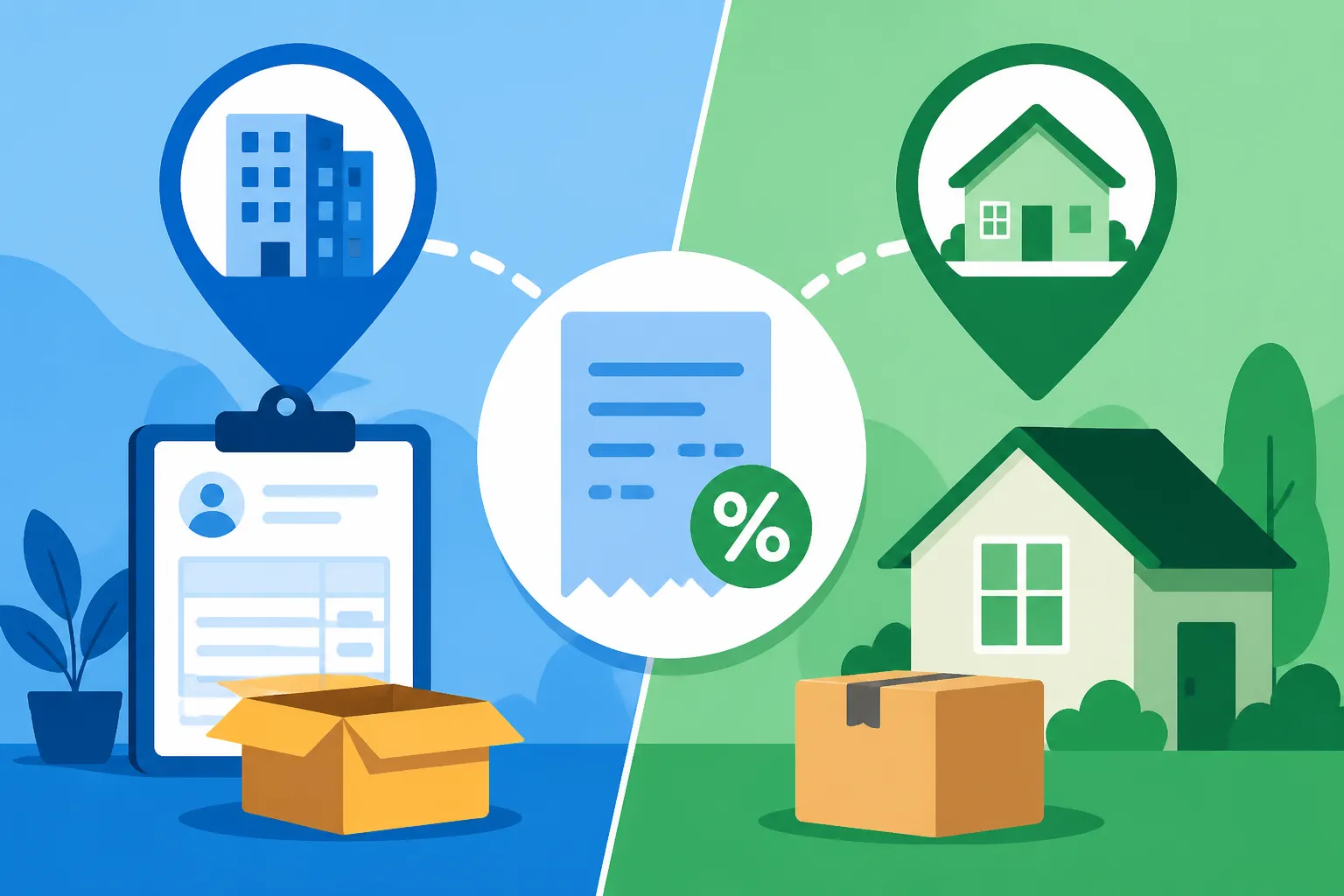
In almost every physical goods transaction, the shipping address is the legal "point of delivery." Tax authorities view the billing address as merely a financial detail—a way to verify that your credit card is legitimate. The billing address tells the bank who is paying, but the shipping address tells the government who is consuming.
Because sales tax is technically a "consumption tax," the location of the consumer at the moment they take possession of the item is the only thing that matters. If you live in a state with no sales tax, like Oregon, but you ship a gift to a friend in California, you will be charged the California Sales Tax Rate 2026 based on your friend's address. It doesn't matter that your credit card is linked to a tax-free zone; the item is entering a taxable zone.
The Consumption Tax Philosophy
The logic here is deeply rooted in the idea of fairness to local brick-and-mortar stores. If you could avoid sales tax simply by having a billing address in a tax-free state while living in a high-tax city, everyone would just use a P.O. Box in Delaware. Local shops in your neighborhood would go out of business because they couldn't compete with the "tax-free" online prices.
By forcing the tax to be based on the shipping address, the government levels the playing field. This is why you will see the Sales Tax by ZIP Code (and Why ZIP Isn't Enough) fluctuate so wildly. Even within the same city, one side of the street might have a special school district tax that the other side doesn't. The shipping address is the only way for a seller to pinpoint exactly which local buckets need to be filled.
The Conflict of Gift-Giving and Third-Party Delivery
One scenario that frequently trips up consumers is gift-giving. Imagine you are a resident of Florida, where the Florida Sales Tax Rate (6% + County Surtax) is relatively moderate. You decide to buy a high-end designer bag for your sister who lives in Chicago. When you enter her shipping address, you are shocked to see the Chicago Sales Tax Rate applied, which is among the highest in the country.
Even though you are the one paying, and your billing address is in Florida, the "taxable event" is occurring in Illinois. Your sister is the one who will be wearing the bag on the streets of Chicago. Therefore, the Illinois Department of Revenue demands their share. This also applies to "buy online, pick up in-store" (BOPIS) scenarios. In those cases, the "shipping address" is effectively the store's address, and you pay the tax rate of the physical location where you take possession of the goods.
When the Billing Address Actually Matters
While shipping addresses dominate physical commerce, the billing address is not entirely irrelevant. There are specific instances—mostly involving intangible items—where the billing address becomes the primary or secondary data point for tax calculation.
This usually happens when there is no physical "shipping" taking place. If a company doesn't have a delivery address to look at, they have to rely on the next best thing to determine your location. This is a common practice in the digital economy, but it is fraught with legal grey areas that vary significantly from state to state.
Digital Goods and SaaS Subscriptions
When you buy a digital movie, a subscription to a streaming service, or a piece of professional software, there is no box arriving at your door. In these cases, many states allow or require sellers to use the billing address as a proxy for the user's location. If you are wondering Is SaaS Taxable? Software-as-a-Service by State, you will find that states like New York or Texas have very specific rules about where that service is "used."
If you provide a shipping address for a digital purchase, the seller might use that. But if you only provide a credit card, the billing ZIP code becomes the anchor for the Digital Products Sales Tax by State calculation. Platforms like Avalara help digital sellers keep track of which states consider digital downloads taxable and which ones allow the use of a billing address when a shipping address is unavailable.
Services and Professional Fees
For services that aren't tied to a physical location—like remote consulting, legal advice, or online tutoring—the billing address is often the default. If a consultant in California provides a marketing plan to a client in New York, the question of Are Services Taxable in My State? becomes paramount. If the service is taxable, the New York client's billing address will typically determine the rate.
However, if the service is performed on-site, the location of the work performed usually overrides everything else. If a plumber comes to your house, they charge the tax rate of your home's address, regardless of where your credit card is registered. The billing address only takes the lead when the "place of use" is ambiguous or purely virtual.
The "Last Mile" Challenge: ZIP Codes vs. Geolocation
One of the biggest mistakes small businesses make is assuming that a ZIP code is enough to determine a sales tax rate. In reality, ZIP codes were created by the USPS for mail delivery efficiency, not for tax jurisdiction boundaries. A single ZIP code can overlap multiple cities, counties, and special taxing districts.
This is why your shipping address needs to be verified at the street level. If you live on the border of a city, your neighbor across the street might pay a lower rate because they are technically outside the city limits, even though you share the same ZIP code. This granularity is why the Sales Tax Calculator: How to Calculate Sales Tax tools found online are often just estimates until you enter your full house number and street name.
| Feature | Billing Address | Shipping Address |
|---|---|---|
| Primary Use | Payment Verification | Tax Jurisdiction Selection |
| Physical Goods | Rarely used for tax | Almost always used for tax |
| Digital Goods | Used as a proxy | Used if provided |
| Services | Used for remote work | Used for on-site work |
| Audit Risk | Low for sellers | High for sellers |
Home-Rule Cities and Special Districts
In states like Colorado or Alabama, local jurisdictions have "home-rule" authority. This means they can set their own tax laws and collect their own taxes independently of the state. If you are shipping to a Colorado Home-Rule Cities Sales Tax area, the shipping address is the only way to know if you need to file a separate return for that specific city.
Furthermore, special districts—like a transportation authority in California or a stadium district in Wisconsin—often add a fraction of a percent to the total. You can see this in action by looking at California District Taxes Explained. These micro-taxes are triggered solely by the precise latitude and longitude of the shipping destination. A billing address simply cannot provide that level of detail.
The Role of Geolocation Technology
Modern tax software has moved beyond ZIP codes and now uses "rooftop-level" geolocation. When a customer enters their shipping address on a Shopify or BigCommerce site, a call is made to a service like Avalara to get the exact tax rate for that specific GPS coordinate. This ensures that the seller doesn't under-collect (which leads to fines) or over-collect (which leads to angry customers and potential lawsuits).
Using the shipping address as the anchor allows for this precision. If a business tried to do this with a billing address, they would often find themselves in conflict with state laws that demand tax based on where the product is physically received. For high-ticket items, like when calculating How Much Is Sales Tax on a Car by State, the registration address (essentially the shipping/home address) is the only one the DMV cares about.
Impact of Economic Nexus on Tax Location
In the past, you might not have been charged sales tax at all if the online store didn't have a physical warehouse or office in your state. However, the 2018 Supreme Court decision in South Dakota v. Wayfair changed everything. Now, most states have "economic nexus" laws.
This means that once a seller reaches a certain amount of sales in your state (usually $100,000 or 200 transactions), they are legally required to collect sales tax from you. This has made the shipping address even more important, as sellers must now track their sales volume by destination state. You can find more about these triggers in our Economic Nexus by State 2026: Thresholds Guide.
Small Sellers and Marketplace Facilitators
If you are buying from a small artist on a platform like Etsy or a third-party seller on Amazon, you might wonder why you're being charged tax even if the seller is tiny. This is because of "Marketplace Facilitator" laws. Large platforms are now required to collect and remit tax on behalf of their sellers based on the buyer's shipping address.
This takes the pressure off the small business owner, but it reinforces the shipping address as the gold standard for tax. Whether the seller is a billion-dollar corporation or a hobbyist in their garage, the platform's software is looking at where you want the package sent to decide the total. If you are curious about your own state's requirements, check out Do I Need to Collect Sales Tax for Online Sales? to see how these rules might apply to your own side hustle.
The Problem of "Trailing Nexus"
Even if a company moves out of a state, they might still have to collect tax there for a period of time, known as trailing nexus. Throughout this period, they will continue to look at your shipping address to determine your rate. The complexity of these rules is why many businesses choose to outsource their tax department to automated systems.
For a consumer, this means that the "Is there tax?" question is no longer about where the company is located, but where you are located. As long as you are shipping to a state with a sales tax, you should expect to see that line item on your receipt. The only way to truly avoid it is to live in or ship to one of the States With No Sales Tax (NOMAD Explained), where the shipping address effectively acts as a "get out of tax free" card.
Drop Shipping and Three-Party Transactions
Drop shipping adds another layer of complexity to the billing vs. shipping debate. In a drop shipping scenario, you (the customer) buy from a "Seller," but the "Supplier" actually ships the item to you. Here, there are two transactions: one between you and the Seller, and one between the Seller and the Supplier.
In both cases, the shipping address remains the focal point. The Seller must determine if they have nexus in your state to charge you tax. Simultaneously, the Supplier must determine if they need to charge the Seller tax. If the Seller provides a valid resale certificate, they can avoid paying the Supplier, but you, the final consumer, will still pay tax based on your shipping location.
Resale Certificates and Exemptions
If you are a business owner buying products to resell, your "shipping address" might still be in a taxable zone, but you can avoid the tax by providing a resale certificate. This tells the seller, "Don't charge me tax based on this shipping address because I am going to charge the tax to my customer later."
This is common in B2B transactions. However, if you are a regular consumer, you don't have this luxury. Even if you are buying items for your business that aren't for resale—like office chairs or stationery—you must pay the tax based on where those items are delivered. Understanding How to Use a Resale Certificate (Form CDTFA-230) is vital for businesses, but for the average shopper, the shipping address is the final word on the matter.
International Shipping and Customs
When you ship items internationally, the "billing vs. shipping" debate shifts into the realm of duties and VAT (Value Added Tax). If you are in the U.S. and buy a gift for someone in the UK, your U.S. billing address doesn't matter; the UK shipping address triggers VAT and potential customs duties.
Within the U.S., interstate shipping is protected by certain federal guidelines, but once that shipping address is outside the country, the local rules of the destination country take over entirely. It is a universal rule of commerce: the tax follows the goods, not the money.
Summary Checklist for Buyers and Sellers
If you are still feeling a bit overwhelmed by the technicalities, here is a quick way to remember how your next purchase will be taxed:
- Physical Goods: Always look at the shipping address. The Average Sales Tax Rate by State will give you a ballpark, but your specific street address is the final decider.
- Digital Goods: Check the billing address first, but be prepared for the shipping address to take over if you provided one for account verification.
- Pick-up in Store: The store's physical address is your "shipping address" for tax purposes.
- Gifts: The recipient's address is the only one that matters to the Department of Revenue.
- Services: If it's remote, your billing address is usually the anchor. If it's in-person, the location of the service is the key.
By keeping these rules in mind, you can avoid "sticker shock" at checkout. The jump in price isn't a mistake or a hidden fee; it's simply the law catching up to your location. Whether you are shipping to a high-tax hub or a quiet rural county, the shipping address is the definitive map that the tax man uses to find his way to the transaction.
Disclaimer
This guide is intended for informational purposes only and does not constitute legal, tax, or professional accounting advice. Sales tax laws, including sourcing rules and nexus thresholds, are subject to frequent change by state and local authorities. Always consult with a qualified tax professional or use certified tax compliance software to ensure your business or personal transactions are in accordance with the most current regulations.