Is Clothing Taxable? Sales Tax on Apparel by State
Trying to figure out if you need to charge or pay sales tax on a simple t-shirt or a new pair of jeans can feel like navigating a legal labyrinth. It’s not always straightforward, especially when you consider how much sales tax varies across different states, cities, and even specific types of apparel. This guide is here to untangle the complexities of sales tax on clothing, breaking down the rules state by state, and offering clarity for both weary shoppers and diligent business owners alike.
The Age-Old Question: Is Clothing Really Taxable Everywhere?
It’s a fair question, and one that trips up a lot of people. You might walk into a store in one state, buy a jacket, and pay sales tax, only to cross the border into another state and find that a similar purchase is suddenly tax-free. This isn't just random luck; it’s a deliberate, if sometimes confusing, system. The primary reason for this patchwork of rules goes back to how states classify clothing and the legislative decisions made over the years regarding what constitutes an "essential" good or a common purchase that benefits from an exemption.
Why the Confusion Exists
The confusion surrounding sales tax on clothing stems from a few key factors. First, there's no single, national sales tax law in the United States; each state, and often local jurisdiction, sets its own rules. This means a shirt sold in Portland, Oregon, where there's no state sales tax, will be treated differently than the exact same shirt sold in Chicago, Illinois, which has a significant combined state and local rate. Secondly, even within states that tax clothing, there can be specific exemptions based on price, type of clothing, or even the occasion for which it's purchased. For example, some states might exempt clothing under a certain dollar amount, while others might exempt only specific items like diapers or certain safety gear. This variability makes it incredibly difficult for consumers and businesses, especially those operating across state lines or selling online, to keep track.
The Tangible Personal Property Rule
At its core, sales tax in most states is applied to the sale of "tangible personal property." Clothing, being a physical, movable item, generally falls squarely into this category. If a state has a sales tax, and it doesn't explicitly exempt clothing, then clothing is almost certainly taxable. This is the default position for the vast majority of states. However, the exceptions are what make it tricky. States might decide that certain types of tangible personal property, like food or medicine, are essential enough to be exempt, or at least taxed at a reduced rate. Clothing sometimes gets caught in this net, particularly when lobbying efforts or public sentiment push for exemptions, often highlighting the burden sales tax can place on lower-income families when buying necessities. For businesses, accurately determining if an item is tangible personal property and then applying the correct rate, or exemption, based on the customer's location is a foundational step in how to calculate sales tax (step by step).
States Where Most Clothing is Sales Tax Exempt
While most states do tax clothing, there are a handful that offer significant exemptions, making them a haven for shoppers looking to save a few extra dollars on their apparel purchases. These states have recognized that clothing is often a necessity and have chosen to ease the financial burden on their residents. Understanding these distinctions is crucial, whether you're planning a shopping trip or running an apparel business.
The "Big Five" (and friends) with Blanket Exemptions
When we talk about states with no sales tax on clothing, a few immediately spring to mind. These are the states that generally consider most clothing purchases to be entirely sales tax exempt, regardless of price or specific type (with very few exceptions for highly specialized items that might be considered accessories or sporting goods, but not general apparel).
The most prominent states with broad clothing exemptions include:
- Delaware: Delaware is one of the few states with no statewide sales tax at all, meaning almost everything, including clothing, is tax-free.
- Montana: Similar to Delaware, Montana does not levy a statewide sales tax.
- New Hampshire: Another state that boasts no general sales tax, making clothing purchases exempt.
- Oregon: Oregon is also among the states with no sales tax (NOMAD explained), which means no sales tax on clothing.
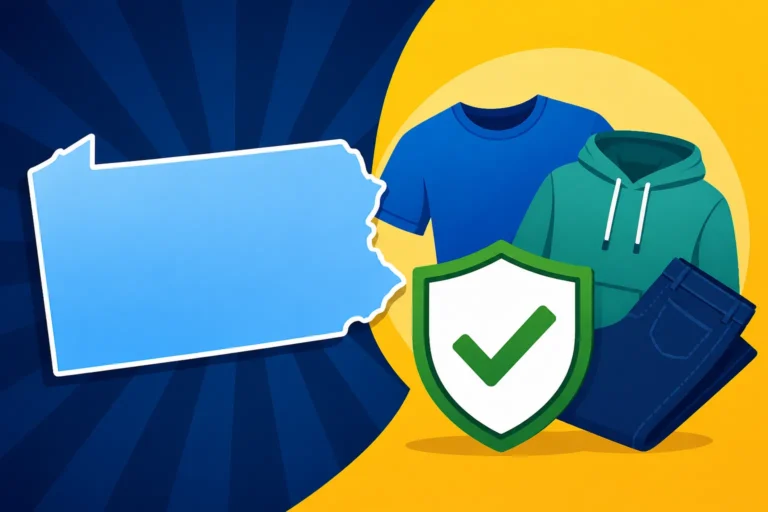
- Pennsylvania: This state stands out for explicitly exempting most clothing from its 6% state sales tax. There are very few exceptions here, typically for items that aren't considered "wearing apparel," like fur coats (if they cost more than $150) or certain sporting goods. So, your everyday shirts, pants, and shoes are generally tax-free.
Beyond these "Big Five," there are other states that have very specific, but broad, exemptions. For instance, Minnesota exempts most clothing, but the rule can be a bit more nuanced than Pennsylvania's, especially around certain accessories or athletic gear that might not fall under the general apparel definition. New Jersey also exempts most clothing and footwear from its sales tax, a significant benefit for its residents and shoppers. This means you can often buy a new wardrobe without seeing that extra percentage added to your bill.
Navigating Partial Exemptions and Price Thresholds
The waters get a little murkier in states that offer partial exemptions or apply price thresholds to clothing items. This is where it's no longer a simple "yes" or "no" to sales tax on apparel. Instead, the taxability depends on how much the item costs. These rules are designed to exempt more common, affordable clothing items while still taxing luxury goods.
A classic example of a price threshold state is New York. In New York, individual articles of clothing and footwear are exempt from the state's 4% sales tax if they are sold for less than $110. However, if a single item costs $110 or more, the entire price of that item becomes taxable. This can lead to some interesting shopping strategies, and certainly some confusion for retailers. For example, a $109 dress would be tax-free, but a $110 dress would be subject to the full sales tax. Furthermore, while the state sales tax might be exempt under $110, local sales taxes in jurisdictions like New York City (which has an additional 4.875% local rate) do apply to all clothing purchases, regardless of price, up to the first $110. This means you still pay some tax even on lower-priced items in NYC, but not the state portion. If you're wondering about the full breakdown, you can learn more about NYC sales tax rate (8.875%) explained.
Massachusetts is another state that utilizes a similar price threshold. Clothing items are exempt from sales tax up to $175. If an item costs more than $175, only the amount above $175 is subject to sales tax. So, a $200 jacket would only be taxed on $25 of its price ($200 – $175 exemption). This is different from New York's "all or nothing" approach and can be a pleasant surprise for shoppers in Massachusetts.
These thresholds require businesses to have robust point-of-sale systems that can accurately apply the correct tax (or exemption) based on the price of each item. It's not enough to simply know the state's general sales tax rate; you need to understand these specific item-level rules.
States Where Clothing is Generally Taxable (The Majority)
For most of the United States, if you buy an article of clothing, you're going to pay sales tax. This is the standard, and understanding this default position is key before diving into any potential exceptions. These states treat clothing like any other piece of tangible personal property, applying their general sales tax rate to the purchase price.
Standard Application of Sales Tax
In the majority of states, clothing, footwear, and accessories are subject to the standard state sales tax rate, along with any applicable local sales taxes. This means that when you buy a shirt in Houston, Texas, for example, you'll pay the combined state and local rate that applies in that city. There’s no special exemption for clothing itself; it’s treated just like buying a book, a piece of furniture, or a kitchen appliance. The sales tax is simply added to the price at the register, and that's that.
Consider a state like California, which has a base statewide sales tax rate of 7.25%. When you buy clothing in California, that 7.25% is applied. However, many cities and counties in California also have district taxes, meaning the total rate you pay could be significantly higher. For example, in Los Angeles, the combined rate is typically 9.50% or more. This means that a $100 pair of jeans could incur $9.50 in sales tax in Los Angeles. The same principle applies in states like Texas, Florida, Illinois, and many others, where clothing is just another taxable good. You can look up sales tax rates by state 2026: all 50 states to get a broader picture of these rates.
The key takeaway here is that if a state doesn't have an explicit, well-known exemption for clothing (like Pennsylvania or New Jersey), assume it's taxable. Businesses operating in these states need to ensure their POS systems are correctly configured to charge the applicable state and local rates to all clothing items.
Specific Exemptions Within Taxable States (e.g., uniforms, safety gear)
Even in states where clothing is generally taxable, there can be very specific, often narrowly defined, exemptions. These aren't blanket exemptions for all clothing, but rather for particular types of apparel that serve a special purpose. These exceptions are often driven by policy goals, such as making essential items more affordable or supporting certain industries.
Common examples of such specific exemptions include:
- Work Uniforms: In some states, if an employer purchases uniforms for employees, or if an employee is required to purchase a specific uniform for work, those purchases might be exempt from sales tax. The reasoning is often that these are business expenses rather than personal consumer goods. However, the rules can be strict: the uniform usually needs to be distinctively marked or of a type not suitable for general wear to qualify.
- Safety Apparel: Items like hard hats, safety glasses, steel-toed boots, and other protective clothing required by law or necessary for hazardous occupations might be exempt in some states. This is often viewed as an essential safety measure rather than a discretionary purchase.
- Diapers: A growing number of states are exempting diapers from sales tax, recognizing them as essential baby supplies. While not "clothing" in the traditional sense, they are worn and are a significant expense for families, so they sometimes get grouped into similar exemption discussions.
- Medical or Therapeutic Devices: Clothing or footwear specifically designed and prescribed for medical purposes (e.g., orthopedic shoes, compression stockings) may also be exempt in certain states, especially if they are considered durable medical equipment.
It's crucial for businesses to understand these highly specific exemptions. If you sell specialized uniforms or safety gear, you'll need to know if your customers qualify for an exemption and how to properly document it, typically through an exemption certificate. For most consumers, however, these narrow exemptions won't apply to their everyday clothing purchases.
Understanding Specific Item Classifications
The world of apparel isn't just shirts and pants. It extends to footwear, accessories, and highly specialized gear, each of which can have its own sales tax nuances. The way a state defines "clothing" can significantly impact whether certain items are taxed or exempt, leading to frustrating gray areas for both sellers and buyers.
Footwear and Accessories: Are They Different?
One of the biggest areas of confusion involves footwear and accessories. Are shoes always considered clothing? What about a belt, a handbag, or a piece of jewelry? The answer, unfortunately, is "it depends entirely on the state."
In states with broad clothing exemptions, like Pennsylvania or New Jersey, footwear is almost always included in the exemption. A pair of sneakers, dress shoes, or boots are considered "wearing apparel" and are therefore tax-free. However, even in these states, accessories might be treated differently. For example, jewelry, watches, handbags, and even some hats or scarves might be considered separate from general "clothing" and therefore taxable. The logic here is often that these items are more discretionary or luxury-oriented compared to basic garments needed for daily wear.
In states that generally tax clothing, footwear and accessories are almost universally taxable as well. If a t-shirt is taxed, it's highly probable that your new pair of running shoes, your belt, and your new earrings will also be subject to sales tax. There typically isn't a separate exemption carved out for shoes in states that already tax general apparel.
The key is to consult specific state guidelines. Some states provide detailed lists or definitions of what constitutes "clothing," "footwear," and "accessories," and how each category is treated. For example, a state might define "footwear" as anything worn on the foot, but then specify that ski boots or roller skates are not considered exempt footwear because they are primarily sports equipment, not general wearing apparel. Businesses need to meticulously categorize their inventory to ensure correct tax application.
Specialty Apparel: Costumes, Sports Gear, and More
Beyond everyday clothing, there's a whole world of specialty apparel that can raise sales tax questions. Think about Halloween costumes, athletic uniforms, protective gear for sports, or even theatrical costumes. How are these items treated?
Generally, if an item is primarily designed for a specific sport or activity, and not for everyday wear, many states will classify it differently than general clothing. For instance, a football helmet, shin guards, or a wetsuit might be considered sporting goods rather than "clothing" and would therefore be taxable even in states with clothing exemptions. The same can apply to elaborate costumes that are not suitable for regular public attire. The rationale is that these items serve a specialized, often recreational, purpose rather than the basic function of clothing.
However, the lines can get blurry. Is a pair of yoga pants "sports gear" or "clothing"? Most states would likely consider them clothing, as they are commonly worn for everyday activities beyond just exercise. What about a team jersey? If it's a replica jersey, it's usually treated as clothing. If it's a performance jersey worn in competition, it might be classified differently.
The rule of thumb for specialty apparel is to consider its primary function and how a reasonable person would use it. If it's clearly for a specific activity or sport, it's more likely to be taxed, even in states with general clothing exemptions. Businesses selling these items need to be particularly careful with their product classifications and understand the specific definitions provided by each state's tax department. Misclassifying an item could lead to under-collecting sales tax and facing penalties down the line.
The Impact of Online Shopping on Clothing Sales Tax
In today's digital age, a huge percentage of clothing purchases happen online. This shift has fundamentally changed how sales tax is collected on apparel, introducing new complexities for consumers and demanding heightened vigilance from online retailers. The rules around economic nexus and marketplace facilitators have become especially relevant for anyone buying or selling clothes virtually.
Economic Nexus and Your Online Purchases
Before the landmark 2018 Supreme Court decision in South Dakota v. Wayfair, sales tax on online purchases was largely determined by physical presence (nexus). If an online retailer didn't have a physical presence (like a store, warehouse, or employee) in your state, they generally weren't required to collect sales tax from you. This meant many online clothing purchases went untaxed.
However, Wayfair changed everything. It established the concept of "economic nexus," meaning states can now require out-of-state retailers to collect sales tax if their sales activity in that state exceeds certain thresholds, regardless of physical presence. These thresholds are typically based on sales revenue (e.g., $100,000 in sales) or transaction volume (e.g., 200 separate transactions) into the state annually. Almost every state that levies sales tax has now adopted economic nexus laws. You can explore the economic nexus by state 2026: thresholds guide for detailed information.
What does this mean for your online clothing purchases? It means that virtually every major online apparel retailer, and even many smaller ones, now has an obligation to collect sales tax in most states where they ship clothing. So, if you're buying a new pair of shoes from an online boutique in California, and you live in Texas, that California business will likely be required to collect Texas sales tax from you if they meet Texas's economic nexus threshold. This has effectively closed the "tax-free online shopping" loophole for most mainstream purchases.
Marketplace Facilitators and Their Role
Further complicating (or simplifying, depending on your perspective) online sales tax for clothing are "marketplace facilitator" laws. Many states have enacted these laws, which shift the sales tax collection responsibility from the individual third-party seller to the marketplace platform itself.
Think about platforms like Amazon, Etsy, or eBay. If you're buying clothing from a small business operating on one of these marketplaces, it's no longer the small business's sole responsibility to calculate and collect the sales tax. Instead, the marketplace facilitator (Amazon, Etsy, etc.) is responsible for collecting and remitting the sales tax on behalf of all their third-party sellers that use their platform. This applies even if the individual third-party seller doesn't meet the state's economic nexus threshold on their own.
For consumers, this means you'll almost always see sales tax added to your clothing purchases from these major platforms, regardless of where the individual seller is located. For small businesses selling clothing on these marketplaces, it significantly simplifies compliance, as the platform handles the complex calculations and remittances. However, if that same small business also sells clothing on their own independent website, they would still need to manage their own sales tax obligations for those direct sales, including tracking their economic nexus in various states. This distinction is critical for understanding sales tax for online sellers: complete guide.
Sales Tax Holidays: A Welcome (Temporary) Reprieve
While year-round exemptions are rare, many states offer sales tax holidays, providing a temporary reprieve from sales tax on certain items, with clothing often being a primary focus. These tax-free periods are hugely popular, especially for families gearing up for the school year.
Back-to-School and Other Clothing-Focused Holidays
The most common type of sales tax holiday that includes clothing is the "Back-to-School" tax-free weekend. These usually occur in late July or early August, just before schools resume. During these periods, states temporarily exempt sales tax on school supplies, certain computers, and, most importantly for this discussion, clothing and footwear.
States like Texas, Florida, Tennessee, Alabama, and many others regularly host these events. For example, the Texas Tax-Free Weekend 2026 (Aug 7-9) is a major shopping event where qualifying clothing, footwear, and school supplies under a certain price limit are exempt from sales tax. Similarly, the Florida Back-to-School Tax Holiday (all August) often extends for longer periods and covers a wide array of items.
These holidays are a big deal for families, allowing them to save a significant amount on necessary items for their children. They also represent a huge sales opportunity for retailers, who often see a surge in traffic and revenue during these periods. Beyond back-to-school, some states might also offer other, less common, clothing-related sales tax holidays, such as "severe weather preparedness" holidays that include certain outerwear or boots, or even "hunting and fishing" holidays that might exempt specific apparel related to those activities. You can find a full calendar of these events in the sales tax holidays by state 2026: full calendar.
Price Limits and Qualifying Items During Exemptions
It's vital to remember that sales tax holidays, while beneficial, almost always come with specific rules and limitations. The most common restriction is a price limit per item. For instance, during a back-to-school holiday, clothing items might only be exempt if they cost $100 or less per item. If you buy a single jacket for $120, it would typically be fully taxable, even though a $99 jacket next to it would be tax-free. This isn't usually an "exemption on the first $100," but rather an "all or nothing" rule for individual items.
Here's a table illustrating some common state sales tax holiday rules for clothing:
| State | Typical Holiday Name | Clothing Exemption Limit (Per Item) | Other Common Exempt Items | Notes |
|---|---|---|---|---|
| Texas | Back-to-School | $100 | School Supplies, Backpacks | Typically early August, specific dates vary annually. |
| Florida | Back-to-School | $100 (often higher for shoes) | School Supplies, PCs | Can last for an extended period, specific dates vary. |
| Tennessee | Sales Tax Holiday | $100 | School Supplies, PCs | Usually late July. |
| Maryland | Shop Maryland Tax-Free Week | $100 | None specifically (general apparel) | Typically a full week in August. |
| Missouri | Back-to-School | $100 | School Supplies | Some local jurisdictions may opt out. |
| Oklahoma | Sales Tax Holiday | $100 | None specifically (general apparel) | Generally in August. |
Beyond price limits, there are often strict definitions of what "qualifies" as clothing. For example, accessories like jewelry, handbags, watches, and even often briefcases or luggage, are typically not exempt during these holidays, even if they are under the price limit. Certain sports equipment (e.g., cleats, shin guards) might also be excluded, while general athletic wear (e.g., shorts, t-shirts) might qualify.
For both consumers and businesses, checking the specific rules for each state's sales tax holiday every year is essential. State tax departments usually publish detailed guidance well in advance of the holiday. For businesses, this means ensuring your POS system is updated to automatically apply the exemptions to qualifying items during the specified dates and times. It's a logistical challenge, but one that can significantly benefit your customers and boost your sales. If you want to dive deeper into the specifics, check out the Tax-Free Weekend Back-to-School Guide 2026.
Tips for Businesses: Staying Compliant with Clothing Sales Tax
For businesses, especially those selling apparel, sales tax compliance is far from a set-it-and-forget-it task. The varied rules across states, the nuances of item classification, and the shifting landscape of online sales require constant attention. Getting it wrong can lead to audits, penalties, and a whole lot of stress.
Determining Nexus and Registration
The very first step for any business selling clothing, whether online or brick-and-mortar, is to accurately determine where you have "nexus." As we discussed, nexus means a connection to a state that triggers a sales tax collection obligation. This isn't just about physical stores anymore; it includes inventory in a warehouse (like Amazon FBA), employees, and now, significant sales volume (economic nexus).
Once you've identified all the states where you have nexus, the next crucial step is to register for a sales tax permit (sometimes called a seller's permit or certificate of authority) in each of those states before you start collecting tax. Collecting sales tax without a valid permit is a big no-no and can lead to serious trouble. Each state has its own registration process, and while many can be done online, it requires careful attention to detail regarding your business structure, anticipated sales, and filing frequency. You can find detailed guides on how to get a sales tax permit by state to help you navigate this process.
Consider a small online clothing boutique, "Trendy Threads." Initially, they only sold to customers in their home state of North Carolina. However, after a successful holiday season, their sales to customers in Florida and Texas surpassed the economic nexus thresholds in those states. Trendy Threads now has an obligation to register for sales tax permits in Florida and Texas, even though they don't have a physical store there. Neglecting this step could result in the business being liable for uncollected sales tax out of their own pocket, plus penalties and interest.
Automating Sales Tax Collection for Apparel Sellers
Given the immense complexity of sales tax rules—different rates, varying exemptions for clothing based on price or type, and the constant changes in rates and nexus laws—manual sales tax management for apparel sellers is virtually impossible and highly prone to error. This is where automation becomes not just a convenience, but a necessity.
Sales tax compliance software is designed to integrate with your e-commerce platform (like Shopify, BigCommerce) or point-of-sale (POS) system and automatically:
- Determine Nexus: Some advanced solutions can help monitor your sales activity to alert you when you're approaching or have met economic nexus thresholds in new states.
- Calculate Rates: Apply the correct state, county, city, and district sales tax rates based on the customer's shipping address (or origin, depending on the state's sourcing rules). These systems keep up-to-date with the combined state + local sales tax rates explained to ensure accuracy.
- Manage Exemptions: Accurately apply clothing exemptions (like Pennsylvania's blanket exemption or New York's $110 threshold) and tax holiday rules during the specified periods. This is where a solution like Avalara truly shines, as it has vast databases of tax rules for virtually every product and jurisdiction.
- File Returns: Prepare and often file your sales tax returns automatically, ensuring you meet all deadlines and remit the correct amounts.
For a business like "Trendy Threads," implementing sales tax software eliminates the guesswork. When a customer in Massachusetts buys a $150 dress, the system automatically knows to only tax the $25 above the $125 threshold. When a customer in Pennsylvania buys a $50 shirt, it knows to apply a zero tax rate. And during a Texas tax holiday, it applies the temporary exemption. Without such a system, managing these varied rules across potentially dozens of states would consume an inordinate amount of time and resources, detracting from the core business of selling great clothes. Tools like Avalara are leaders in this space, providing comprehensive solutions for businesses of all sizes, making it easier to stay compliant even with the trickiest clothing tax rules. You can also explore options among the best sales tax compliance software 2027 to find the right fit for your business.
Navigating the Nuances: Real-World Scenarios
Sales tax can throw curveballs you might not expect, especially when dealing with transactions that cross state lines or when customers return items. Understanding these real-world scenarios is crucial for maintaining compliance and customer satisfaction.
When Your Customer is from Another State
Imagine you own a popular boutique in Portland, Oregon, where there's no state sales tax. A customer walks in, falls in love with a beautiful jacket, and tells you they want it shipped to their home in Seattle, Washington. Now what? Does the lack of sales tax in Oregon mean they won't pay tax, or does the high Seattle sales tax rate 2026 (10.55%) apply?
Generally, sales tax is based on the destination of the sale, meaning where the customer receives the goods. So, in this scenario, if your Oregon boutique has nexus in Washington (either physical presence or economic nexus), you would be obligated to collect Washington state and local sales tax (including Seattle's high rate) from that customer. It doesn't matter that the purchase originated in a tax-free state; what matters is where the clothing is consumed. This destination-based sourcing rule is common for interstate sales.
Conversely, if a customer from a state with clothing exemptions (like Pennsylvania) comes to your store in a state that taxes clothing (like California), they would pay California sales tax on their purchase while in your store. The exemption only applies to purchases made in their home state, not when they are shopping out of state where the rules are different. This illustrates why understanding origin vs destination sales tax sourcing is so important for retailers. For businesses, this means your sales tax calculation needs to dynamically adjust based on the shipping address, not just the location of your store or the customer's billing address.
Handling Returns and Exchanges with Sales Tax
What happens when a customer returns a clothing item or wants to exchange it? Sales tax treatment for returns and exchanges can be surprisingly complex, but generally, the goal is to reverse the original transaction.
- Returns: When a customer returns an item for a full refund, you should also refund the sales tax that was originally collected on that item. If the sales tax was already remitted to the state, most states allow you to take a credit on your next sales tax return for the refunded amount. This ensures neither you nor the customer is out of pocket for tax on a sale that didn't ultimately happen.
- Exchanges for the Same Price: If a customer exchanges an item for another item of the exact same price (e.g., a different size or color of the same shirt), and no additional money changes hands, then no new sales tax is typically collected. The original sales tax effectively transfers to the new item.
- Exchanges for a Higher Price: If a customer exchanges an item for a more expensive one, sales tax would be collected only on the difference in price. For example, if they return a $50 shirt (on which $3 in tax was paid) for a $70 shirt, you would refund the $3 tax, and then charge tax on the full $70 for the new shirt, or just on the $20 difference, depending on your state's specific rules for exchanges. It's often simpler to process it as a return and a new sale, refunding the old and charging anew.
- Exchanges for a Lower Price: If a customer exchanges an item for a less expensive one, you would refund the difference in price, as well as the proportionate sales tax difference.
The crucial aspect for businesses is to have clear policies and procedures for handling sales tax on returns and exchanges and to ensure your POS system can accurately process these adjustments. Proper documentation of returns and tax refunds is also essential for audit purposes. Remember, sales tax is ultimately the state's money that you're holding in trust, so accurate accounting for all sales, returns, and exchanges is paramount.
Disclaimer
The information provided in this article is for general informational purposes only and does not constitute tax or legal advice. Sales tax laws are complex and constantly changing. Businesses and individuals should consult with a qualified tax professional or legal advisor for advice specific to their situation. Always refer to official state government websites for the most current and accurate sales tax information.