Does Etsy Collect Sales Tax for Sellers?
As a small business owner, especially one leveraging platforms like Etsy, the world of sales tax can feel like a labyrinth designed to confuse and frustrate. You’re pouring your heart and soul into creating amazing products, and the last thing you want is to spend countless hours deciphering complex tax codes. A huge point of confusion for many is whether Etsy, as a marketplace, takes care of sales tax for them. This comprehensive guide will demystify Etsy's role in sales tax collection and clarify your remaining obligations as a seller.
The Evolving Landscape of Sales Tax for Online Sellers
For years, sales tax was relatively straightforward for small businesses, especially those without physical storefronts in multiple states. But the digital age, coupled with landmark legal decisions, completely reshaped this landscape, leaving many online entrepreneurs scratching their heads.
Before Marketplace Facilitator Laws: The Seller's Burden
Before 2018, sales tax was primarily governed by what's known as "physical nexus." This meant that a business only had to collect sales tax in states where it had a physical presence – think a brick-and-mortar store, an office, employees, or even inventory stored in a warehouse. For many Etsy sellers operating out of their homes, this often meant only collecting sales tax in their home state.
Imagine Sarah, an Etsy seller in Ohio who ships her handmade jewelry to customers across the country. In the "old days," Sarah likely only worried about Ohio sales tax. If a customer in California bought a necklace, Sarah wouldn't collect California sales tax because she didn't have a physical presence there. The burden would theoretically fall on the buyer to pay "use tax" to California, a rarely enforced and largely unknown obligation for consumers. This system, while simpler for many small online sellers, meant states were missing out on significant tax revenue, particularly as e-commerce exploded. The patchwork of rules was already a headache, but it was nothing compared to what was coming next.
The South Dakota v. Wayfair Decision and Economic Nexus
Everything changed with the Supreme Court's 2018 ruling in South Dakota v. Wayfair, Inc. This pivotal decision overturned decades of precedent and allowed states to require out-of-state sellers to collect sales tax even if they didn't have a physical presence. The new concept introduced was "economic nexus," meaning that if your sales or transaction volume into a state exceeded a certain threshold (typically $100,000 in sales or 200 separate transactions annually, though thresholds vary by state and some states have since dropped the transaction count), you could be required to collect and remit sales tax there.
For many small Etsy sellers, this ruling created instant panic. Suddenly, the possibility of being responsible for sales tax in dozens of states where they had no physical tie became very real. Keeping track of sales into every single state, understanding varying thresholds, registering for permits, and then collecting and remitting the correct local sales tax rates was an overwhelming prospect. It was a clear signal that the world of online sales tax was about to get a whole lot more complex for individual businesses. If you want to dive deeper into this, check out our guide on South Dakota v. Wayfair: What It Means for Sellers.
Etsy as a Marketplace Facilitator: A Game Changer
Thankfully for many, the Wayfair decision paved the way for another legislative response that shifted the burden away from individual sellers for most marketplace sales: marketplace facilitator laws.
What is a Marketplace Facilitator?
A "marketplace facilitator" is essentially a third-party company, like Etsy, Amazon, eBay, or Shopify, that facilitates sales between a seller and a buyer. They handle the listing, process the payment, and often coordinate other aspects of the transaction. Recognizing the immense burden that economic nexus placed on small businesses, and the difficulty states faced in tracking millions of individual online sellers, states began to enact marketplace facilitator laws. These laws generally require the marketplace itself to collect and remit sales tax on behalf of its third-party sellers for transactions made through the platform.
The core reason states implemented these laws was to simplify sales tax collection and ensure compliance across the vast landscape of online commerce. Instead of chasing tens of thousands of individual Etsy sellers who might meet economic nexus thresholds in their state, tax authorities can now deal with a single entity – Etsy – for all sales facilitated through its platform. This greatly streamlined the process for both the states and, critically, for the vast majority of Etsy sellers. It meant that for many, the immediate threat of multi-state sales tax compliance was alleviated for their Etsy sales.
How Etsy Collects and Remits Sales Tax
For sales made through the Etsy platform, Etsy generally acts as a marketplace facilitator in states that have enacted such laws. This means:
- Etsy determines the sales tax rate: When a buyer makes a purchase, Etsy's system automatically calculates the applicable sales tax based on the buyer's shipping address. This calculation includes state, county, city, and any special district taxes.
- Etsy collects the tax from the buyer: The sales tax is added to the buyer's total at checkout, just like any other part of the purchase price.
- Etsy remits the tax to the state: Etsy then takes on the responsibility of periodically reporting and remitting these collected sales tax funds directly to the appropriate state tax authorities.
What does this mean for you, the Etsy seller? For transactions facilitated by Etsy in states where marketplace facilitator laws are in effect (which is almost every state with a sales tax), you typically do not need to do anything. You don't need to register for a sales tax permit in those states, you don't need to collect the tax, and you don't need to remit it. Etsy handles it all. This is a massive relief for countless small business owners, freeing them up to focus on their craft. You can learn more about these specific laws in our guide on Marketplace Facilitator Laws by State.
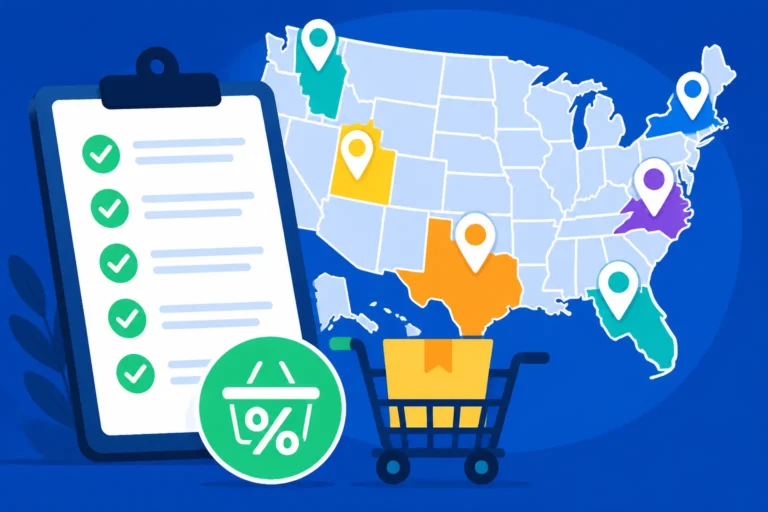
Here's a simplified look at when some key states implemented marketplace facilitator laws, meaning Etsy started collecting sales tax for transactions in those states around these times:
| State | Marketplace Facilitator Law Effective Date (Approx.) |
|---|---|
| Alabama | January 1, 2019 |
| California | October 1, 2019 |
| Florida | July 1, 2021 |
| Illinois | January 1, 2020 |
| New York | June 1, 2019 |
| Texas | October 1, 2019 |
| Washington | January 1, 2020 |
This table provides general dates and is not exhaustive. Etsy's specific implementation might have varied slightly.
Understanding Your Remaining Sales Tax Responsibilities (Beyond Etsy)
While Etsy takes a significant load off your shoulders, it's crucial to understand that their collection efforts are generally limited to sales made through their platform. This doesn't necessarily absolve you of all sales tax responsibility, especially if you sell through other channels.
When You Still Need Your Own Sales Tax Permit
The most common scenario where an Etsy seller still needs to register for a sales tax permit and manage their own sales tax collection and remittance is when they sell items outside of the Etsy marketplace. This could include:
- Your Own E-commerce Website: If you have your own Shopify store, Squarespace site, or any independent website where you process payments directly, Etsy's marketplace facilitator rules do not apply to those sales. You are responsible for determining your nexus obligations, collecting, and remitting sales tax for these sales.
- In-Person Sales: Selling at craft fairs, pop-up shops, farmers' markets, or any other physical event means you are making direct sales. In these instances, you are typically required to collect sales tax from customers, usually at the rate of the location where the sale occurs, assuming you have nexus there.
- Wholesale or Direct B2B Sales: If you sell your products directly to other businesses (e.g., a boutique wants to stock your items), and these sales are not processed through Etsy, you'll need to handle the sales tax. This might involve collecting tax or accepting valid resale certificates from your business customers.
In these situations, you would need to assess your sales volume and physical presence to determine if you meet economic nexus thresholds or have a physical nexus in any given state. For example, if you sell $150,000 worth of goods annually through your personal website to customers in California, you would meet California's economic nexus threshold (currently $500,000) and would need to register for a seller's permit there and collect sales tax on those direct sales. Many states have lower thresholds, like some that still use a 200-transaction count alongside a monetary amount, though these are becoming less common. Our guide on Economic Nexus by State 2026: Thresholds Guide provides a detailed breakdown.
Dealing with States Where Etsy Doesn't Facilitate (Rare, But Possible)
It's important to note that the vast majority of states with a sales tax now have robust marketplace facilitator laws, meaning Etsy collects for you in almost every relevant jurisdiction. However, the world of sales tax is always evolving. New rules or interpretations can emerge, or a particular type of product might fall into an edge case. While highly unlikely for standard retail sales, it's wise to always stay informed about any changes. For example, if a state were to repeal its marketplace facilitator law (again, very unlikely) or if you sold a unique item that Etsy's system somehow didn't classify correctly for tax purposes, you might have a residual obligation.
It's also crucial to remember that economic nexus thresholds are often based on gross sales, not just taxable sales. This means even if many of your products are exempt from sales tax in a particular state, those sales still count towards meeting the threshold. Once you cross that threshold, you might be required to register and file, even if you only end up remitting zero tax because all your sales were exempt. This highlights why tracking all your sales, regardless of taxability, is important. For a deeper understanding of nexus, refer to our article on Sales Tax Nexus Explained (Physical vs Economic).
What to Do If You Have Sales Tax Nexus Outside of Etsy
If you determine that you have sales tax nexus in a state due to your non-Etsy sales activities, taking the correct steps is paramount to staying compliant and avoiding potential penalties.
Registering for a Sales Tax Permit
The very first step is to register for a sales tax permit (sometimes called a seller's permit, certificate of authority, or vendor's license) in each state where you have established nexus and are making direct sales. This is not optional. You must register before you begin collecting sales tax. Collecting sales tax without a valid permit can lead to serious issues, as you are essentially collecting money on behalf of the state without authorization.
The process for registration varies by state. Some states have relatively straightforward online applications that can be completed in an hour, while others might require more detailed business information or even take a few weeks to process. You'll typically need your business legal name, address, EIN (Employer Identification Number) or Social Security Number, and details about the type of products or services you sell. It can be a daunting process if you suddenly realize you need to register in several states. Our guide on How to Get a Sales Tax Permit by State can walk you through the specifics for each state. If you find yourself needing to register in multiple states, our post on Registering for Sales Tax in Multiple States offers valuable insights.
Collecting and Remitting Sales Tax for Non-Etsy Sales
Once you have your sales tax permit(s), your next responsibility is to accurately calculate, collect, and remit sales tax for all sales that are not facilitated by Etsy. This involves several ongoing tasks:
- Accurate Rate Determination: Sales tax rates are not uniform across a state. They can vary significantly by county, city, and even specific taxing districts within a city. This is why a customer in Houston, Texas, might pay a different combined rate than a customer in Dallas, Texas, even though both cities are in the same state. Determining the correct rate for every single transaction, based on the buyer's exact address, is one of the biggest challenges for online sellers. Our resource on Sales Tax by ZIP Code (and Why ZIP Isn't Enough) delves into this complexity.
- Collection at Point of Sale: For your own website sales, your e-commerce platform needs to be configured to charge the correct sales tax. For in-person sales, you'll need to manually add the tax to the customer's total.
- Reporting and Filing: You'll need to keep meticulous records of all sales, collected taxes, and any exemptions. Then, on a regular schedule (monthly, quarterly, or annually, as assigned by each state), you must file a sales tax return with each state where you've collected tax and remit the funds you've collected. This is often where many small businesses struggle due to the volume of data and varied state forms. For a step-by-step approach, see our article on How to File a Sales Tax Return: Step by Step.
This is where sales tax automation software becomes invaluable. Solutions like Avalara or TaxJar can integrate with your e-commerce store (like Shopify) and automatically calculate the correct sales tax at checkout, track your nexus, and even help you prepare and file your returns. Trying to manage this manually, especially if you have nexus in multiple states, is a recipe for errors and missed deadlines. For a comparison of options, check out our guide on the Best Sales Tax Compliance Software 2027.
Important Considerations for Etsy Sellers
Even with Etsy handling much of the sales tax burden, there are still a few critical details you, as a seller, need to keep an eye on to ensure full compliance.
Product Taxability and Exemptions
While Etsy collects sales tax on most tangible personal property, the taxability of certain products can vary significantly from state to state. This is especially true if you sell items that fall into categories like:
- Digital Products: E-books, downloadable patterns, digital art prints – these are taxed differently in various states. Some states consider them taxable, others exempt, and some have specific rules based on how they're delivered or accessed.
- Services: If you offer custom design services, consultation, or repair services alongside your physical products, the taxability of those services can be complex and is often determined at the state level.
- Clothing: While most clothing is taxable, some states offer exemptions for certain types of clothing or price points. For instance, New York has an exemption for clothing and footwear under $110. Pennsylvania and New Jersey exempt most clothing altogether. Our guide on Is Clothing Taxable? Sales Tax on Apparel by State offers specific state details.
If you are selling these types of items through your own channels, you need to be aware of how each state treats them. Even within Etsy, their system generally accounts for these variations, but understanding the nuances can help you ensure your listings are correctly categorized and that you're prepared for your own direct sales obligations. Additionally, if you purchase raw materials or supplies wholesale to create your Etsy products, you can often use a Resale Certificate by State: Complete Guide to avoid paying sales tax on those purchases, as they are intended for resale.
Staying Compliant and Avoiding Penalties
The sales tax landscape is always shifting, with new rules, updated rates, and changing economic nexus thresholds. For instance, you might see 2026 Sales Tax Rate Changes by State which could impact your direct sales. As an Etsy seller, even if Etsy handles most of your sales tax, staying informed about these changes is crucial for any sales you make outside the platform.
Here are some best practices to ensure you remain compliant:
- Understand Your Nexus: Regularly review your sales channels and volumes to ensure you know where you have nexus (both physical and economic). This often means keeping good records of where your products are shipped and your total sales volume into each state. Our guide on How to Know If You Have Sales Tax Nexus can help.
- Keep Meticulous Records: Whether it's sales data, exemption certificates received from wholesale buyers, or proof of sales tax remitted, organized records are your best friend in case of an audit.
- Know Your Filing Deadlines: If you do have sales tax obligations outside of Etsy, make sure you know your assigned filing frequency (monthly, quarterly, annually) and the specific due dates for each state. Missing deadlines can result in penalties and interest.
- Consider Automation: As mentioned, tools like Avalara can automate much of the heavy lifting for sales tax, from rate calculation to filing. This investment can save you significant time, stress, and potential audit risks down the road, especially as your business grows. Don't let sales tax become a bottleneck for your creative endeavors.
By understanding Etsy's role as a marketplace facilitator and diligently managing your direct sales obligations, you can confidently navigate the sales tax world, keeping your business compliant and thriving.
Disclaimer
Please note that this content is intended for informational purposes only and does not constitute professional tax advice. Sales tax laws are complex and constantly changing. Always consult with a qualified tax professional for advice tailored to your specific business situation.