NYC Sales Tax Rate (8.875%) Explained
If you have ever stood at a checkout counter in Manhattan or scrolled through your final cart on a delivery app while in Brooklyn, you have likely felt that sudden pinch of sticker shock. The NYC sales tax rate of 8.875% is one of the highest in the nation, and understanding how it breaks down—and more importantly, how to avoid it legally—is a massive headache for residents and business owners alike. This guide dives into the nitty-gritty of why that rate exists and how it actually impacts your wallet.
The Anatomy of the 8.875 Percent Sales Tax
When you see that 8.875% added to your receipt, you aren't just paying one single tax to one single office. New York City’s tax is a "combined" rate, meaning it is a stack of different taxes levied by different levels of government. If you are trying to understand How Combined Sales Tax Rates Work, NYC is the perfect, albeit expensive, case study. It is a cocktail of state requirements, local needs, and regional infrastructure funding.
The New York State Base Rate 4 Percent
At the very bottom of the pile is the New York State base sales tax. This is a flat 4% that applies across the entire state, from the tip of Long Island all the way up to the Canadian border. This 4% is the foundation. Every purchase made in the state starts here, unless the item is specifically exempted by state law. For a deeper dive into the broader state landscape, you can check out our guide on the New York Sales Tax Rate 2026.
The New York City Local Rate 4.5 Percent
This is where things get specific to the Five Boroughs. Unlike many other jurisdictions where the local city tax might be 1% or 2%, New York City tacks on a significant 4.5%. This money stays within the city to fund everything from the NYPD and FDNY to public parks and local infrastructure. Because the city has such a high cost of operations, this local add-on is higher than what you might find in many upstate counties.
The MCTD Surcharge 0.375 Percent
The final sliver that gets you to that 8.875% is the Metropolitan Commuter Transportation District (MCTD) surcharge. This 0.375% is a very specific regional tax applied to the NYC metropolitan area, including the five boroughs and surrounding counties like Westchester, Rockland, and Nassau. This tiny percentage is dedicated to funding the MTA. So, every time you buy a coffee or a laptop in the city, you are technically contributing a fraction of a cent to keep the subways and buses running.
The NYC Clothing and Footwear Exemption
One of the biggest points of confusion for both shoppers and retailers is the "Under $110" rule. This is a unique feature of the New York tax code that can save you a lot of money if you know how it works. Essentially, New York City (and New York State) provides a sales tax exemption for certain clothing and footwear, but there is a very strict price ceiling.
Understanding the 110 Dollar Threshold
If an item of clothing or footwear costs less than $110, it is exempt from the 4% state tax, the 4.5% NYC local tax, and the 0.375% MCTD surcharge. In other words, if you buy a pair of jeans for $109.99, you pay 0% sales tax. However, the moment that item hits $110.00 or more, the entire amount becomes taxable at the full 8.875% rate. This is not a "bracket" system where you only pay tax on the amount over $110; it is an all-or-nothing cliff. For more context on how this compares to other regions, see Is Clothing Taxable in New York?.
What Qualifies as Clothing
The definition of "clothing" can be surprisingly pedantic. It generally includes items intended to be worn on the human body, such as shirts, pants, socks, and coats. It also includes fabric, thread, and zippers used to make clothing. However, it does not include jewelry, handbags, or "athletic equipment" that isn't suitable for everyday wear. If you buy a pair of sneakers to wear to work, they are usually exempt under $110. If you buy specialized spiked track shoes, they might not be. This is a common pain point for retailers who have to categorize thousands of SKUs accurately.
Multi Item Purchases and Sales
Another common question is how sales and "Buy One Get One" (BOGO) offers affect the tax. The tax is based on the per-item price. If you buy two shirts that are $80 each, your total is $160, but since each individual item is under $110, the entire transaction is tax-free. However, if you buy a suit that is sold as a single unit for $200, you pay tax on the full $200, even if the jacket and pants could technically be priced separately.
Groceries vs Prepared Food the Bagel Tax
If you’ve lived in New York long enough, you’ve probably heard of the infamous "bagel tax." It’s a classic example of how complicated sales tax can get. In NYC, most "grocery" items—things you buy at a supermarket to take home and prepare—are exempt from sales tax. But the moment that food is "prepared," it becomes taxable.
The Sliced Bagel Rule
Here is the scenario: if you go into a deli and buy a bag of six plain bagels to take home, you pay $0.00 in sales tax. If you ask the person behind the counter to slice and toast one of those bagels with cream cheese, it is now "prepared food," and you will be charged the full 8.875% NYC sales tax on that single bagel. This rule applies to almost anything that is heated, sliced, or served with utensils. It’s a constant source of frustration for small business owners who have to explain to tourists why their $5.00 bagel suddenly costs $5.44.
Soda and Candy Exceptions
Even within the grocery store, not everything is exempt. New York has specific rules for what qualifies as "food." Soft drinks, fruit drinks (that contain less than 70% real fruit juice), and candy are generally taxable at the full rate. If you want to understand the logic (or lack thereof) behind these distinctions, our guide on Candy & Soda Sales Tax (The Flour Test) explains how even the ingredients in a Kit-Kat can change its tax status.
Restaurant and Catering Services
When you dine in at a restaurant in NYC, you are almost always going to pay the 8.875% rate. This includes the food, the drinks, and even the "service" if it’s a mandatory charge. For larger events, catering is also fully taxable. Businesses in this sector often use automated tools like Avalara to ensure they are applying the correct local surcharges, especially if they are catering an event that crosses city lines into a different tax jurisdiction.
NYC Sales Tax Comparison vs Other Cities
To really understand if 8.875% is "fair," it helps to look at the competition. NYC is often cited as having a high tax burden, but when you look at the Highest & Lowest Sales Tax States 2026, you'll see that several other major metropolitan areas actually have higher combined rates.
| City | Base State Rate | Local/County/District Rate | Total Combined Rate |
|---|---|---|---|
| New York City | 4.00% | 4.875% | 8.875% |
| Chicago | 6.25% | 4.00% | 10.25% |
| Los Angeles | 7.25% | 2.25% | 9.50% |
| Seattle | 6.50% | 3.75% | 10.25% |
| Houston | 6.25% | 2.00% | 8.25% |
As the table shows, the Chicago Sales Tax Rate is significantly higher than NYC's. Similarly, the Seattle Sales Tax Rate 2026 (10.55%) puts New York's 8.875% into a slightly more "affordable" perspective, though that is cold comfort when you are paying rent in Manhattan.
Why ZIP Codes are Not Enough for NYC Accuracy
A major mistake that many online sellers and even local businesses make is relying solely on 5-digit ZIP codes to calculate sales tax. In a complex environment like New York, this is a recipe for an audit. ZIP codes were designed by the USPS for mail delivery, not by the Department of Taxation and Finance for revenue collection.
ZIP Codes That Cross Borders
There are several ZIP codes in the New York area that straddle the line between NYC (8.875%) and a neighboring county with a different rate. For example, parts of the 11001 ZIP code are in Queens (NYC), while other parts are in Nassau County. If a business uses the wrong rate because they only looked at the ZIP code, they could be under-collecting or over-collecting tax. This is why many professional retailers use "rooftop-level" calculation tools like Avalara to ensure the address is pinned to the exact tax jurisdiction.
Sourcing Rules Shipping vs Billing
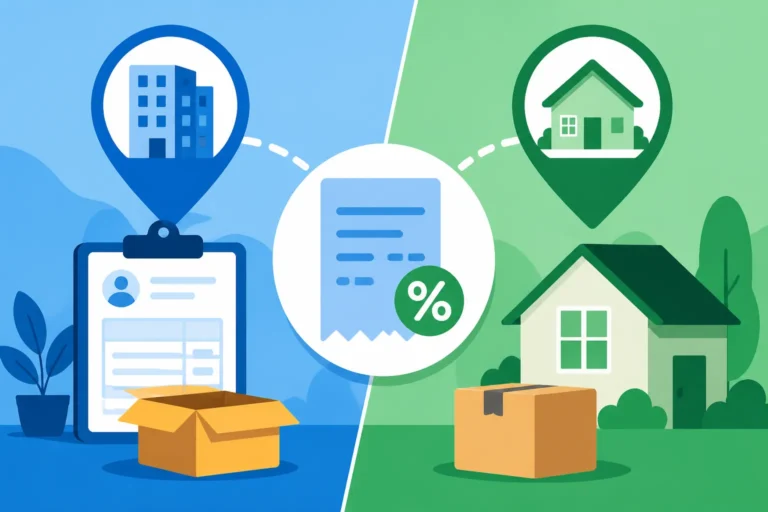
In New York, sales tax is generally based on the "destination" of the goods. This means that if you live in New Jersey (where sales tax is lower) but you buy something while you are physically standing in a store in Soho, you pay the NYC rate. Conversely, if you live in NYC but order something online to be shipped to your summer house upstate, you pay the rate of the destination address, not your NYC billing address. For more on this, read Is Sales Tax Based on Billing or Shipping Address?.
Marketplace Facilitators
If you are selling on platforms like Amazon or Etsy to customers in NYC, you might not have to worry about the math yourself. New York has "Marketplace Facilitator" laws which require the platform to collect and remit the 8.875% tax on your behalf. However, if you sell through your own Shopify site, the burden is on you to get it right. Understanding Does Shopify Collect Sales Tax for Sellers? is crucial for any NYC-based entrepreneur to avoid a massive back-tax bill.
Business Compliance and the Certificate of Authority
If you plan to open a business in New York City, you cannot simply start charging customers 8.875% and keeping the change. You are acting as a trustee for the state. To do this legally, you must register for a "Certificate of Authority." This is essentially your "license to collect" sales tax.
How to Register
The process involves applying through the New York Business Express website. You should do this at least 20 days before you plan to make your first sale. Operating without a Certificate of Authority can lead to massive fines—sometimes up to $10,000—and even criminal charges. For a step-by-step on the paperwork, see How to Get a Sales Tax Permit in New York.
Filing Frequencies
Once you are registered, the state will tell you how often you need to file. Most small businesses start as "Quarterly" filers, but if you are doing high volume in the city, you might be moved to "Monthly" filing. Even if you have a month with zero sales, you must still file a "zero return" to tell the state you didn't collect anything. If you're feeling overwhelmed by the schedule, check out the New York Sales Tax Due Dates 2026 to stay on track.
The Role of Technology
Given the complexity of the NYC 8.875% rate, the clothing exemptions, and the "bagel tax" nuances, many NYC businesses use software like Avalara to automate their filings. Automation helps ensure that you aren't just getting the rate right, but that you are also filing on time to avoid the 10% late payment penalty that New York is famous for.
Sales Tax on Services and Digital Goods
In NYC, it isn't just physical products that are taxed. The city has a very broad view of what constitutes a "taxable service." This can be a major trap for freelancers and service providers who think they are exempt because they don't sell "stuff."
Taxable Services in the City
NYC taxes several services that the rest of the state does not. This includes "beautician services" (like haircuts and manicures), tanning, and even "protective and detective services." If you are a dog walker or a gym owner, you need to look closely at Are Services Taxable in My State? to see if your specific niche falls under the city's tax umbrella.
Digital Products and SaaS
The world of software is another gray area. New York generally considers "pre-written software" (even if downloaded) to be tangible personal property and therefore taxable. Software-as-a-Service (SaaS) is also generally taxable in NYC, though there are specific exemptions for "custom" software. This is a high-audit area, and many tech startups in the city use Avalara to help categorize their subscriptions correctly. You can learn more about this in our guide: Is SaaS Taxable in New York?.
Final Thoughts for NYC Shoppers and Sellers
Navigating the NYC sales tax rate of 8.875% feels like trying to navigate the subway during rush hour—it's crowded, expensive, and full of weird rules. Whether you are a shopper trying to time your big purchases for items under $110, or a business owner trying to keep the auditors at bay, the key is knowing the breakdown. Remember that the 8.875% is a team effort between the state, the city, and the MTA. While it's a high price to pay, it's part of what keeps the "City That Never Sleeps" running. Keep an eye on your receipts, stay updated on 2026 Sales Tax Rate Changes by State, and when in doubt, use a calculator to make sure the math adds up.
Disclaimer
This guide is intended for informational purposes only and does not constitute professional tax, legal, or financial advice. Sales tax laws in New York City are subject to frequent change by legislative action or administrative ruling. Always consult with a qualified tax professional or the New York State Department of Taxation and Finance for specific guidance regarding your business or personal situation.