Sales Tax on E-books by State
Navigating the ever-changing landscape of sales tax can feel like trying to read a map in the dark, especially when it comes to digital products like e-books. Many online sellers and even consumers find themselves scratching their heads, wondering if that new novel downloaded to their tablet is subject to the same sales tax as a physical copy from a bookstore. This guide is here to shed some much-needed light on this tricky subject, helping you understand how different states handle sales tax on e-books and what that means for your digital library or business.
The Shifting Landscape of E-book Sales Tax
It wasn't that long ago that sales tax was a pretty straightforward affair, mostly applying to tangible goods you could pick up, feel, and put in a shopping cart. Then came the digital revolution, and with it, a whole new category of products that challenged our traditional understanding of "goods" and "services." E-books are right at the forefront of this complexity, blurring lines and forcing states to adapt their tax codes, often with wildly different results.
Why E-books Are Different from Physical Books
Think about it: when you buy a paperback, you're getting a physical item. You hold it, you store it on a shelf, and it physically changes hands. That's a clear-cut tangible personal property, and sales tax has always applied to those. But an e-book? You don't "hold" an e-book in the traditional sense. You download it, stream it, or access it through a platform. It's bits and bytes, not paper and ink. This fundamental difference is precisely why states struggle with how to tax them.
Some states view e-books as just another form of "tangible personal property" by extending the definition to include digital equivalents that are stored on a device, much like Is Software Taxable? (Canned vs Custom) or other digital products. They argue that if you gain permanent possession and use of the content, it's essentially the same as owning a physical book. Other states see the transaction as providing a service—access to content or a license to use it—which might be taxable under specific service tax laws. And then there are states that simply haven't updated their laws, or explicitly exempt digital products, leaving e-books untaxed. It’s a real patchwork, making it incredibly difficult for businesses to know their obligations without deep research into each state's rules.
The Post-Wayfair World and Digital Products
The landmark 2018 Supreme Court decision in South Dakota v. Wayfair fundamentally changed sales tax for remote sellers. Before Wayfair, if you didn't have a physical presence (like a storefront or warehouse) in a state, you generally didn't have to collect sales tax there. But Wayfair introduced the concept of "economic nexus," meaning that selling a certain dollar amount or number of transactions into a state could create a sales tax obligation, even if you never set foot there.
This change drastically increased the number of states where online sellers, including those selling e-books, might suddenly have to collect sales tax. What makes it even more challenging for digital products is that the rules for what constitutes a "taxable sale" can vary wildly. A state might have an economic nexus threshold of $100,000 in sales, but only if those sales are of taxable goods or services. If e-books are considered non-taxable in that state, your e-book sales might not count towards the threshold, or they might not be taxable even if you do meet nexus. It's enough to make your head spin, and it underscores why understanding Economic Nexus by State 2026: Thresholds Guide is crucial for any online business, especially those selling digital content.
How States Classify E-books for Sales Tax Purposes
When it comes to e-books, there's no single, universally accepted classification across the United States. States have taken various approaches, often leading to confusion for sellers and buyers alike. Understanding these different classifications is the first step toward figuring out your sales tax responsibilities.
E-books as Tangible Personal Property
Some states, in an attempt to simplify taxation and align digital products with physical ones, treat e-books as if they were tangible personal property. This usually happens when the digital good is delivered electronically but is downloaded, stored, and retained by the customer for permanent use. For these states, the fact that you "own" the e-book file on your device, even if it's not a physical object, makes it taxable.
For instance, states like Pennsylvania specifically classify electronically delivered software, digital books, and other digital content as taxable tangible personal property, meaning they are subject to the standard sales tax rate. The logic here is that the customer receives a product that they can possess and use indefinitely, similar to a physical book. This approach simplifies things for the state, but it can feel counterintuitive to sellers who deal purely in digital files. If you're selling into one of these states, you'll need to collect and remit sales tax just as you would for a physical item.
E-books as Taxable Services
Another common approach is for states to classify e-books, or the access to them, as a taxable service. This often comes into play when the e-book is part of a subscription, a streaming service, or doesn't involve a permanent download but rather temporary access to content. In these scenarios, states argue that the customer isn't really "owning" a product but rather paying for the privilege to access or use content, which is a service.
For example, Washington state often takes a broad view on the taxation of digital products and services. While they have specific rules for digital goods, services that provide access to content can also be taxable. If your e-book platform provides access to a library of books via a subscription model, rather than individual permanent downloads, it might fall under their taxable service category. This classification is less common for one-time e-book purchases but becomes very relevant for subscription-based reading apps or digital libraries. Sellers in these states need to pay close attention to the specific terms of their e-book delivery to determine if it's considered a service. For a broader look at this, you might want to check out our guide on Sales Tax on Services: What's Taxable by State.
E-books as Intangible or Exempt
Then there are states that either classify e-books as intangible property, which is often explicitly exempt from sales tax, or simply have not updated their laws to include digital products, resulting in their de facto exemption. These states often cling to the traditional definition of tangible personal property, and since an e-book isn't something you can physically touch and move, it falls outside their taxable scope.
California is a prime example of a state where e-books are generally not subject to sales tax. The California Department of Tax and Fee Administration (CDTFA) considers e-books to be intangible personal property, and as such, they are not subject to sales tax. This is a huge relief for sellers with nexus in California, as it removes a significant compliance burden for this specific product. Other states like Texas and Florida also tend to exempt most digital goods unless they are bundled with taxable tangible personal property or specifically listed as a taxable service. It's a seller's dream scenario, but these exemptions can change, so it's vital to stay informed on the latest 2026 Sales Tax Rate Changes by State.
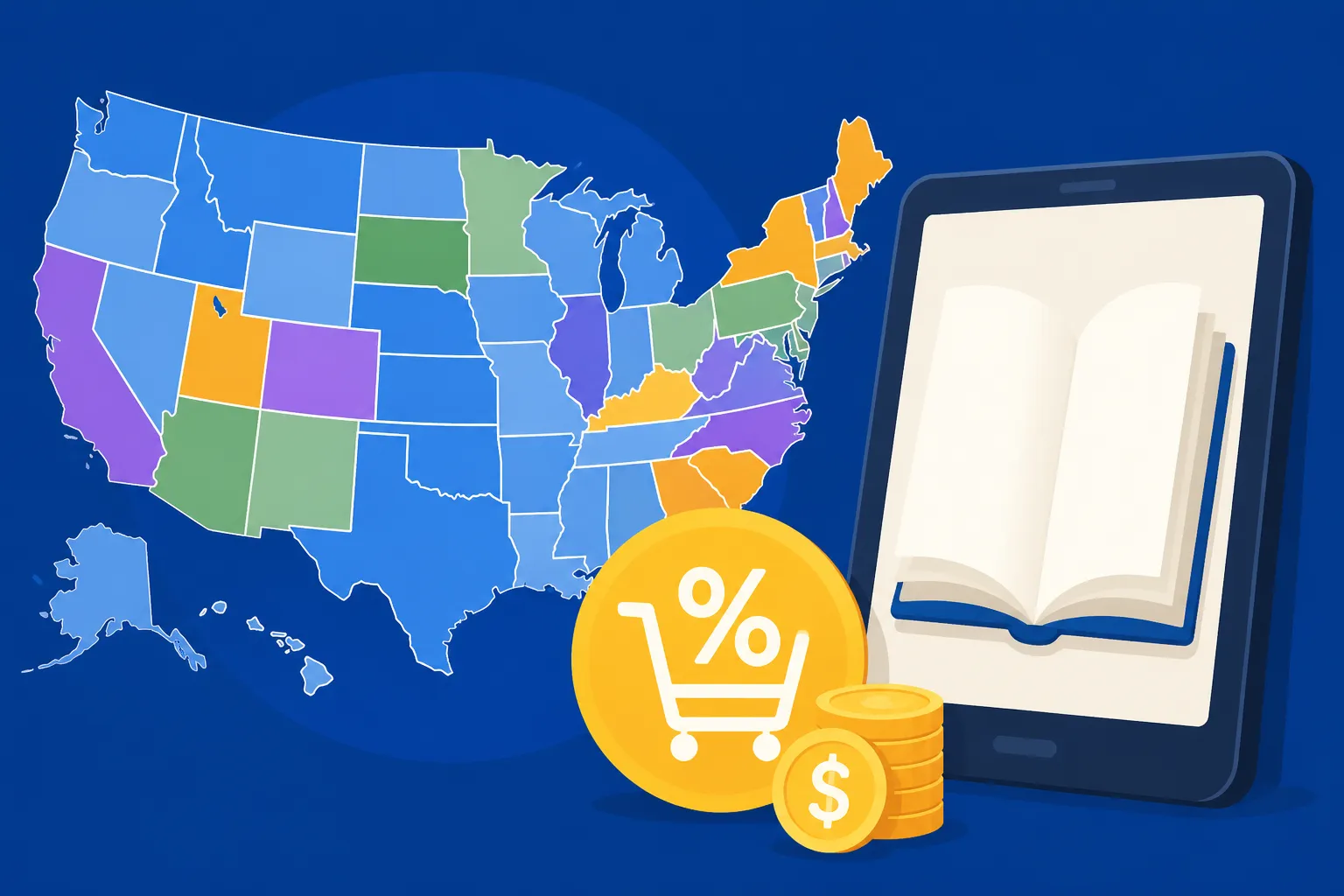
State-by-State Breakdown: Sales Tax on E-books
Trying to keep track of every state's individual rules for e-books can feel like a full-time job. It’s a highly fragmented landscape, with significant variations that can trip up even the most diligent sellers. Let's break down some general trends and examples to help you get a clearer picture. This is where understanding specific state laws becomes critical, as a misstep could lead to unexpected tax liabilities.
States Where E-books Are Generally Taxable
Many states have taken explicit steps to make e-books and other digital products subject to sales tax, often classifying them either as tangible personal property or taxable services. These states generally want to ensure a level playing field with physical goods and capture revenue from the burgeoning digital economy.
- Washington: This state is known for its broad approach to taxing digital products. E-books and other electronically delivered digital goods are generally subject to sales tax in Washington. If you sell e-books to customers in Washington, you'll need to collect their state sales tax, which is currently 6.5%, plus any applicable local taxes. This can make the effective rate quite high in some areas, like Seattle.
- Pennsylvania: Pennsylvania specifically includes digital books in its definition of "tangible personal property" for sales tax purposes. This means that if you're selling an e-book to a customer in Pennsylvania, you're responsible for collecting the state's 6% sales tax, along with any local sales tax that might apply in Allegheny County (1%) or Philadelphia (2%). It's a straightforward rule, but one that sellers sometimes overlook assuming digital means tax-free.
- New York: New York also generally imposes sales tax on digital products, including e-books, considering them as "taxable information services" or "receipt of certain property by electronic means." So, if your business has nexus in New York, you'd be collecting the 4% state sales tax along with any local taxes, which can push the combined rate significantly higher, especially in NYC Sales Tax Rate (8.875%) Explained. This is a state where digital taxation can get particularly complex, requiring careful attention to where your customers are located.
These are just a few examples, but they illustrate a common theme: states that are actively trying to keep pace with the digital economy are more likely to have specific provisions to tax e-books. Staying on top of these changes is a continuous effort, and using a service like Avalara can really help automate the process of knowing what's taxable where.
States Where E-books Are Generally Exempt
On the flip side, several states choose to exempt e-books from sales tax, often due to their classification as intangible property or simply because their tax codes haven't been updated to explicitly include them. These are often seen as more business-friendly states for digital sellers, at least for this particular product category.
- California: As mentioned earlier, California generally considers e-books to be intangible personal property, and therefore, they are not subject to sales tax. This is good news for sellers with customers in the Golden State, as you won't need to collect sales tax on those e-book sales. However, it’s important to remember that this exemption applies to the e-book itself; if you bundle it with a physical product or a taxable service, the whole transaction might become taxable.
- Texas: Texas's sales tax laws are quite detailed, but they generally exempt digital information products like e-books. While software and certain digital services can be taxable, e-books typically fall under an exemption for "information services" or "data processing services" if they are merely delivering content. Always double-check the specifics, but for a standalone e-book, it's usually not taxed in Texas.
- Florida: In Florida, electronically delivered digital products, including e-books, are generally not subject to sales tax. Florida's tax code often focuses on tangible goods, and while some digital services are taxed, e-books themselves typically fall outside the scope of taxable items. This makes sales to Florida customers simpler for e-book sellers.
It's absolutely critical not to assume that just because one state exempts e-books, another will. The rules are highly specific to each jurisdiction, and a slight change in how an e-book is delivered (e.g., streaming vs. permanent download) could alter its taxability. For general sales tax questions, our Sales Tax Calculator: How to Calculate Sales Tax can be a helpful tool, but for digital goods, state-specific guidance is key.
States with Nuanced or Conditional Taxation
Beyond clear-cut taxable or exempt classifications, many states have nuanced rules where the taxability of an e-book depends on specific conditions. This is where it gets truly challenging, as sellers need to analyze not just the product but also the transaction type.
- Subscription vs. One-Time Download: Some states might exempt a one-time purchase and download of an e-book but tax a subscription service that grants access to a library of e-books. For example, if a state taxes "digital streaming services," a subscription-based e-book app might be taxable even if individual e-book downloads are not. This distinction is vital for platforms like Kindle Unlimited or Scribd.
- Bundled Sales: What if you sell a physical book and its digital counterpart together as a package? Many states have "bundled transaction" rules that dictate how to tax such sales. Depending on the state, the entire bundle might become taxable, or you might need to allocate the price between the taxable and non-taxable components. For instance, if you sell a "deluxe edition" that includes a physical book, an e-book, and an audiobook, how that's taxed will vary wildly by state, especially in places with Mandatory Statewide Local Add-Ons (CA, UT, VA).
- Licensing vs. Ownership: Some states draw a distinction between licensing intellectual property (which is often exempt) and selling a digital product for permanent use. If your e-book is essentially a license to read the content for a limited time or under specific conditions, its taxability might differ from a permanent download classified as tangible personal property.
This level of detail requires sellers to not only understand Sales Tax Nexus Explained Physical vs Economic in each state they sell into but also to categorize each transaction carefully. This is precisely why more and more e-book sellers are turning to robust sales tax software solutions to manage these complexities.
Practical Steps for E-book Sellers
The variability in how states tax e-books can be daunting for any business, whether you're a small indie author selling directly from your website or a larger publisher. However, ignoring sales tax obligations is not an option. Penalties for non-compliance can be severe, including fines, interest, and even personal liability. Taking proactive steps to understand and manage your sales tax responsibilities is crucial for long-term success.
Determining Your Nexus and Compliance Obligations
Before you can even think about collecting sales tax on e-books, you absolutely must know where you have nexus. As discussed, thanks to the Wayfair decision, economic nexus means you can owe sales tax in a state even without a physical presence, purely based on your sales volume or transaction count into that state.
- Monitor Thresholds: Each state has its own economic nexus thresholds. Most commonly, it's either $100,000 in gross sales or 200 separate transactions into the state in the current or previous calendar year, though some states have higher thresholds (like California and Texas at $500,000). You need to continuously track your sales into every state to determine when you cross these thresholds. Remember, these thresholds apply to all sales, not just e-books, even if e-books themselves aren't taxable in that state.
- Register for Permits: Once you establish nexus in a state, your next step is to register for a sales tax permit or license there. This is non-negotiable. Selling into a state where you have nexus without a permit is illegal and can lead to significant penalties. Our guide on How to Get a Sales Tax Permit by State can walk you through this process for various jurisdictions.
- Understand Taxability: After you're registered, you then need to determine if your e-books are actually taxable in that specific state. This is where the state-by-state breakdown we discussed earlier comes into play. You can't just assume; you need to research the exact laws for digital products in each state where you have nexus.
Leveraging Technology for Accurate Taxation
Manually tracking nexus, monitoring sales thresholds, looking up tax rates for every zip code, and figuring out the taxability of every product in every state is virtually impossible for most businesses, especially as they grow. This is where sales tax compliance software becomes an absolute lifesaver.
Companies like Avalara specialize in automating sales tax calculations, collections, and filings. Imagine this scenario: you sell an e-book to a customer in Pennsylvania. Instead of you having to remember that e-books are taxable there, look up the state rate, factor in any local rates for that specific address, and apply it, a platform like Avalara can do it instantly at the point of sale. It integrates with most e-commerce platforms and accounting software, taking the guesswork and heavy lifting out of sales tax.
Here's how these tools typically help:
- Nexus Tracking: Some solutions can help monitor your sales into each state and alert you when you're approaching an economic nexus threshold.
- Rate Calculation: They automatically apply the correct sales tax rate based on the customer's exact location, down to the street address in many cases, accounting for state, county, city, and special district taxes. This is crucial given that sales tax rates can vary wildly even within the same state, as explored in Sales Tax by ZIP Code (and Why ZIP Isn't Enough).
- Product Taxability: Advanced systems can often handle product taxability rules, though sometimes these need to be manually configured for highly specific digital products like e-books.
- Filing & Remittance: Many services will even prepare and file your sales tax returns and remit the collected taxes to the proper authorities on your behalf, significantly reducing your administrative burden.
While there's an investment involved, the time savings and peace of mind that come with automated compliance often far outweigh the costs. You can explore a comparison of different options in our Best Sales Tax Compliance Software 2027 guide.
Staying Updated with Evolving Tax Laws
Sales tax laws, especially those pertaining to digital products, are not static. States are constantly reviewing, revising, and enacting new legislation to keep up with technological advancements and evolving business models. What's true today might not be true six months from now.
- Regular Research: Make it a point to regularly check the websites of state tax departments for any updates or proposed changes to digital product taxation. Many states publish bulletins or advisories when new rules are implemented.
- Industry News: Follow reputable sales tax compliance blogs and news sources. These often provide timely summaries of legislative changes that impact online sellers.
- Professional Advice: For complex situations or when you're unsure, consult with a sales tax professional. Their expertise can save you from costly mistakes.
- Software Updates: If you're using sales tax software, ensure it's kept up to date. Providers like Avalara are constantly updating their systems to reflect the latest changes in state and local tax laws, so leveraging these updates is critical.
Remember, ignorance of the law is not an excuse. Proactively managing your sales tax obligations for e-books and other digital products is essential for the financial health and legal compliance of your business. It's a continuous journey, but with the right information and tools, it's definitely manageable.
| State | E-book Taxability (General Rule) | Key Nuance/Context |
|---|---|---|
| California | Exempt | Classified as intangible personal property. |
| Texas | Exempt | Generally considered an "information service." |
| Florida | Exempt | Electronically delivered digital products not taxed. |
| Washington | Taxable | Classified as a "digital good." |
| Pennsylvania | Taxable | Included in definition of "tangible personal property." |
| New York | Taxable | Taxed as "information services" or "digital property." |
| Illinois | Taxable | Considered "tangible personal property" if delivered digitally. |
| Colorado | Exempt (State level) | Home-rule cities may impose local sales tax if defined as tangible. See Colorado Home-Rule Cities Sales Tax. |
| Ohio | Taxable | Classified as "specified digital products." |
| Massachusetts | Exempt | Considered intangible; some digital services are taxable. |
| Arizona | Taxable (TPT) | Taxed under Transaction Privilege Tax (TPT) as an "other retail sale." |
| North Carolina | Taxable | Classified as a "digital property." |
Disclaimer
The information provided in this guide is for general informational purposes only and does not constitute professional tax advice. Sales tax laws are complex and constantly changing. Always consult with a qualified tax professional or the appropriate state tax authority for advice tailored to your specific situation.