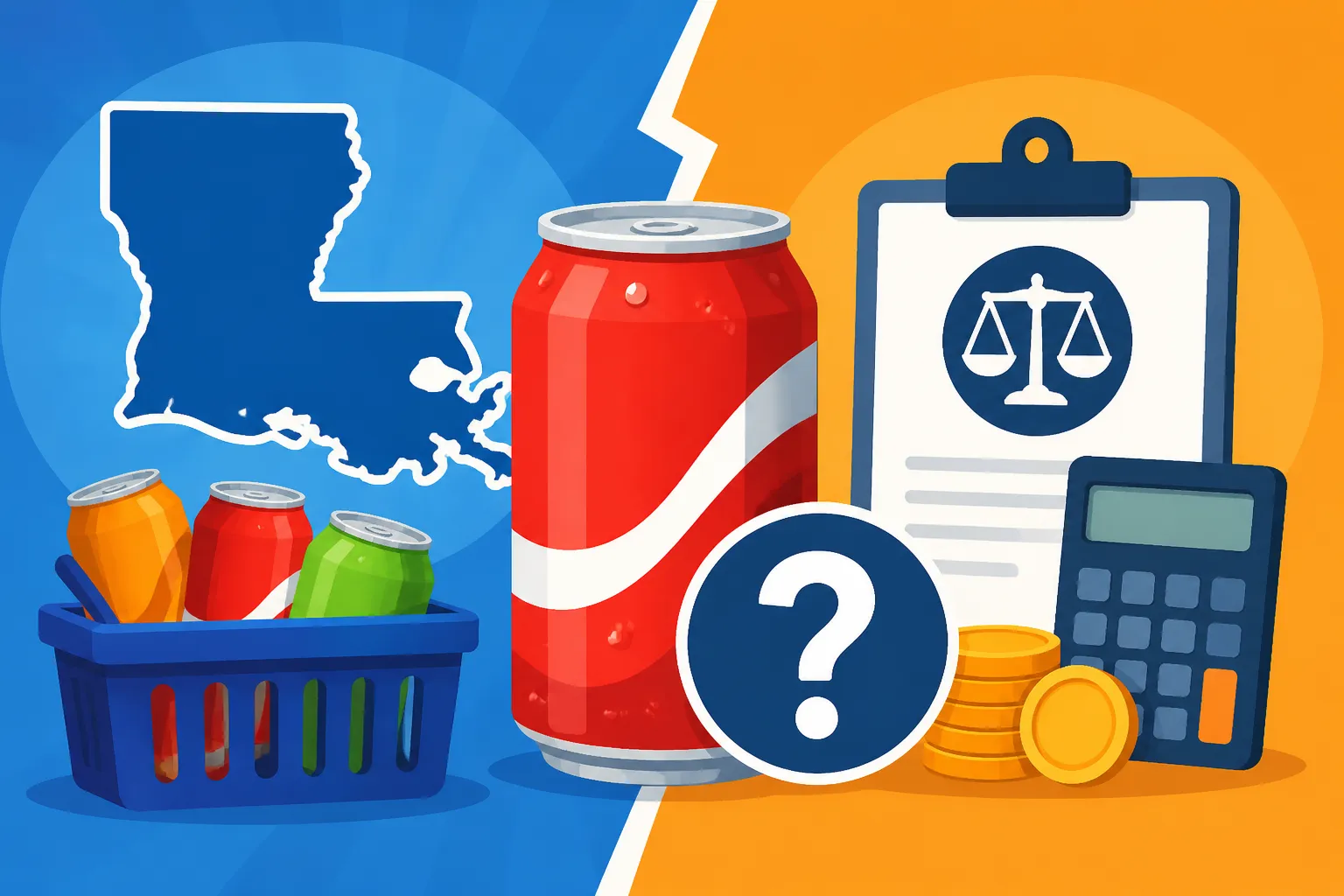
Is Soda Taxable in Louisiana?
Navigating sales tax rules, especially for seemingly simple items like a can of soda, can feel like trying to solve a riddle in a state as unique as Louisiana. For small business owners and even casual shoppers, it's frustrating to figure out if that sweet bubbly drink you’re grabbing off the shelf or from a vending machine is going to cost you a little extra in sales tax. This comprehensive guide is here to untangle the complexities of sales tax on soda in Louisiana, helping you understand exactly what you're expected to pay and why.
The Straight Scoop: Is Soda Taxable in Louisiana?
Let's cut right to the chase because nobody likes ambiguity, especially when it comes to their wallet. In Louisiana, soda is generally considered a taxable tangible personal property, meaning yes, it is subject to sales tax. Unlike some states that might offer exemptions or reduced rates for "food for home consumption" or differentiate between types of beverages, Louisiana's approach is more straightforward in this regard: if it's a soft drink, it's taxable.
This means whether you're picking up a 12-pack of cola at a grocery store, grabbing a single bottle from a convenience store cooler, or getting a fountain drink with your meal, you're going to pay sales tax on that soda. The state considers these beverages to fall under the broad category of taxable goods. There's no special carve-out for carbonated beverages or sugary drinks, which simplifies things in one sense, but doesn't necessarily make the overall sales tax landscape in Louisiana any less daunting. Understanding the general rule is the first step, but the real complexity often lies in the actual rate you'll pay and the myriad local jurisdictions that add their own layers to the tax burden.
State Sales Tax on Beverages
Louisiana has a state sales tax rate of 4.45% that applies to the sale of most tangible personal property, and soda is squarely in that category. This state rate is the foundation upon which all other local taxes are built. It’s important to remember that this 4.45% is just the starting point; it's rarely the final rate you'll encounter due to Louisiana's extensive system of local sales taxes.
For instance, if you're buying a soda that costs $1.00 before tax, the state portion of the tax would be $0.0445. However, this base rate doesn't account for the additional percentages levied by parishes, municipalities, and other special taxing districts. This combined effect is what makes figuring out the true cost of an item so tricky across different locations in Louisiana. While the state's portion is relatively easy to understand, it’s only one piece of a much larger, often confusing, puzzle.
Local Sales Tax on Soda
This is where things get genuinely wild in Louisiana, making it one of the most complex states for sales tax in the entire country. Beyond the statewide 4.45% rate, nearly every parish, city, and even some special districts impose their own sales taxes. These local rates can vary dramatically, often adding significant percentages to the final sales tax rate. It's not uncommon for combined state and local rates to exceed 9% or even 10%. For example, some areas within Orleans Parish, including New Orleans, can see rates that climb significantly when you factor in all the local add-ons.
This means that a soda purchased in Baton Rouge might have a different total sales tax rate than the exact same soda purchased in Shreveport or a rural parish like West Carroll Parish. The specific local rate depends entirely on the exact physical address where the transaction takes place. This makes it incredibly challenging for businesses, especially those operating across multiple locations or selling online to customers throughout the state, to accurately calculate and collect sales tax. It’s not just about knowing if soda is taxable, but how much it’s taxed in each specific spot. For a deeper dive into the overall local sales tax situation, you might find our article on Louisiana Parish Sales Tax Complexity helpful.
Why Louisiana's Sales Tax on Beverages Gets Complicated
Even though the rule about soda being taxable is straightforward, the implementation in Louisiana is anything but simple. The sheer volume and variability of local sales tax jurisdictions create a labyrinth for businesses and consumers alike. You can easily find yourself asking, "Why is sales tax different in every city?" and in Louisiana, that question really hits home.
Imagine running a small business with a delivery service that crosses parish lines. You suddenly need to apply different sales tax rates based on the customer's delivery address. This isn't just a minor inconvenience; it's a significant operational challenge that requires meticulous record-keeping and a deep understanding of ever-changing local tax ordinances.
Understanding Combined Rates
When we talk about the sales tax rate you actually pay on a soda in Louisiana, we're almost always talking about a "combined rate." This isn't just the state rate; it's the state rate plus the parish rate, plus any city rate, plus any special district rates that apply to that specific location. For example, if the state rate is 4.45%, and a particular parish adds 5%, and a specific city within that parish adds another 1%, your combined rate would be 10.45%.
This layered approach means that a single purchase can be subject to multiple taxing authorities. It's not like a flat statewide rate where you just apply one number. Businesses have to track all these individual components to ensure they're collecting the correct amount. This is a critical distinction that often trips up new businesses or those expanding into Louisiana. For a clearer picture on how these rates are built, check out our explanation of Combined State + Local Sales Tax Rates Explained.
The Role of Sourcing Rules for Soda Sales
When it comes to sales tax, where a sale is deemed to have occurred (the "sourcing rule") can significantly impact the rate applied. Louisiana generally follows destination-based sourcing for intrastate sales, which means the sales tax rate is determined by the location where the buyer receives the product, not where the seller is located.
Consider an online retailer based in Shreveport selling a case of soda to a customer in Baton Rouge. Even though the business is in Shreveport, they would need to charge the combined state and local sales tax rate applicable to the customer's address in Baton Rouge. This is vital for businesses selling across parish lines or through e-commerce platforms. If you're selling from a physical store, it's usually simpler, as the point of sale determines the local rates. However, for remote sellers, getting the destination right is paramount. Ignoring sourcing rules can lead to under-collection or over-collection, both of which can lead to compliance headaches.
How to Determine the Correct Sales Tax for Soda Sales
For businesses, especially those operating across different cities and parishes, accurately determining the sales tax rate for soda (or any product) in Louisiana is a constant challenge. It's not enough to know that soda is taxable; you need to know the exact percentage to charge for every single transaction.
This isn't a "set it and forget it" kind of task. Sales tax rates, particularly at the local level, can change. In fact, many states see 2026 Sales Tax Rate Changes by State regularly, and Louisiana is no exception. Staying on top of these fluctuations requires diligent monitoring and reliable tools.
Using Sales Tax Rate Lookup Tools
Given the complexity, relying on accurate sales tax rate lookup tools is essential for any business selling soda in Louisiana. These tools can pinpoint the exact combined state and local sales tax rate for any specific address, down to the street level, helping to ensure compliance.
There are various solutions available, ranging from free online calculators to more sophisticated, integrated software. Many businesses turn to services like Avalara for their robust sales tax calculation engines. These platforms integrate directly into e-commerce sites, POS systems, and accounting software, automatically applying the correct sales tax rate at the point of sale. This automation is a lifesaver, especially when dealing with the granular detail required by Louisiana's tax structure. Manually looking up rates for every single transaction or location is simply not sustainable for most businesses. For a deeper look at your options, you might find our guide on Best Sales Tax Compliance Software 2027 helpful.
Here's a simple example of how rates can vary for a $5.00 purchase of soda in different Louisiana locations:
| Location (Example ZIP) | State Rate | Parish Rate | City/District Rate | Combined Rate | Tax on $5.00 Soda |
|---|---|---|---|---|---|
| Baton Rouge (70801) | 4.45% | 5.00% | 0.00% | 9.45% | $0.47 |
| New Orleans (70112) | 4.45% | 5.00% | 4.00% | 13.45% | $0.67 |
| Shreveport (71101) | 4.45% | 4.00% | 0.00% | 8.45% | $0.42 |
| Lafayette (70501) | 4.45% | 5.00% | 2.00% | 11.45% | $0.57 |
Please note: These rates are illustrative and subject to change. Always verify current rates with official sources or specialized software.
Actionable Steps for Businesses
If you're selling soda in Louisiana, here are some practical steps to ensure you're collecting the right amount of sales tax:
- Register for a Sales Tax Permit: Before you even collect a dime, you need to be properly registered with the Louisiana Department of Revenue. This is non-negotiable. Learn more about How to Get a Sales Tax Permit by State.
- Identify Your Nexus: If you have a physical presence or meet economic nexus thresholds in Louisiana, you're obligated to collect sales tax. For comprehensive information, our guide on Economic Nexus by State 2026: Thresholds Guide is an excellent resource.
- Use Address-Specific Rate Lookups: Do not rely on ZIP codes alone. Sales tax rates can vary within a single ZIP code in Louisiana. Instead, use a street-address specific lookup tool. A service like Avalara is invaluable here for pinpoint accuracy. Our article on Sales Tax by ZIP Code (and Why ZIP Isn't Enough) explains why this is so important.
- Automate Sales Tax Calculation: For most businesses, especially those with numerous transactions or diverse customer locations, manual calculation is a recipe for errors. Integrating sales tax software into your POS or e-commerce platform automates the process, ensuring correct rates are applied and reducing your compliance burden.
- Stay Informed on Rate Changes: Louisiana's local rates can shift. Regularly review updates from the Louisiana Department of Revenue or ensure your automated system is configured to receive and apply these changes promptly.
By taking these steps, businesses can navigate the complexities of Louisiana sales tax on soda with greater confidence, helping to avoid costly audits and penalties down the road.
Specific Scenarios and Exemptions for Soda
While soda is generally taxable across the board in Louisiana, it’s worth considering different retail scenarios to understand if there are any subtle distinctions. Unlike some states where the "prepared food" designation or specific food definitions can change taxability, Louisiana keeps it fairly simple for soft drinks.
Soda Sold in Grocery Stores vs. Restaurants
In many states, there can be a difference in how groceries (food for home consumption) are taxed versus prepared food sold in restaurants. In Louisiana, however, soda pretty much faces the same tax treatment regardless of where it's purchased. If you buy a six-pack of Coca-Cola at a Winn-Dixie or a single Pepsi at a local diner, it's considered tangible personal property subject to the applicable combined sales tax rate.
Louisiana does not typically exempt groceries from sales tax in the same way some other states do. While the state sales tax rate on certain food for home consumption was temporarily reduced in the past, the general rule is that groceries are subject to the full state sales tax rate. Since soda is consistently categorized as a taxable item within that framework, its taxability remains stable whether it's bought to drink at home or with a meal out.
Vending Machine Sales
Vending machine sales of soda also fall under the taxable category. If you drop a dollar and a quarter into a vending machine for a cold soda, you're paying a price that, by law, includes the sales tax. For businesses operating vending machines, this means the displayed price typically needs to be "tax-included" or the vendor must factor in the sales tax when setting prices to ensure proper remittance.
The responsibility for collecting and remitting sales tax on these transactions still lies with the vendor. The convenience of a vending machine doesn't negate the tax obligation, and the same combined state and local rates apply based on the machine's physical location. Therefore, a vending machine full of sodas on a street corner in the French Quarter of New Orleans will apply different rates than one located on a college campus in rural northern Louisiana.
Are There Any Exemptions for Soda?
Unfortunately for soda drinkers, there are generally no specific sales tax exemptions for soda in Louisiana. It doesn't qualify as a medical necessity, an essential food item often exempted in other states, or an item typically associated with sales tax holidays.
While Louisiana does offer various sales tax exemptions for things like manufacturing equipment, agricultural supplies, or purchases by certain non-profit organizations, sugary beverages like soda are consistently treated as fully taxable goods. This means that if you're looking to save a few pennies on your soda purchase in Louisiana, a sales tax exemption is unlikely to be your ticket. Your best bet is to be aware of the exact combined sales tax rate in your area so you're not surprised at the register.
Disclaimer
Please remember that sales tax laws are subject to change, and interpretations can vary. This guide provides general information and should not be considered legal or tax advice. For specific guidance regarding your business or situation, always consult with a qualified tax professional or the Louisiana Department of Revenue.