Do I Pay Tax on Online Clothing Orders?
You know the drill. You've filled your online cart with that perfect sweater or those fantastic new jeans, feeling all excited about your new wardrobe additions. Then you hit checkout, and BAM! An extra line item for "sales tax" pops up, often adding a surprising chunk to your total. It's frustrating, right? Especially when you're sure you didn't pay tax on clothing from another store last week, or maybe you've heard that clothing isn't taxed at all. Figuring out if you owe sales tax on online clothing orders can feel like a confusing maze, but it doesn't have to be. This comprehensive guide is here to unravel the mystery and give you the real scoop on when, why, and how sales tax applies to your digital fashion purchases, helping you understand those checkout surprises.
The Shifting Landscape of Online Sales Tax
It wasn't that long ago that buying clothing online often meant dodging sales tax, especially if the retailer didn't have a physical store in your state. Those days, for the most part, are gone. The world of online sales tax has undergone a massive transformation, making things a lot more complex for both businesses and consumers.
How Online Sales Tax Became Standard
For decades, the general rule was that if an online retailer didn't have a physical presence – like a brick-and-mortar store, warehouse, or employees – in your state, they weren't required to collect sales tax from you. This often gave online shopping a perceived price advantage over local stores, particularly for items like clothing. However, state governments rightly felt this created an unfair playing field for local businesses and caused them to lose out on significant tax revenue.
Everything changed with the landmark 2018 Supreme Court decision in South Dakota v. Wayfair. This ruling completely overturned previous precedents and allowed states to require out-of-state sellers to collect sales tax, even if they had no physical presence. This new concept is known as "economic nexus." Suddenly, online retailers of all sizes, from small boutiques to massive e-commerce giants, found themselves needing to understand the sales tax laws of every state where they met specific sales thresholds. This means that if you’re buying from an online store, there’s a much higher chance now that they have a nexus in your state and are therefore legally obligated to collect sales tax on your clothing purchase. For a deeper dive, you can explore our guide on Economic Nexus by State 2026: Thresholds Guide.
Understanding Nexus for Online Sellers
The term "nexus" is crucial here. It essentially means a connection strong enough to require a business to collect sales tax. Before Wayfair, nexus almost always meant a physical presence. After Wayfair, economic nexus came into play. Each state now sets its own economic nexus thresholds, usually based on a certain amount of sales revenue or number of transactions into that state within a calendar year. For example, a state might require a seller to collect sales tax if they make over $100,000 in sales or have 200 separate transactions into that state in a year.
This means that even if a clothing boutique is based in California, if they sell enough dresses and shirts to customers in Texas, they might establish economic nexus in Texas and have to start collecting Texas sales tax. This complexity is why many online retailers, even smaller ones, are now collecting sales tax on virtually all their orders. They simply have to, to stay compliant with state laws. If they don't, they risk significant penalties and audits.
State-by-State Rules for Clothing Sales Tax
The biggest hurdle in understanding sales tax on clothing orders isn't just if it's collected, but how it's collected, because the rules vary wildly from state to state. There’s no single federal sales tax, so each state gets to make its own decisions about what’s taxable and what isn’t. This patchwork of rules is why you might pay tax on a t-shirt in one state but not another.
States with No Sales Tax on Clothing
Let's start with the good news! There are a handful of states that generally do not impose a statewide sales tax on most goods, including clothing. If you happen to live in one of these states, you won't pay sales tax on your online clothing orders, regardless of the price or the type of apparel, unless a local jurisdiction within that state levies its own sales tax. These lucky states are:
- Alaska: While Alaska has no state sales tax, many of its local jurisdictions (cities, boroughs) impose their own sales taxes. So, depending on your specific address, you might still see a local sales tax on your online clothing order, even though the state itself doesn't have one.
- Delaware: Completely tax-free for sales tax. You won't pay state or local sales tax on clothing here.
- Montana: No statewide sales tax.
- New Hampshire: No statewide sales tax.
- Oregon: No statewide sales tax.
For a comprehensive look at all the states without a sales tax, check out our guide on States With No Sales Tax (NOMAD Explained). If you live in one of these states, you’re generally in the clear for clothing purchases, but always double-check your local municipality in Alaska.
States with Specific Clothing Exemptions or Thresholds
This is where it gets really interesting and can be a source of confusion. Several states offer partial exemptions or have specific rules that make certain clothing items tax-free, but only under particular conditions. It's not a blanket exemption, which means paying close attention to price points or specific categories of apparel.
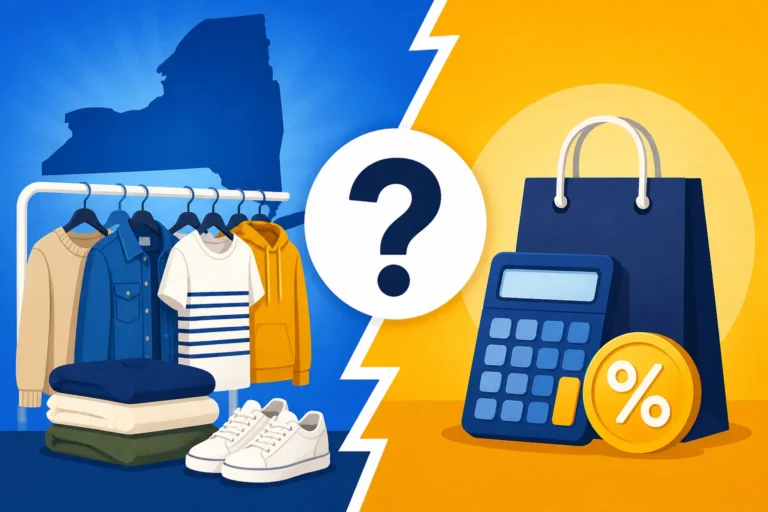
- New York: This is probably one of the most well-known examples. New York state exempts clothing and footwear from the state's 4% sales tax if the item costs less than $110. So, if you buy a pair of socks for $10, it's tax-free. If you buy a pair of designer jeans for $150, the entire $150 is subject to the state's 4% sales tax (plus any applicable local taxes, which can vary wildly by county and city). This means a shirt for $109.99 is tax-free, but one for $110.00 will incur tax. Online retailers selling to New York customers must program their systems to recognize this threshold.
- Massachusetts: Similar to New York, Massachusetts exempts individual articles of clothing that cost $175 or less. If an item exceeds $175, the entire price of that item becomes taxable. So, a $170 dress is exempt, but a $180 dress is fully taxable. This isn't just for the state sales tax, but also applies to local option taxes, if any.
- Rhode Island: This state offers an exemption for individual articles of clothing and footwear that cost $250 or less. If the item costs more than $250, the entire price is subject to sales tax.
- Pennsylvania: Good news for shoppers here! Pennsylvania generally exempts most clothing items from sales tax. This exemption applies to almost all clothing and footwear. However, there are some exceptions. The exemption does not apply to furs, bathing suits, costumes, or clothing accessories like jewelry, handbags, and wallets. So, while your new winter coat might be tax-free, that matching scarf and hat could still be taxed.
- Minnesota, New Jersey, Vermont: These states also generally exempt most clothing from sales tax, similar to Pennsylvania, with some minor exceptions for accessories or specific types of apparel.
These varying thresholds and exemptions mean that the sales tax you see at checkout can drastically change based on the individual item's price, not just your overall cart total. For more detailed state-specific information, you can read our article on Is Clothing Taxable? Sales Tax on Apparel by State.
States Where Clothing is Fully Taxable
For the vast majority of states that have a sales tax, clothing is treated just like any other tangible personal property. This means that if you're buying clothing online and you live in a state like California, Texas, Florida, or Illinois, you can expect to pay sales tax on your purchase. There are no special exemptions or price thresholds – a $5 pair of socks and a $500 jacket will both be subject to sales tax at the prevailing state and local rates.
This is the norm for most of the country. Online retailers selling into these states are required to collect and remit the applicable sales tax. The exact rate you pay will depend on your specific location (ZIP code, or more accurately, your full street address), as local jurisdictions often add their own sales taxes on top of the state rate. For instance, someone buying clothing in Los Angeles will pay a different combined rate than someone in rural Modoc County, even though both are in California.
Common Questions About Online Clothing Sales Tax
Beyond the basic state rules, there are other common scenarios that can make understanding sales tax on online clothing orders a bit tricky. Let's break down some of those often-asked questions.
What About Shipping and Handling?
This is a frequently debated point. You've found a great deal on a dress, and it's even tax-free in your state due to a low price point. But then you notice tax on the shipping fee! This happens more often than you might think. Whether shipping and handling charges are subject to sales tax generally depends on how each individual state views these charges.
In many states, if the item being shipped is taxable, then the shipping and handling charges associated with that item are also considered taxable. So, if you buy a taxable shirt, the shipping fee for that shirt will likely also be taxed. This is often the case in states like California, New York, and Texas. Conversely, if the item itself is exempt from sales tax (perhaps you're in Pennsylvania where most clothing is exempt), then the shipping charges for that exempt item usually won't be taxed either.
However, some states have specific rules. For example, some states will exempt shipping if it's separately stated on the invoice and optional, but tax it if it's bundled into the price. This area is incredibly complex and varies from state to state, so it's always best to check the specific rules for your location or simply anticipate that shipping might be taxed if the items in your order are. For more details on this, our guide on Is Shipping Taxable? Freight Sales Tax by State can provide more clarity.
Returns and Exchanges
What happens when you return that online clothing purchase? Generally, if you return an item for which you paid sales tax, the retailer should refund you the sales tax along with the purchase price. This is standard practice, as the original sale is effectively reversed. So, if you paid $5 in sales tax on a $100 shirt you returned, you should get back both the $100 and the $5 in tax.
For exchanges, it can be a little different. If you exchange an item for another item of the exact same value, and the original item was taxable, there might be no additional sales tax implication. However, if you exchange for a more expensive item, you would likely pay sales tax on the difference in price. If you exchange for a cheaper item, you might receive a refund for the price difference and the corresponding sales tax. Always check the retailer's return policy and your receipt carefully.
Does the Seller's Location Matter?
For online purchases, the seller's physical location isn't as relevant as it once was, thanks to economic nexus. What truly matters is where you, the customer, are located. The sales tax rate applied to your online clothing order is almost always based on the destination – meaning your shipping address. This is known as "destination-based sourcing."
So, if you're in Dallas, Texas, and you order a t-shirt from an online store based in Portland, Oregon (a state with no sales tax), you'll still pay the sales tax rate applicable to Dallas, because the retailer has economic nexus in Texas and is required to collect based on your destination. The rate applied will be the combined state and local rate for your specific address, which for Dallas, currently sits at 8.25% (6.25% state + 2% local). This is why two people ordering the exact same item from the same website might pay different amounts of sales tax if they live in different cities or states. You can learn more about this in our article on Origin vs Destination Sales Tax Sourcing.
How Online Retailers Determine Sales Tax
Given the incredible complexity of sales tax laws across over 13,000 different taxing jurisdictions in the U.S. (states, counties, cities, districts), how do online clothing retailers even manage to calculate the correct tax? It's certainly not by manually looking up every address!
The Role of Sales Tax Software
Modern online retailers rely heavily on specialized sales tax software to handle these calculations accurately and in real-time. These sophisticated systems integrate directly with their e-commerce platforms (like Shopify, WooCommerce, or Magento) and point-of-sale systems. When you enter your shipping address at checkout, the software instantly looks up the precise sales tax rate applicable to that address, factoring in state, county, city, and special district taxes. It also takes into account product taxability rules (is clothing taxable? Are certain price points exempt?) and even sales tax holidays.
Companies like Avalara and TaxJar are industry leaders in providing these automated solutions. They maintain massive databases of sales tax rates and rules for every jurisdiction, ensuring that businesses are collecting the correct amount of tax for every single order. Without such software, it would be virtually impossible for online sellers to comply with the post-Wayfair sales tax landscape, especially as their sales volume grows across multiple states.
What You See at Checkout
When you're checking out online, the process typically looks something like this:
- You Add Items: You load up your cart with sweaters, dresses, shoes, and accessories.
- You Enter Your Shipping Address: This is the critical step. The moment you input your street, city, state, and ZIP code, the sales tax calculation begins.
- Real-time Calculation: The retailer's sales tax software springs into action. It identifies your jurisdiction, checks the taxability of each item in your cart based on that jurisdiction's rules (e.g., applying the New York $110 rule if you're in New York), and calculates the precise sales tax amount.
- Tax Displayed: The sales tax is then displayed as a separate line item before you finalize your purchase. This is your chance to see exactly how much extra you'll be paying.
This automated process, while sometimes resulting in an unwelcome surprise for consumers, is how retailers ensure compliance. It’s also important to remember that the sales tax displayed is typically based on the current rates. You can always check our resource on Sales Tax Rates by State 2026: All 50 States for the latest information.
Navigating Sales Tax Holidays for Clothing
Beyond specific state exemptions, there’s another popular way to save on sales tax for clothing: sales tax holidays! Many states offer these special periods, often around back-to-school season, where certain items, including clothing, are temporarily exempt from sales tax up to a specific price limit.
Understanding the Details of Sales Tax Holidays
During a sales tax holiday, a state will temporarily suspend sales tax on qualifying items for a designated period, usually a weekend or a full week. Clothing is a very common item included in these holidays. However, there are usually very important caveats:
- Price Limits: Most sales tax holidays have a per-item price limit for clothing. For example, a state might exempt clothing items under $100 or $50 during the holiday. If a single item of clothing costs more than that limit, it typically does not qualify for the exemption, and the full price of the item remains taxable. This means that while a $95 pair of jeans might be tax-free, a $120 winter coat might not.
- Qualifying Items: Not all clothing is created equal during these holidays. Usually, "clothing" means general-purpose apparel and footwear. Items often excluded are accessories (jewelry, handbags, wallets), athletic uniforms not for general wear, and sometimes even specific types of footwear like skis or roller skates.
- Dates: The dates are crucial. Sales tax holidays are temporary. If you miss the window, you'll pay sales tax. They are typically held in late July or early August, just before the school year begins. For instance, the Texas Tax-Free Weekend 2026 (Aug 7-9) is a prime example of this type of event.
Online Purchases During Tax-Free Weekends
The great news is that most states now extend their sales tax holidays to include online purchases. This means if you buy qualifying clothing from an online retailer during the designated tax-free period, and the retailer has nexus in your state, they are usually required to honor the sales tax exemption. The retailer's sales tax software should automatically apply the exemption at checkout if your purchase meets all the criteria. This is a fantastic opportunity to save a bit of money on larger clothing purchases, especially if you're stocking up for the family or for an upcoming season. Keep an eye on the official announcements from your state's Department of Revenue for specific dates and qualifying items. You can find a complete list of these events in our Sales Tax Holidays by State 2026: Full Calendar.
State Sales Tax Rules for Clothing: A Quick Reference
Here's a simplified table to give you a general idea of how sales tax applies to clothing in various states. Remember, local taxes can add to these rates, and rules can change!
| State | General Sales Tax Rate | Clothing Taxability | Notes |
|---|---|---|---|
| California | 7.25% | Fully Taxable | Most clothing items are subject to state and local sales tax. |
| Florida | 6% | Fully Taxable (with exceptions) | Generally taxable, but Florida often has sales tax holidays for clothing, especially for back-to-school. |
| New York | 4% (state) | Exempt if item is under $110 | Individual items of clothing and footwear costing less than $110 are exempt from state sales tax, but local taxes may still apply depending on the jurisdiction's rules. |
| Texas | 6.25% | Fully Taxable (with exceptions) | Most clothing items are subject to state and local sales tax. Texas also offers annual sales tax holidays for clothing within certain price limits. |
| Massachusetts | 6.25% | Exempt if item is $175 or less | Individual items of clothing and footwear costing $175 or less are exempt; if over $175, the entire item is taxed. |
| Pennsylvania | 6% | Generally Exempt | Most clothing items are exempt from sales tax. Exceptions include furs, costumes, and certain accessories like jewelry and handbags. |
| Delaware | 0% | Not Taxable | Delaware has no statewide sales tax, so clothing purchases are always tax-free. |
| Minnesota | 6.875% | Generally Exempt | Most clothing items are exempt from sales tax. However, accessories and some other non-general apparel items may be taxable. |
| Washington | 6.5% | Fully Taxable | All clothing items are generally subject to state and local sales tax. |
| Illinois | 6.25% | Fully Taxable (with exceptions) | Clothing is generally taxable. |
The Bottom Line for Online Clothing Orders
Understanding whether you'll pay sales tax on your online clothing orders really boils down to three main factors:
- Where you live: Your shipping address determines the applicable state and local sales tax rates, and whether your state has specific exemptions for clothing.
- The specific clothing item: Is it a basic t-shirt, or a fancy accessory? Does its price hit a state's exemption threshold?
- The seller's nexus: Does the online retailer have a strong enough connection (economic or physical) to your state to be required to collect sales tax? (Usually, the answer is yes, thanks to Wayfair.)
The days of assuming online purchases are tax-free are largely behind us. Online retailers are increasingly sophisticated in their sales tax compliance, using tools from companies like Avalara to ensure they're collecting the correct amount. So, next time you hit that checkout button, don't be surprised to see sales tax added to your new outfit. It's just the new reality of online shopping, reflecting the complex, ever-evolving world of sales tax. Knowing the rules in your state can help you plan your purchases, especially around those useful Sales Tax Holidays by State 2026: Full Calendar.
Disclaimer
The information provided in this article is for general informational purposes only and does not constitute tax or legal advice. Sales tax laws are complex and subject to change. Always consult with a qualified tax professional or the appropriate state tax authority for advice specific to your situation.