Sales Tax on Software by State
If you're selling software, whether it's a boxed product, a digital download, or a subscription service, trying to figure out your sales tax obligations across different states can feel like trying to solve a Rubik's Cube blindfolded. It's incredibly complex and inconsistent, leaving many business owners frustrated and worried about compliance. This comprehensive guide will walk you through the intricate world of sales tax on software, state by state, helping you understand where and how to navigate these often-conflicting rules.
The Nuance of Software Taxation: Why It's Not So Simple
For years, sales tax was a straightforward affair: you bought a tangible item, and you paid tax on it. But software, especially in our modern digital age, doesn't always fit neatly into that box. This fundamental disconnect is precisely why sales tax on software is such a thorny issue for businesses and tax authorities alike. It’s not just about a single transaction; it’s about a product that morphs from physical to digital, from a one-time purchase to an ongoing service, sometimes all within the same offering.
Tangible vs. Intangible: The Old Battleground
Back in the day, when software came on floppy disks or CDs, it was pretty clear-cut. You bought a physical disc, you paid sales tax, just like buying a book or a lamp. The software was considered a "canned" or "off-the-shelf" tangible personal property. States had an easy time classifying it and collecting revenue. However, as the internet blossomed and physical media gave way to digital downloads and cloud-based solutions, the traditional definition of "tangible personal property" became increasingly outdated. How do you tax something you can't touch, hold, or put on a shelf?
Many states struggled with this shift. Some tried to shoehorn digital products into existing definitions, while others created new categories or exemptions. This led to a patchwork of rules, where what was taxable in one state might be exempt in another, simply based on whether the software was deemed "tangible" (like a download that feels similar to getting a disc) or "intangible" (like accessing a cloud service without ever owning a file). This legal gray area made it a nightmare for businesses trying to understand their obligations, particularly as their customer base grew beyond state lines.
The "Sales" Tax Misnomer: Is It a Sale or a Service?
Adding another layer of complexity is the question of whether taxing software is actually a "sales" tax at all, or if it falls under the purview of a "services" tax. When you download a program, is that a sale of a product? Or when you subscribe to a service like Adobe Creative Cloud or Microsoft 365, are you buying software, or are you paying for access to a service that uses software? States often have different rules for taxing tangible goods versus services. Historically, many services were exempt from sales tax, but states are increasingly looking to broaden their tax base by taxing services, and software often gets caught in this net.
For instance, if you hire a developer to create custom software for your specific business needs, many states consider that a service, and it might be exempt from sales tax. But if you buy the exact same software off-the-shelf, it might be taxable. This distinction creates a massive headache for businesses that offer a mix of custom development, licensed software, and ongoing support. What part is a service? What part is a product? Where do you draw the line? The reality is that for many software offerings today, the lines are incredibly blurry, demanding a careful analysis of the specific offering and the laws in each jurisdiction. This is a critical component when considering Sales Tax on Services: What's Taxable by State.
How States Categorize Software for Sales Tax Purposes
Given the complexities, states have developed various ways to categorize software. Understanding these classifications is key to determining your sales tax obligations. It's not a one-size-fits-all situation, and what one state calls "canned software," another might treat differently depending on its delivery method.
Canned Software: Generally Taxable
"Canned software" refers to pre-written, off-the-shelf software that is not customized for a specific user. Think about popular operating systems, word processors, accounting software like QuickBooks, or even video games you download from an online store. Historically, this type of software, especially when delivered on physical media, was almost universally treated as tangible personal property and, therefore, subject to sales tax.
Even in the digital age, many states continue to treat digitally downloaded canned software in the same manner as its physical counterpart. The logic is that you're acquiring a license to use a pre-existing product, much like buying a physical good. For example, if you download a standard photo editing program, it's generally presumed to be taxable in most states that tax software. The challenge comes when this "canned" software is delivered as a service, blurring the lines with SaaS models. Businesses need to be diligent about understanding whether digital downloads are considered "tangible" enough to trigger sales tax in the states where their customers reside.
Custom Software: Often Exempt (But Not Always!)
Custom software, on the other hand, is software developed specifically for a particular customer's needs. This could be a unique inventory management system built from the ground up for a manufacturing plant or a bespoke CRM system designed for a specific service provider. Because custom software involves a significant service component—the intellectual labor, design, and development—many states historically considered it a service and thus, exempt from sales tax.
The rationale for exemption often centers on the idea that you're paying for the developer's expertise and labor, not just a ready-made product. However, it's not always a guaranteed exemption. Some states might look at the final delivery method. If the custom software is eventually delivered on a physical medium (like a USB drive or server installation), some jurisdictions might attempt to tax that physical component, even if the bulk of the cost was for the development service. Furthermore, maintenance and support contracts for custom software can also have varying taxability, sometimes being taxed if tied to taxable updates, or exempt if considered a pure service. It's a nuanced area where the details of your contract and delivery matter immensely. This distinction between "canned" and "custom" is a major part of understanding Is Software Taxable? (Canned vs Custom).
Software-as-a-Service (SaaS): The Modern Wildcard
SaaS, or Software-as-a-Service, is arguably the biggest game-changer in software taxation. With SaaS, users access software over the internet, typically on a subscription basis, without needing to install or maintain it on their own devices. Think Salesforce, Zoom, Google Workspace, or Netflix (though Netflix is usually considered a streaming service, it operates on a similar access model). Since there's no download or physical product, many states initially struggled with how to apply sales tax. Is it a service? Is it an intangible digital product? Is it a rental of software?
The trend over the last decade has been for more and more states to enact specific legislation or issue guidance to clarify the taxability of SaaS. This has led to a highly inconsistent landscape. For instance, states like Texas, New York, and Washington generally tax SaaS, often considering it a taxable service or a data processing service. Texas, for example, has a specific rule regarding data processing services, which includes many SaaS offerings. Meanwhile, states like California and Florida traditionally consider SaaS to be an exempt service.
The complexity is compounded by how states define "true object" of the transaction, where the "true object" is whether the customer primarily desires the software itself or the service it provides. This makes compliance incredibly challenging for SaaS providers who have customers across the country. Determining nexus – the connection a business needs with a state to be required to collect sales tax – for SaaS can also be tricky, especially with economic nexus rules. Companies like Avalara provide robust solutions to help businesses track the ever-changing taxability of SaaS across different jurisdictions, ensuring they remain compliant as new rules emerge. Understanding this particular category is crucial and directly relates to the broader discussion on Is SaaS Taxable? Software-as-a-Service by State.
Key State-Specific Approaches to Software Sales Tax
Because there’s no federal sales tax, each state gets to make its own rules about what’s taxable and what’s not. This leads to a dizzying array of approaches, especially when it comes to something as intangible and evolving as software. No wonder businesses often feel overwhelmed trying to keep up!
States That Broadly Tax Software (Including SaaS)
Several states have taken a broad approach, deciding that most forms of software, including many SaaS offerings, should be subject to sales tax. Their reasoning often stems from a desire to modernize their tax base to capture revenue from the growing digital economy, or from a broad interpretation of what constitutes a taxable "service" or "digital product."
- Texas: The Lone Star State is a prime example of a state that broadly taxes software. It considers the sale of software (both canned and custom, regardless of delivery method) as taxable tangible personal property. More importantly for modern businesses, Texas explicitly taxes data processing services, which includes a wide range of SaaS applications. If 80% or more of the charge for a bundled service relates to data processing (which many SaaS subscriptions do), the entire charge is taxable. This is a critical detail for anyone doing business in the state and why understanding Is SaaS Taxable in Texas? (80% Rule) is essential. This can make compliance tricky, as you might need to understand the nuances of how your specific SaaS offering is classified.
- Washington: Washington has also taken a stance that broadly taxes software, including SaaS. It generally considers both canned software (whether delivered physically or electronically) and digital automated services (which encompass SaaS) to be subject to sales tax. The state's Department of Revenue has clear guidance that clarifies this position, reflecting a commitment to taxing digital transactions.
- New York: In New York, canned software is generally taxable, even when delivered electronically. For SaaS, New York imposes sales tax if the customer accesses pre-written software that is remotely accessed and provides the user with control over the functions of the software. This often means many typical SaaS subscriptions are subject to New York sales tax. While the state sales tax is 4%, local taxes can push the combined rate much higher, making compliance for a business selling to customers in, say, New York City, quite complex.
These states exemplify a trend towards taxing digital products and services more aggressively, requiring businesses to be acutely aware of their offerings and customer locations. For businesses operating nationally, staying on top of these varied rules is incredibly important, and a robust sales tax compliance system becomes invaluable.
States That Exempt Most Software (or have very specific rules)
On the flip side, some states either largely exempt software or maintain a more traditional view, taxing only very specific forms, typically those delivered physically. These states often hold onto the principle that intangible products or services should not be subject to sales tax, or they haven't explicitly updated their laws to capture digital services.
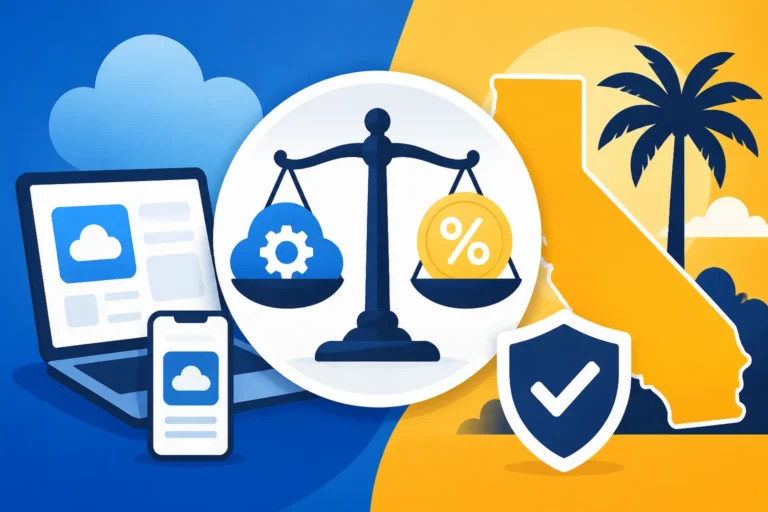
- California: California is often cited as a state that generally exempts SaaS from sales tax. The state typically views SaaS as a service, and services are generally not subject to sales tax unless specifically enumerated as taxable. While custom software is usually exempt as a service, canned software delivered electronically can still be subject to sales tax if it is considered tangible personal property, though the interpretation often leans towards exemption for downloads that aren't also made available on physical media. Navigating the nuances of California District Taxes Explained only adds to the complexity even when a product is generally exempt.
- Florida: Florida also largely exempts SaaS from sales tax. While certain information services can be taxable, the state generally doesn't impose sales tax on services unless they are part of the sale of tangible personal property. This means that a subscription to a cloud-based software application, where no physical property changes hands, is typically not subject to sales tax in Florida. However, if that SaaS product includes tangible components or a mixed transaction, taxability could change.
- Massachusetts: Massachusetts has a specific and rather complex rule. While canned software delivered electronically is generally taxable, custom software is often exempt. When it comes to SaaS, the general rule is that if the true object of the transaction is to obtain the intellectual property of the software rather than a service, it’s taxable. However, if the service component predominates, it might be exempt. This kind of "true object" test can lead to ambiguous situations that require careful analysis.
These states' approaches can provide relief for some software providers, but it doesn't mean they can ignore sales tax entirely. It still requires businesses to verify their specific product or service against the state's detailed regulations.
States with Mixed or Evolving Rules
Then there's the middle ground: states with mixed rules, where taxability might depend heavily on the specifics of the transaction, or states that are actively in the process of changing their laws. These are often the trickiest for businesses to navigate because the rules might not be clear-cut or might be subject to frequent updates.
- Louisiana: Louisiana recently made headlines by enacting legislation to tax SaaS, effective January 1, 2025. Prior to this, SaaS was generally considered an exempt service. This is a classic example of a state adapting its tax laws to capture the digital economy, and it highlights the need for businesses to stay incredibly current. This significant change demonstrates why it's vital to stay updated on 2026 Sales Tax Rate Changes by State and especially, Louisiana Now Taxes SaaS (Jan 2025).
- Illinois: Illinois taxes canned software, whether delivered electronically or physically. However, its stance on SaaS has been a bit more nuanced. While pure SaaS might not be taxable, if the software is considered "information services" or part of a broader taxable service, it could be. This ambiguity often requires a detailed review of the specific service provided and professional tax advice.
- Colorado: Colorado is known for its "home-rule" cities, which means many cities and even some counties can set their own sales tax rules independently of the state. While the state sales tax is relatively low (2.9%), the local sales taxes can vary wildly and apply differently to software. This makes compliance in Colorado exceptionally challenging, as a SaaS provider might need to track taxability at the state, county, and individual city level. Some cities might tax SaaS, while others don't, making it a patchwork quilt of rules within a single state. Understanding Colorado Home-Rule Cities Sales Tax is a must for any vendor selling there.
The constantly shifting landscape means businesses cannot simply set it and forget it when it comes to sales tax on software. Regular review of state tax guides, consulting with tax professionals, and utilizing compliance software are essential. Avalara, for instance, is one of the contextual brands that specializes in tracking these dynamic sales tax rules across all jurisdictions, which is critical for staying compliant.
| State | Canned Software (Physical) | Canned Software (Digital Download) | Custom Software | SaaS (Software-as-a-Service) |
|---|---|---|---|---|
| California | Taxable | Generally Exempt | Exempt | Generally Exempt |
| Texas | Taxable | Taxable | Taxable | Taxable (as data processing) |
| New York | Taxable | Taxable | Generally Exempt | Taxable |
| Florida | Taxable | Generally Exempt | Exempt | Generally Exempt |
| Washington | Taxable | Taxable | Taxable | Taxable (as digital service) |
| Illinois | Taxable | Taxable | Exempt | Mixed/Nuanced (often exempt) |
| Louisiana | Taxable | Taxable | Generally Exempt | Taxable (Effective Jan 2025) |
Disclaimer: This table provides a general overview and is not exhaustive. Sales tax laws are complex and can change. Always consult specific state guidance or a tax professional for your unique situation.
Staying Compliant with Software Sales Tax
Given the labyrinthine nature of sales tax on software, maintaining compliance requires more than just a passing glance at the rules. It demands a proactive, informed approach, especially for businesses with a national or even international customer base. Neglecting these obligations can lead to significant penalties, fines, and audit headaches down the road.
The Importance of Accurate Sourcing
One of the most perplexing aspects of sales tax for online and digital product sellers is accurate sourcing. Sourcing rules dictate which jurisdiction's tax rate applies to a sale, particularly when the seller and buyer are in different locations. Is the sale sourced to the origin (where the seller is located) or the destination (where the buyer receives the product or service)? For physical goods, this is relatively straightforward: you ship it to an address, and that's the destination. But for software, especially SaaS, which is accessed remotely, it can get incredibly complicated.
Most states use destination-based sourcing for sales tax, meaning the sales tax rate is determined by the customer's location. This means if you're a software company based in California but selling to a customer in Seattle, Washington, you generally need to collect Washington's sales tax, and potentially Seattle's local sales tax if you have nexus there. Accurately pinpointing the customer's exact location – down to the specific taxing jurisdiction within a state – is crucial. This is often done using the customer's billing or shipping address, or sometimes the IP address for digital products. Incorrect sourcing can mean you're collecting too much tax (making you unpopular with customers) or too little (leaving you liable to the state). It's a key challenge that often requires a dedicated solution, which ties into understanding Origin vs Destination Sales Tax Sourcing.
Leveraging Technology for Compliance
Given the sheer volume of varying state and local rules, the constant changes, and the complexities of sourcing and taxability, manually managing sales tax for software is virtually impossible for most businesses. This is where technology becomes not just a convenience, but a necessity for robust compliance. Sales tax compliance software solutions are designed to automate the entire process, from rate calculation to filing.
These platforms integrate with your e-commerce systems, accounting software, and CRMs to automatically calculate the correct sales tax at the point of sale, based on the customer's location, the specific product being sold (e.g., canned vs. SaaS), and the most up-to-date state and local tax laws. They then help you track your sales tax obligations across all your nexus states and can even assist with filing your returns. Companies like Avalara are leading providers in this space, offering sophisticated engines that monitor tax rule changes in real-time, helping businesses avoid costly errors and ensure they're collecting and remitting the correct amounts.
For any business selling software across state lines, investing in a reliable sales tax compliance solution is often the most cost-effective way to manage risk and free up valuable time that would otherwise be spent wrestling with complex tax codes. It's a proactive step towards ensuring long-term compliance and peace of mind. For more insights on this, you might find our guide on Best Sales Tax Compliance Software 2027 particularly helpful. Furthermore, if you're curious about how these systems can streamline your operations, consider exploring whether Sales Tax Automation: Is It Worth It? for your business needs.
Disclaimer
The information provided in this guide is for general informational purposes only and does not constitute tax, legal, or other professional advice. Sales tax laws are complex, constantly changing, and vary by state and locality. You should consult with a qualified tax professional or your state's tax authority for advice tailored to your specific situation.