Is Shipping and Handling Taxable?
The world of sales tax can feel like a minefield, and nothing trips up businesses quite like trying to figure out if you need to charge sales tax on shipping and handling fees. It’s a question that plagues online sellers, brick-and-mortar stores offering delivery, and just about anyone who sends goods to customers. The rules are frustratingly inconsistent from state to state, leaving many business owners scratching their heads and fearing an audit. This comprehensive guide is here to untangle that knot, walking you through the nuances of how shipping and handling charges are taxed across the U.S. and helping you confidently determine your obligations.
Understanding Sales Tax on Shipping and Handling Charges
It seems like a simple enough question: is the money I charge for shipping and handling taxable? Unfortunately, the answer is rarely a straightforward "yes" or "no." The taxability of these charges depends on a complex interplay of state laws, the nature of the items being shipped, and even how you list these fees on your invoice. There's no one-size-fits-all federal rule, which is why it's such a common point of confusion and error for businesses operating across state lines or even within states with intricate local tax structures.
The Basic Principle: Tangible Personal Property vs. Services
At the heart of the issue lies the fundamental distinction between taxable tangible personal property and non-taxable services. In many states, if you're selling a physical product that is subject to sales tax, then any charges directly associated with getting that product to the customer might also be taxable. Think of it as part of the overall cost of acquiring the taxable item. However, if the service component of shipping or handling is considered separate and distinct from the sale of the product, and that service itself isn't generally taxable in a particular state, then it might be exempt.
For instance, if you sell a taxable widget for $100 and charge $10 for shipping, some states see that $10 as an integral part of the $100 sale, making the entire $110 taxable. Other states might view the $10 shipping fee as a non-taxable service of transportation, especially if it's clearly separated on the invoice. This distinction becomes even more critical when you consider states that have a Sales Tax on Services: What's Taxable by State as part of their broader tax code. The key takeaway here is that the item being sold often dictates the taxability of the shipping fee. If the item itself is exempt from sales tax (like some groceries or clothing under a certain price point in certain states), then the shipping charge for that item is typically also exempt.
The "True Object" Test and "Separately Stated" Rule
Many states use what's often referred to as the "true object" test. This means they look at the primary purpose of the transaction. If the true object of the transaction is to acquire the tangible personal property, and shipping is merely incidental to that acquisition, then the shipping charges are generally taxable. This test is particularly relevant in situations where a service might also be involved but is secondary to the sale of a product.
Another crucial factor is whether shipping and handling charges are "separately stated" on the invoice or receipt. This isn't just about showing a line item for "shipping." It means clearly distinguishing the actual cost of postage or freight from any internal "handling" fees, which often relate to labor, packaging materials, or other operational expenses.
- Separately Stated: If you explicitly itemize "shipping" and "handling" as distinct charges from the product cost, some states will treat them differently. For example, in Texas, if you clearly separate handling from actual delivery charges, the handling portion might be taxable, while shipping might not be if it's true freight.
- Conflated Charges: If you combine "shipping and handling" into a single, undifferentiated line item, or worse, bake it directly into the product's price, states are much more likely to tax the entire amount. They often assume that if you can't or won't break it down, the whole charge is part of the taxable sale. It’s always best practice to be as transparent as possible on your invoices, even if it feels like extra work. This transparency can save you from collecting (or over-collecting) tax unnecessarily.
This leads to a confusing patchwork of rules that demands careful attention. Businesses often find themselves navigating a maze where even slight changes in invoicing can alter their sales tax obligations.
State-Specific Rules for Shipping and Handling
States Where Shipping is Always Taxable
In a number of states, if the item being sold is subject to sales tax, then the shipping, delivery, freight, and handling charges are also taxable, regardless of whether they are separately stated or not. These states often view the delivery service as an inseparable part of the overall sale of the tangible personal property. The rationale is that without the delivery, the customer wouldn't receive the product, so the delivery charge is essential to the transaction.
For example, states like Arizona, Florida, North Carolina, and Washington generally consider delivery charges taxable if the items being shipped are taxable. Let's take Washington state. If you sell a taxable item, the shipping and handling charges are considered part of the selling price and are subject to sales tax, even if you clearly break out the charges on your customer's invoice. It doesn't matter if you're shipping across town in Seattle or across the country; if the item is taxable, the shipping is too. This is a common structure that simplifies things in one sense (always tax it if the product is taxable), but it can sometimes feel unfair to customers who see a tax added to a service they perceive as separate. If you're calculating the Washington Sales Tax Rate Explained, remember to include those shipping fees!
States Where Shipping is Never Taxable (if separately stated)
On the flip side, some states take a more lenient approach. In these jurisdictions, if you sell a taxable item and separately state the shipping charges on the invoice, those shipping charges might be exempt from sales tax. The key here is "separately stated." If you lump it in with "handling" or fail to itemize it, you're likely to lose the exemption.
States like California, Texas, and New York often fall into this category, but with important nuances. In California, if the shipping charges are reasonable and separately stated, and the transportation is directly to the purchaser, it's generally not taxable. However, if you charge an inflated shipping fee that includes a profit margin or "handling" costs, the entire amount could become taxable. Similarly, in Texas, separately stated transportation charges are not taxable when the seller contracts with a third-party common carrier, and the charges represent the actual freight. If you deliver using your own vehicle, or if the "shipping" charge includes more than just actual freight, it might be taxable. It’s crucial for businesses to understand the precise wording of their state’s laws. For businesses trying to navigate the complex sales tax in California, knowing that Is Shipping Taxable in California? largely depends on separate stating can be a significant help.
States Where Taxability Depends on the Product
And then there are the states that introduce yet another layer of complexity: the taxability of shipping depends on what you're shipping. This means if an item is exempt from sales tax, its associated shipping charges are also exempt. Conversely, if the item is taxable, the shipping charges are taxable. This often applies even if the shipping is separately stated.
Consider Illinois, for example. The taxability of shipping and handling is generally determined by the taxability of the item being shipped. If you're shipping a tax-exempt item like certain food products (before the state eliminates the grocery tax in 2026), the shipping for that item would also be exempt. But if you're shipping a pair of taxable shoes, the shipping fee would be taxable. This approach requires businesses to carefully segregate their sales data by product type to correctly apply sales tax to shipping. For any business in Illinois, knowing the nuances of what's taxable is key. This is why resources detailing Is Clothing Taxable? Sales Tax on Apparel by State or Sales Tax on Groceries & Food by State become incredibly valuable.
Here's a simplified table illustrating these state variations, though remember, local rules and specific scenarios can always add more wrinkles:
| State Approach | Description | Example States |
|---|---|---|
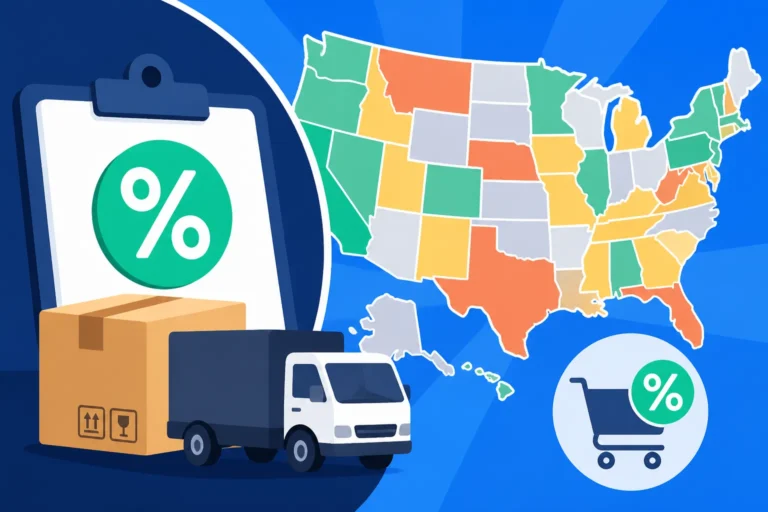
| Always Taxable | If the product is taxable, shipping/handling is taxable, regardless of separate stating. | Arizona, Florida, North Carolina, Washington, Pennsylvania, Georgia |
| Never Taxable (if separate) | If shipping is separately stated and reasonable, it's generally exempt, regardless of product taxability. | California (for direct to purchaser), Texas (for common carrier), New York (if transportation not part of sale), Rhode Island |
| Depends on Product | If the product is taxable, shipping is taxable. If the product is exempt, shipping is exempt. | Illinois, Ohio, Michigan, Colorado, Massachusetts, New Jersey, Virginia (if shipping is integral part of the sale; otherwise, often not taxed if separately stated) |
This table is a good starting point, but always verify with specific state tax departments or professional advice, as interpretations can change.
Key Factors Influencing Taxability
Beyond the basic state-by-state rules, there are other critical elements that can swing the pendulum on whether you owe sales tax on shipping and handling. Ignoring these factors can lead to under-collection and potential penalties, or over-collection, which can annoy customers.
What is "Shipping" Versus "Handling"?
Many businesses combine "shipping" and "handling" into one line item on their invoices, thinking it simplifies things. This is often where they run into trouble. State tax authorities often view these two components very differently:
- Shipping: This typically refers to the direct cost of postage or freight charged by a third-party carrier (like UPS, FedEx, or USPS) to transport the goods from the seller to the buyer. In many states that allow for non-taxable shipping, this is the portion that is eligible for exemption. For example, if you send a package from your warehouse in Dallas to a customer in Houston, the actual cost charged by the carrier to get it there is the "shipping" component.
- Handling: This is a much broader category and can include a multitude of internal costs. Think about it: the labor involved in picking and packing the order, the cost of packaging materials (boxes, bubble wrap, tape), insurance on the shipment, or even an administrative fee for processing the order. Most states view these "handling" components as services provided by the seller, and if the underlying product is taxable, then these services are often considered part of the taxable sales price. Even in states where separately stated shipping is exempt, the handling portion, if not clearly segregated and justified, is likely to be taxed. This is a common pitfall; many businesses just apply a flat "shipping and handling" fee that includes profit, making it entirely taxable in states that might otherwise exempt pure shipping costs.
The best practice here, if your state allows for shipping exemptions, is to explicitly separate "Shipping" (actual freight cost) from "Handling" (internal costs) on your invoices. Even better, consider not charging a separate "handling" fee if your state is strict on taxing those.
The Impact of Marketplace Facilitator Laws
The sales tax landscape for online sellers has been dramatically reshaped by marketplace facilitator laws, a direct result of the South Dakota v. Wayfair: What It Means for Sellers Supreme Court decision. These laws generally require platforms like Amazon, eBay, Etsy, and Walmart to collect and remit sales tax on behalf of third-party sellers using their marketplace, even if the individual seller doesn't meet economic nexus thresholds in a particular state.
How does this affect shipping and handling?
- Marketplace Responsibility: When a marketplace facilitator collects sales tax, they are typically responsible for applying the correct tax rates to both the product and any associated shipping and handling charges, based on the laws of the destination state. This means if you're selling through a platform like Amazon, and they are collecting sales tax for a California customer, they will apply California's rules regarding shipping taxability. Marketplace Facilitator Laws by State have simplified things for many small online sellers, as the marketplace shoulders the burden of calculation and remittance.
- Direct Sales: If you also sell through your own website, you are still responsible for calculating and collecting sales tax on shipping and handling for those direct sales, based on your own nexus obligations and the destination state's rules. This is where many businesses trip up; they assume because Amazon handles it for marketplace sales, they're off the hook entirely. But if you have Sales Tax Nexus Explained (Physical vs Economic) in a state and sell directly to customers there, you must comply.
It’s a dual system: the marketplace handles its sales, and you handle yours. Understanding this distinction is crucial for Sales Tax for Online Sellers: Complete Guide.
Common Mistakes and How to Avoid Them
The complexities of sales tax on shipping and handling lead to several common errors that can result in audits, penalties, and even loss of customer trust.
- Assuming One Rule Fits All: The biggest mistake is assuming that because shipping is non-taxable in your home state, it's non-taxable everywhere else. Or, conversely, that it's always taxable. This ignorance of differing state rules is a recipe for disaster. Always check the specific rules for each state where you have sales tax nexus.
- Improperly Stating Charges: As discussed, lumping "shipping" and "handling" together, or failing to clearly itemize them, often leads to the entire charge being taxed, even in states where pure shipping might be exempt. Be meticulous with your invoicing.
- Charging an Inflated "Shipping" Fee: If you're using "shipping" as a way to recoup packaging costs, labor, or make a profit, and it far exceeds the actual freight cost, tax authorities might reclassify the entire fee as taxable, even if your state typically exempts shipping. Transparency and accuracy are key.
- Ignoring Economic Nexus: With Economic Nexus by State 2026: Thresholds Guide now widespread, businesses must monitor their sales volume into every state. If you cross a threshold (e.g., $100,000 in sales or 200 transactions in many states), you suddenly have nexus and new obligations for collecting and remitting sales tax on all taxable sales, including shipping. Many businesses are caught off guard here.
- Not Reviewing Annually: Sales tax laws, including those for shipping and handling, can change. States tweak their definitions, introduce new exemptions, or clarify existing rules. What was true last year might not be true today. Make it a point to review your sales tax policies, especially for shipping, on an annual basis.
Practical Steps for Compliance
Navigating the sales tax rules for shipping and handling doesn't have to be a constant headache. By taking a structured approach and leveraging available tools, you can ensure compliance and avoid costly missteps.
How to Determine Your State's Rules
The first step, and arguably the most crucial, is to pinpoint the exact rules for each state where your business has sales tax nexus. This isn't a one-time task; it's an ongoing commitment due to the dynamic nature of sales tax laws.
- Identify Your Nexus States: Before you can determine taxability, you need to know where you're required to collect sales tax. This includes states where you have a physical presence (office, warehouse, employees) and states where you've met economic nexus thresholds. Don't forget about temporary nexus from trade shows or even affiliate nexus. Understanding your Sales Tax Nexus Explained (Physical vs Economic) is foundational.
- Consult State Tax Authority Websites: Each state's Department of Revenue or equivalent tax agency will have guidance documents, statutes, and often FAQs regarding the taxability of shipping and handling. Search specifically for "sales tax shipping and handling" on their official sites. For instance, the California Department of Tax and Fee Administration (CDTFA) or the Texas Comptroller of Public Accounts are excellent resources for their respective states.
- Review Sales Tax Guides: Many tax compliance companies and accounting firms publish comprehensive guides on state sales tax laws. While these are helpful, always cross-reference them with the official state sources.
- Seek Professional Advice: If your business has significant multi-state sales, or if you're dealing with particularly complex products or services, consulting with a sales tax professional or a tax attorney is highly recommended. Their expertise can save you significant time and potential liability.
- Document Your Findings: Keep detailed records of the rules for each state, including the date you researched them. This documentation can be invaluable if you ever face an audit.
Once you understand the rules for your nexus states, you can then implement consistent policies for charging and collecting sales tax on shipping and handling based on the customer's location.
The Role of Sales Tax Software
For businesses selling across multiple states, manually tracking and applying the correct sales tax rates, including those for shipping and handling, can quickly become overwhelming and prone to error. This is where sales tax compliance software truly shines, transforming a daunting task into a manageable one.
Sales tax software solutions, such as those offered by Avalara, automate the process of calculating sales tax at the point of sale. This means:
- Accurate Rate Calculation: The software identifies the precise sales tax rate based on the customer's destination (down to the street address in many cases), factoring in state, county, city, and special district taxes. This is vital when considering areas like California District Taxes Explained or the intricate local taxes in Louisiana.
- Shipping & Handling Logic: Crucially, these platforms are programmed with the specific sales tax rules for shipping and handling in each state. When a customer checks out, the software will automatically determine if the shipping charge is taxable based on the destination state's laws and the nature of the product, and then apply the correct tax.
- Nexus Management: Many solutions help you track your sales against economic nexus thresholds, alerting you when you're approaching or have crossed a threshold in a new state, prompting you to consider Registering for Sales Tax in Multiple States.
- Filing & Remittance: Beyond calculation, many platforms also assist with filing your sales tax returns and remitting the collected funds to the appropriate state tax authorities, streamlining the entire compliance lifecycle. For businesses aiming for optimal compliance, exploring the Best Sales Tax Compliance Software 2027 is a smart move. Platforms like Avalara integrate with most e-commerce platforms and accounting software, making the transition relatively smooth. They help ensure you’re collecting the right amount of tax, minimizing audit risk, and freeing up your valuable time.
In conclusion, while the sales tax rules on shipping and handling can be notoriously complex, they are navigable. By understanding the core principles, researching state-specific nuances, being meticulous with your invoicing, and leveraging modern compliance tools, you can confidently manage your sales tax obligations.
Disclaimer
The information provided in this guide is for general informational purposes only and does not constitute professional tax advice. Sales tax laws are complex and subject to change. Always consult with a qualified tax professional or state tax authority for advice tailored to your specific situation.