Sales Tax on a $100 Purchase by State
We have all been there: you find the perfect item priced at exactly $100, you head to the checkout with a crisp bill in hand, and suddenly the screen flashes $109.25. It is an incredibly frustrating moment that makes you feel like you are being nickel-and-dimed at every turn. This guide pulls back the curtain on why that happens, showing you exactly how much tax you will pay on a $100 purchase in every corner of the country.
Why Your $100 Receipt Never Actually Says $100
There is a psychological comfort in round numbers. Retailers know this, which is why they love the $99.99 or $100 price point. But in the United States, we live with a "transparent" tax system, meaning the price you see on the shelf is rarely the price you pay at the register. Unlike in many European countries where the Value Added Tax (VAT) is baked into the sticker price, our sales tax is added at the final second.
This creates a constant sense of "bill shock." If you are shopping in a state with no sales tax, $100 is $100. But if you are standing in a high-tax jurisdiction like Chicago or Los Angeles, that same $100 bill isn't going to cover your purchase. The gap between the advertised price and the final cost is driven by a complex layering of state, county, city, and even special district taxes. To truly understand the final number, you have to look at the Combined State + Local Sales Tax Rates Explained to see how these layers stack up.
The Psychology of the Checkout Surprise
For most consumers, the extra few dollars might feel like a minor annoyance, but for a business owner or someone on a tight budget, these percentages represent a significant drain on purchasing power. When you think you are spending $100 but end up spending $110, you have effectively lost 10% of your budget to a variable you can't control. This is why many people find themselves constantly using a Sales Tax Calculator: How to Calculate Sales Tax just to make sure they have enough in their digital wallet before they hit the "buy" button.
The frustration is even deeper for online shoppers. You might be sitting in a low-tax area, but if you are shipping a gift to a friend in a high-tax city, the price changes instantly. This brings up the age-old question: Is Sales Tax Based on Billing or Shipping Address? Generally, it is the destination that matters, which adds another layer of mental math to your Sunday afternoon shopping.
How State and Local Add-ons Create Tax Stacking
Think of sales tax like a layer cake. The bottom layer is the state rate. Most states have a base rate that applies to everything sold within their borders. On top of that, the county might add its own percentage. Then the city adds another. Sometimes, there is even a "special district" tax for things like public transit, stadiums, or school improvements.
By the time you reach the top of the cake, the "icing" (the tax) can be quite thick. In places like Alabama or Louisiana, the state rate is relatively modest, but the local add-ons are massive. This is why looking at a Average Sales Tax Rate by State only tells half the story. You really have to zoom in to the street level to see the full impact on your $100 purchase.
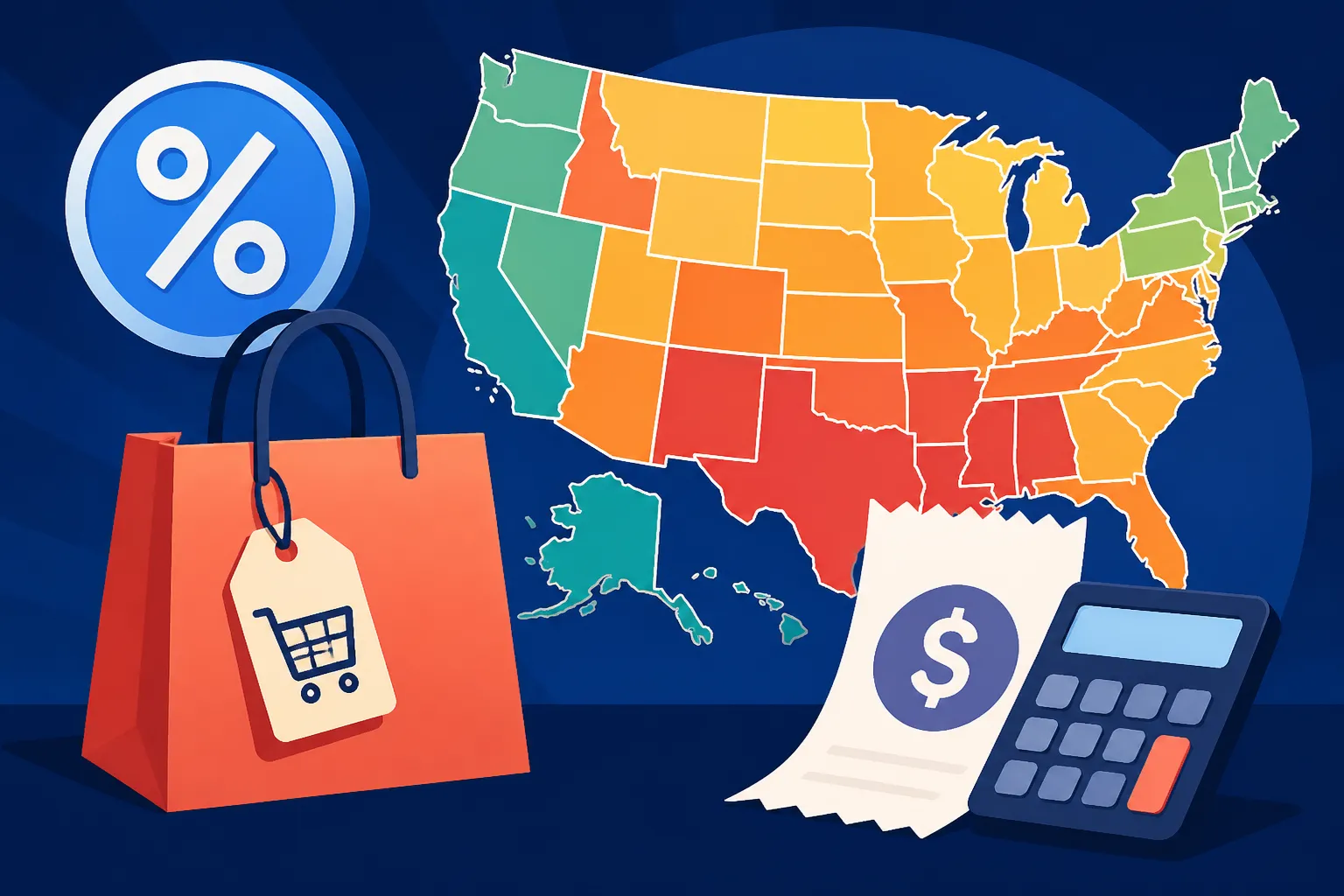
Mapping the Costs: Sales Tax on $100 Across the 50 States
The amount you pay on that $100 purchase varies wildly depending on which side of a state line you are standing on. It is one of the quirks of American federalism that can lead to some very strategic shopping habits.
The Zero-Tax Club: States Where $100 Means $100
There are five states in the U.S. where your $100 purchase will actually cost you $100. These are often referred to by the acronym "NOMAD": New Hampshire, Oregon, Montana, Alaska, and Delaware. For shoppers in these states, the "bill shock" we talked about earlier simply doesn't exist. You can read more about these lucky jurisdictions in our guide to States With No Sales Tax (NOMAD Explained).
However, there is a catch. While these states don't have a state-level sales tax, some—like Alaska—allow local municipalities to charge their own taxes. So, while you might pay $100 in Anchorage, you might pay $105 in a smaller Alaskan village. It is a reminder that even in "tax-free" zones, you have to stay alert to the local rules.
The Middle Ground: States with Moderate Rates
Most Americans live in what I call the "six-to-seven-percent zone." States like Florida, Michigan, and Pennsylvania fall into this category. In these states, your $100 purchase will usually end up costing between $106 and $107.50. It is enough to notice, but usually not enough to make you drive fifty miles out of your way to avoid it.
In these moderate states, the tax is often seen as a fair trade-off for the services provided. However, even here, things are changing. With 2026 Sales Tax Rate Changes by State, many of these "stable" rates are ticking upward to fund infrastructure projects or bridge budget gaps. What was a $106 purchase last year might be $106.50 this year.
The High-Cost Zones: Where $100 Hits $110+
Then there are the heavy hitters. In states like Tennessee, Arkansas, and Louisiana, the combined rate often hovers near or above 10%. If you are buying a $100 item in Birmingham, Alabama, or New Orleans, you are looking at a final price tag of roughly $110. This is where Which States Have the Highest Local Sales Tax? becomes a very relevant question for anyone looking to save money.
In these high-tax areas, the sales tax is often a primary source of revenue because the state might have a lower income tax. It is a "pay as you go" model for government funding, but it certainly makes that $100 purchase feel a lot heavier.
A State-by-State Breakdown: What You Pay on $100
To give you a clearer picture, let's look at a representative sample of how that $100 purchase translates to real-world dollars at the register across different regions.
| State | Base State Tax | Avg. Local Tax | Total Tax on $100 | Total Price Paid |
|---|---|---|---|---|
| Alabama | 4.00% | 5.29% | $9.29 | $109.29 |
| California | 7.25% | 1.60% | $8.85 | $108.85 |
| Colorado | 2.90% | 4.98% | $7.88 | $107.88 |
| Florida | 6.00% | 1.02% | $7.02 | $107.02 |
| Illinois | 6.25% | 2.61% | $8.86 | $108.86 |
| Louisiana | 4.45% | 5.11% | $9.56 | $109.56 |
| New York | 4.00% | 4.53% | $8.53 | $108.53 |
| Oregon | 0.00% | 0.00% | $0.00 | $100.00 |
| Tennessee | 7.00% | 2.55% | $9.55 | $109.55 |
| Texas | 6.25% | 1.95% | $8.20 | $108.20 |
| Washington | 6.50% | 2.89% | $9.39 | $109.39 |
Note: These are average combined rates as of 2026. Specific cities may be significantly higher.
The Hidden Complexity of Local Add-ons and Surcharges
If you look at the table above, you'll notice that in many states, the "Local Tax" is actually higher than the "State Tax." This is the part that drives business owners crazy. If you are selling a $100 product online, you can't just set a single rate for the whole state and call it a day. You have to know exactly where that customer is standing.
Why Your ZIP Code Is Often Misleading
One of the biggest mistakes people make is assuming that a ZIP code is a tax code. It is a common myth, but the reality is much messier. A single ZIP code can overlap two different counties, three different cities, and a special fire district. If you rely solely on ZIP codes, you are bound to get the tax wrong on that $100 purchase.
This is why experts always say Sales Tax by ZIP Code (and Why ZIP Isn't Enough). To get it right, you really need the full street address. For companies that sell thousands of items a day, this is an impossible task to do manually. Many turn to professional services like Avalara to handle the geocoding and real-time rate lookups so they don't end up under-collecting and owing the state money out of their own pockets.
Home-Rule Cities and Special Taxing Districts
In states like Colorado and Alabama, local cities have "Home-Rule" authority. This means they don't just set their own rates; they also have their own rules about what is taxable and they collect their own taxes. If you sell a $100 gadget to someone in a home-rule city, you might have to file a separate tax return just for that one city.
Then there are special taxing districts. These are small areas, sometimes just a few blocks or a single shopping mall, where an extra 0.5% or 1% is added to pay for things like a new parking garage or a community improvement project. You could walk across the street from one store to another and pay a different amount of tax on the exact same $100 item.
Real-World Scenarios: How What You Buy Changes the Tax
The "what" is often just as important as the "where." Not every $100 purchase is treated equally by the tax man.
The Grocery and Clothing Exceptions
If your $100 purchase is made up of milk, bread, and eggs, you might pay zero tax in many states, even if the general sales tax rate is high. States like Texas and Pennsylvania exempt most "unprepared" groceries. On the other hand, if you are in Alabama or Mississippi, you will pay the full rate on those groceries, making that $100 grocery bill hurt a lot more.
Clothing is another weird one. In New York, any single item of clothing under $110 is exempt from the state's 4% sales tax (though local taxes may still apply). So, a $100 pair of jeans in NYC is taxed differently than a $120 pair. Pennsylvania and New Jersey generally don't tax clothing at all. It is a bizarre patchwork that makes you wonder how anyone keeps it all straight without Best Sales Tax Compliance Software 2027.
Digital Goods and the Modern Sales Tax Landscape
What if your $100 purchase isn't something you can hold in your hand? In the old days, "tangible personal property" was the only thing taxed. But today, if you spend $100 on a software subscription, a digital movie collection, or an e-book, many states will still want their cut.
The rules for digital goods are shifting rapidly. Some states tax SaaS (Software as a Service) at the full rate, while others have a reduced rate or no tax at all. This is part of the broader Economic Nexus by State 2026: Thresholds Guide that businesses have to follow. If a company sells enough $100 digital packages into a state, they are legally required to start collecting tax there, even if they don't have an office or a single employee in that state.
Tools to Manage the Madness
If reading all of this makes your head spin, imagine being a small business owner trying to ship products to all 50 states. It is a compliance nightmare. Calculating the tax on a $100 purchase manually for every single jurisdiction in America would take more time than actually running the business.
Why Manual Tracking Fails Small Businesses
Manual tracking is a recipe for disaster. Rates change every quarter, new districts are formed, and "tax holidays" (weekends where certain items are tax-free) pop up throughout the year. If you get it wrong, the penalties and interest can be devastating.
I’ve seen businesses get audited and realize they owed years of back taxes because they didn't realize a specific city had a 1% add-on. It is a gut-wrenching experience that is entirely avoidable. Using a robust system like Avalara helps automate this entire process, ensuring that the $100 purchase in your cart always reflects the exact, down-to-the-penny tax required by law.
Automating with Professional Solutions
In 2026, automation isn't just a luxury; it’s a necessity. Modern platforms integrate directly with your website's checkout. When a customer enters their address, the software instantly checks the exact coordinates, identifies every overlapping tax jurisdiction, and applies the correct rate.
Platforms like Avalara do the heavy lifting so you don't have to. They stay up-to-date with the thousands of rate changes that happen every year, allowing you to focus on selling more $100 items rather than worrying about the $8.25 tax you need to remit to a county three states away. If you're looking to scale, checking out Best Sales Tax Compliance Software 2027 is one of the smartest moves you can make for your sanity and your bottom line.
The Big Picture: Why We Pay Sales Tax
At the end of the day, while that $100 purchase costing $109.50 feels annoying, those tax dollars are what keep our communities running. They fund the roads we drive on to get to the store, the schools our kids attend, and the emergency services that keep us safe.
Understanding the "why" and the "how" doesn't necessarily make it cheaper, but it does take the mystery out of the checkout experience. Whether you are buying a $100 gadget or looking into How Much Is Sales Tax on a Car by State, being an informed consumer means no more bill shock at the register. You'll know exactly what to expect, down to the very last cent.
Disclaimer
This guide is for informational purposes only and does not constitute legal, tax, or financial advice. Sales tax rates, laws, and exemptions are subject to frequent change by state and local authorities. Always consult with a qualified tax professional or refer to official state Department of Revenue resources to confirm current tax obligations for your specific location and situation.