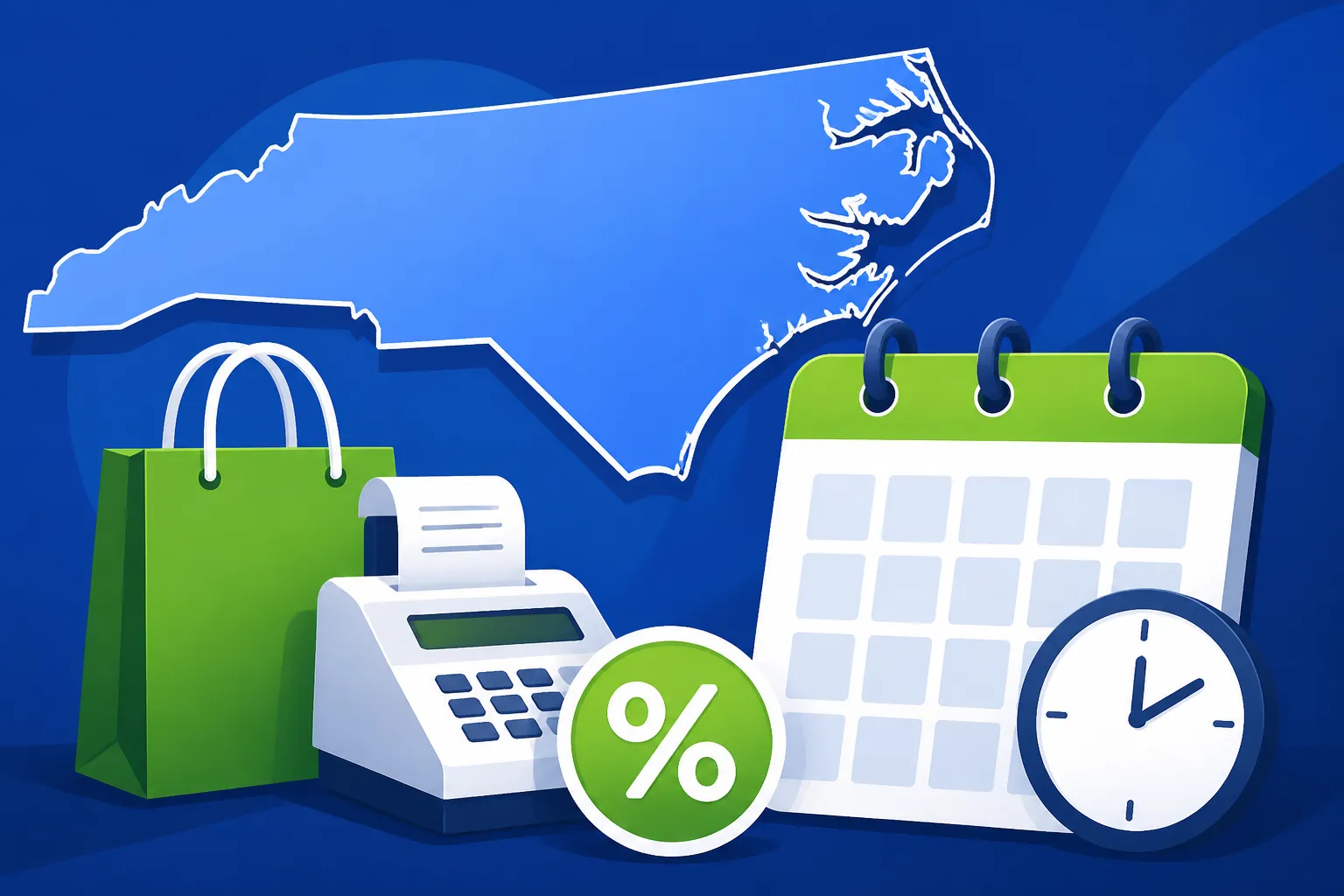
North Carolina Sales Tax Due Dates 2026
Trying to keep up with sales tax due dates in North Carolina can feel like a never-ending game of "don't miss this deadline!" for business owners. Between state holidays, weekends, and just the sheer volume of other tasks, it's easy to get overwhelmed and even miss a crucial date, leading to penalties. This comprehensive guide is designed to clarify all the essential North Carolina sales tax due dates, breaking down everything you need to know to stay compliant and stress-free.
Understanding North Carolina Sales Tax Filing
North Carolina's sales and use tax system, like many states, can feel a bit complex at first glance. It's not just a flat rate; you're dealing with a statewide general rate combined with various local sales taxes for counties and transit authorities. This layered approach means that while the state sets the foundation, your exact obligations depend on where your sales are made and even the specific goods or services you provide. Keeping tabs on what you owe and, more importantly, when it's due is absolutely critical for any business operating in the Tar Heel State. Ignoring these dates can lead to a cascade of penalties and interest, which no business owner wants to deal with.
Who Needs to File Sales Tax in North Carolina
If you're selling tangible personal property, certain services, or digital products in North Carolina, you likely have an obligation to collect and remit sales tax. This obligation, known as nexus, can arise in a couple of ways. Traditionally, a physical presence in the state—like having a storefront, office, employees, or inventory—would trigger sales tax nexus. However, after the landmark 2018 Supreme Court decision in South Dakota v. Wayfair, states can also establish economic nexus.
For North Carolina, this means if your sales into the state exceed $100,000 or you have 200 or more separate transactions in the current or previous calendar year, you are considered to have economic nexus, even if you don't have a physical presence. This applies to both in-state and out-of-state sellers. Once nexus is established, you'll need to obtain a sales tax permit from the North Carolina Department of Revenue (NCDOR). If you're wondering if this applies to you, you might want to dive into our guide on Sales Tax Nexus Explained Physical vs Economic. You can also find out more about specific thresholds in our broader resource, Economic Nexus by State 2026 Thresholds Guide.
Different Types of Sales Tax Returns
For most businesses in North Carolina, filing sales and use tax involves submitting Form E-500, the "Sales and Use Tax Return." This single form consolidates all state and local sales and use taxes collected. It’s designed to be comprehensive, covering everything from general merchandise sales to specific taxes on food, prepared meals, and even certain digital services, depending on their taxability.
While the E-500 is the primary vehicle, the NCDOR also handles various other tax types, such as highway use tax (often related to vehicle sales) and certain excise taxes. However, for the typical retailer or service provider, the E-500 is your main point of interaction. It's crucial to ensure all sales, whether from brick-and-mortar stores, online platforms, or even temporary pop-up shops, are accurately reported on this form according to your assigned filing frequency. Don't forget that if you also have use tax obligations, for instance, on purchases for your business where sales tax wasn't collected, that also gets reported on this same E-500 form.
North Carolina Sales Tax Due Dates 2026 Calendar
Staying on top of your North Carolina sales tax due dates is essential for avoiding penalties and ensuring smooth business operations. The NCDOR generally sets due dates for the 20th of the month following the reporting period. However, filing frequencies can vary, so it's vital to know whether you're a monthly, quarterly, or annual filer. Let's break down the specific deadlines for 2026.
Monthly Filing Deadlines
Many businesses, especially those with higher sales volumes or new registrations, are assigned a monthly filing frequency. This means you report and remit the sales tax collected for each calendar month by the 20th of the following month.
Here are the monthly sales tax due dates for North Carolina in 2026:
| Reporting Period | Due Date (2026) |
|---|---|
| January | February 20 |
| February | March 20 |
| March | April 20 |
| April | May 20 |
| May | June 20 |
| June | July 20 |
| July | August 20 |
| August | September 20 |
| September | October 20 |
| October | November 20 |
| November | December 20 |
| December | January 20, 2027 |
For example, if you collect sales tax throughout January 2026, you'll need to have your Form E-500 filed and the payment remitted to the NCDOR by February 20, 2026. This consistent schedule demands good record-keeping throughout the month to ensure you have all your figures ready well before the deadline.
Quarterly Filing Deadlines
Some businesses, typically those with lower sales tax liabilities, might be assigned a quarterly filing frequency. This simplifies the process by requiring you to report and pay sales tax four times a year, instead of twelve.
The quarterly reporting periods and their corresponding due dates for 2026 are:
| Reporting Period | Due Date (2026) |
|---|---|
| Q1 (Jan – Mar) | April 20 |
| Q2 (Apr – Jun) | July 20 |
| Q3 (Jul – Sep) | October 20 |
| Q4 (Oct – Dec) | January 20, 2027 |
If your business is on a quarterly schedule, you'll compile all the sales tax collected during, say, April, May, and June of 2026, and then file that return and make the payment by July 20, 2026. This can be a bit of a relief compared to monthly filing, but it still requires diligence to ensure you don't overlook an entire quarter's worth of sales.
Annual Filing Deadlines
For businesses with very minimal sales tax liability, the NCDOR might assign an annual filing frequency. This is the least frequent option and is typically reserved for very small businesses or those with infrequent taxable sales.
For annual filers, the sales tax collected for the entire 2026 calendar year will be due by January 20, 2027. This means you collect throughout the year but only have one major filing event. While seemingly simpler, it requires even more discipline to set aside the collected tax throughout the year so you're not caught off guard with a large payment in January. It's often helpful to keep these funds in a separate bank account.
Handling Weekends and Holidays
Life doesn't always align with tax deadlines, and state offices often close on weekends and holidays. The good news is that North Carolina, like most states, has a rule for this: if a sales tax due date falls on a weekend or a state-recognized holiday, the deadline is automatically extended to the next business day.
For example, if July 20, 2026, were a Sunday, then the actual due date for Q2 (April-June) quarterly filers and July monthly filers would shift to Monday, July 21, 2026. It's a small detail, but one that can save you from a last-minute panic or an accidental late filing. Always double-check the calendar, especially around holiday periods, to be absolutely sure of the final deadline.
Navigating Filing Frequencies and Adjustments
Understanding your sales tax filing frequency is just as important as knowing the specific due dates. The North Carolina Department of Revenue determines how often you need to file, and it's not always a "set it and forget it" situation. Your business growth can actually trigger a change in this frequency, which can sometimes catch business owners off guard.
How Filing Frequency is Determined
When you initially register for a sales tax permit in North Carolina, the NCDOR will assign your filing frequency. This decision is primarily based on your estimated sales tax liability. New businesses, even small ones, are often initially set up for monthly filing. This allows the state to monitor your sales activity more closely.
As your business matures, the NCDOR periodically reviews your actual sales tax collections. If your average monthly liability is consistently below a certain threshold (which the NCDOR determines and may adjust), they might re-assign you to a quarterly or even annual filing schedule. Conversely, if your sales grow significantly and you're collecting a lot more tax than your current frequency suggests, you might be moved from quarterly to monthly filing. This reassignment is usually communicated to you in writing. It's important to understand that this isn't something you typically choose; it's assigned by the state based on your activity. For more on this, you can review our detailed guide on Sales Tax Filing Frequency Explained.
Changing Your Filing Frequency
While the NCDOR primarily controls filing frequency assignments, businesses can sometimes request a change, though it's not always guaranteed. If you feel your current frequency no longer reflects your sales volume – perhaps your business has significantly slowed down, or you're now reporting zero sales consistently – you might be able to petition the NCDOR to move to a less frequent schedule.
To do this, you would typically need to contact the NCDOR directly, explain your situation, and provide supporting documentation of your sales activity. They will then review your account and determine if a change is warranted. It’s important to remember that any change initiated by you will still be subject to NCDOR approval and their criteria. It's less common for businesses to request more frequent filing, as monthly filing generally involves more administrative burden, but it could happen if you wanted to remit tax more regularly to avoid holding large sums.
Vendor Discounts and Electronic Filing Incentives
Many states offer a "vendor discount" or "timely filing discount" to businesses as an incentive to file and remit sales tax on time. This discount typically allows you to keep a small percentage of the sales tax you collected to help offset the costs of compliance. Unfortunately, North Carolina is one of the states that does not offer a vendor discount for sales tax. So, while other states might offer a small perk, businesses in NC must remit the full amount of sales tax collected.
However, the NCDOR strongly encourages, and in many cases requires, electronic filing for sales tax returns. Filing electronically through the NCDOR's online portal is not only more convenient but also often more accurate, as the system can perform some basic error checks. While there isn't a direct financial incentive for electronic filing, the benefits are clear: faster processing, instant confirmation that your return has been received, and generally a smoother experience compared to paper filing. It significantly reduces the chances of mail delays or lost returns, helping you meet those critical North Carolina sales tax due dates.
Penalties for Late Filing and Non-Compliance
Missing a sales tax due date in North Carolina isn't just a minor oversight; it can lead to tangible financial consequences for your business. The NCDOR is serious about compliance, and they impose penalties for both failing to file on time and failing to pay on time. These penalties can add up quickly, making it far more expensive to ignore your obligations than to address them proactively.
Understanding Penalties and Interest
The North Carolina Department of Revenue applies distinct penalties depending on the nature of the non-compliance:
- Failure to File Penalty: If you don't file your sales tax return by the due date (including any extensions), you could face a penalty of 5% of the net tax due for each month, or part of a month, that the return is late. This penalty is capped at 25% of the net tax due. This means even if you have no tax due, you still need to file a "zero return" to avoid this penalty.
- Failure to Pay Penalty: If you file your return on time but don't pay the tax due by the deadline, you'll be assessed a penalty of 0.5% of the unpaid tax for each month, or part of a month, that the tax remains unpaid. This penalty is also capped at 25% of the unpaid tax.
- Interest: In addition to penalties, the NCDOR charges interest on underpayments and late payments. The interest rate is adjusted periodically, but it applies from the original due date until the tax is paid in full. Interest accrues even if you have a valid extension to file, as extensions typically only grant more time to file, not to pay.
Consider a scenario: you owe $1,000 in sales tax for a given month. If you file and pay three months late, you could be looking at a 15% failure-to-file penalty ($150) plus 1.5% failure-to-pay penalty ($15), plus any accrued interest. This quickly eats into your profits. To get a broader understanding of penalties across different states, check out our guide on Sales Tax Penalties & Late Filing by State.
Tips for Avoiding Late Penalties
Avoiding sales tax penalties starts with a robust system and proactive habits. Here are some practical tips to keep your North Carolina sales tax compliance on track:
- Mark Your Calendar Religiously: As soon as you know your filing frequency and the due dates, mark them clearly on multiple calendars—digital, physical, whatever works for you. Set reminders a week before the due date and again a day or two before.
- Separate Funds: One of the biggest pitfalls is not having the money ready when it's due. Create a separate bank account for collected sales tax. As soon as you collect it from a customer, transfer it to this dedicated account. This ensures the funds are there when the due date arrives and prevents you from accidentally using them for other business expenses.
- File Even if You Can't Pay: This is a critical piece of advice. If, for some reason, you don't have the full amount of tax due, still file your return on time. This will prevent the often higher "failure to file" penalty. You'll still incur a "failure to pay" penalty and interest, but it's generally a smaller burden. Then, contact the NCDOR to discuss payment options.
- Use Automation Software: Manual calculations and tracking are prone to human error and can easily lead to missed deadlines, especially as your business grows or if you start selling in multiple states. Sales tax compliance software, like Avalara, can automatically calculate the correct sales tax rates at the point of sale, track your nexus obligations, and even prepare and file your returns for you. This significantly reduces the administrative burden and the risk of errors.
- Review Sales Regularly: Don't wait until the day before the due date to gather all your sales data. Establish a routine to review your sales and tax collected weekly or bi-weekly. This helps you catch discrepancies early and ensures you're prepared for filing.
- Understand North Carolina's Specifics: Always be aware of the current North Carolina Sales Tax Rate 2026 and any local district taxes that might apply to your sales.
By integrating these practices, you can dramatically reduce your risk of facing penalties and keep your business in good standing with the NCDOR.
Streamlining Your Sales Tax Compliance
Managing sales tax can feel like a labyrinth, especially with varying rates, changing regulations, and the constant pressure of due dates. For businesses, particularly those operating across multiple jurisdictions or with a high volume of transactions, manually handling sales tax can become a significant drain on resources and a source of constant anxiety. This is where modern solutions come into play, offering a path to efficiency and accuracy.
The Benefits of Sales Tax Automation
Imagine a world where sales tax calculations, collection, and filing happen almost entirely in the background, without you having to manually look up rates, worry about nexus, or spend hours preparing returns. That's the promise of sales tax automation software. These platforms integrate directly with your e-commerce platforms (like Shopify or WooCommerce), accounting software (like QuickBooks or Xero), and ERP systems.
Here's how they can revolutionize your compliance:
- Accurate Rate Calculation: Automation tools use sophisticated databases to instantly determine the correct state, county, city, and special district sales tax rates based on the customer's shipping address (or origin, depending on the state's rules). This is incredibly helpful when you consider the nuances of Sales Tax Rates by State 2026 All 50 States and Combined State + Local Sales Tax Rates Explained.
- Nexus Tracking: As your business grows, so does your potential sales tax nexus footprint. Software can track your sales activity across states, alerting you when you're approaching or have met economic nexus thresholds, prompting you to register for a permit where needed.
- Taxability Determination: Not every product or service is taxable in every state, or even in the same way. Is clothing taxable? What about digital products? Automation can help determine the taxability of your specific offerings based on each state's rules.
- Return Preparation and Filing: Many solutions can automatically populate your sales tax returns (like North Carolina's Form E-500) and even file them directly with the NCDOR and other state tax agencies, ensuring you meet all sales tax due dates. Some software, like Avalara, can handle this end-to-end, saving you immense time and reducing errors. For a deeper dive into available tools, explore our guide on Best Sales Tax Compliance Software 2027.
- Audit Trail: These systems maintain a detailed record of all transactions, calculations, and filings, providing an invaluable audit trail should the NCDOR ever come knocking.
While there's an investment involved, the time savings, reduction in errors, and peace of mind offered by automation often far outweigh the costs, especially for growing businesses.
Seeking Professional Guidance
Even with the best automation tools, there are times when a human expert is indispensable. Sales tax law is incredibly complex and constantly evolving. If your business faces unique challenges or particularly intricate situations, professional guidance can be a lifesaver.
Consider reaching out to a sales tax expert or a knowledgeable CPA if:
- You're expanding rapidly into new states: Understanding new nexus obligations, registration requirements (like How to Get a Sales Tax Permit by State), and local rates can be overwhelming.
- Your products or services have ambiguous taxability: Some items, like software-as-a-service (SaaS) or certain digital goods, have varying tax rules by state. An expert can provide clarity.
- You're dealing with past non-compliance: If you've discovered that you should have been collecting sales tax but haven't, an expert can guide you through options like voluntary disclosure agreements to minimize penalties.
- You're undergoing an audit: Navigating a sales tax audit without professional help can be daunting and potentially costly.
- You need help setting up your initial compliance system: A professional can help you choose the right software, configure it correctly, and establish best practices from the start.
While tools like Avalara can automate much of the grunt work, a seasoned expert provides strategic advice, helps interpret complex regulations, and acts as a trusted advisor, ensuring your business remains compliant and agile in the ever-changing world of sales tax. Don't hesitate to invest in expertise when the stakes are high.
Disclaimer
The information provided in this article is for general informational purposes only and does not constitute tax, legal, or accounting advice. Sales tax laws are complex and subject to change. Always consult with a qualified tax professional or the appropriate state tax authority for advice tailored to your specific situation.