Does Online Shopping Have Sales Tax?
Oh, the days of happily clicking "checkout" and only seeing the product price and shipping, right? Many of us remember a time when shopping online felt like a secret loophole to avoid sales tax. It was a nice perk, a little bonus for choosing convenience. But if you've been shopping lately, you've probably noticed that an extra line item for sales tax has become the norm, often adding a surprising chunk to your total. It's frustrating to suddenly pay more, and it leaves many wondering: "Why am I being charged sales tax online now, and how exactly is it calculated?" This guide will clear up all that confusion, walking you through the monumental shifts that changed online sales tax forever.
The Early Days: When Physical Presence Was King
For many years, the world of sales tax for online purchases operated under a very different set of rules, often leaving consumers delighted and local brick-and-mortar businesses utterly exasperated. It truly felt like the wild west of e-commerce, where a simple click could often mean tax-free shopping, depending on where you and the seller were located.
The Physical Presence Rule and Its Limitations
The entire system was dictated by a legal precedent known as the "physical presence rule." This rule, established way back in 1992 by the Supreme Court case Quill Corp. v. North Dakota, stated that a business only had to collect sales tax from customers in states where it had a "physical presence." Think about it: a storefront, an office, a warehouse, or even an employee. If an out-of-state business didn't have any of those things in your state, they generally weren't required to charge you sales tax.
This rule made a lot of sense in a pre-internet world where commerce was primarily local or via mail-order catalogs from well-established businesses with physical footprints. But as the internet blossomed and online shopping took off, this created a massive disconnect. A small online boutique in Oregon (a state with no statewide sales tax) could sell to a customer in California without collecting California sales tax, simply because they didn't have a physical store or warehouse there. Meanwhile, the local toy store down the street from that California customer had to charge sales tax, putting them at a distinct price disadvantage. It wasn't just unfair; it created a real headache for states trying to fund essential services.
An Uneven Playing Field for Businesses
This "physical presence" distinction led to a hugely uneven playing field. Small businesses with a single physical location found themselves competing against online giants who could offer lower prices because they weren't burdened with collecting and remitting sales tax in dozens of states. For a small business owner struggling to keep their doors open, watching customers migrate online for tax-free purchases was incredibly demoralizing. It wasn't about avoiding tax altogether, as consumers were technically supposed to report and pay "use tax" on these untaxed purchases, but let's be honest, very few people actually did. You can learn more about this often-forgotten obligation in our guide to Use Tax Explained: What It Is & When You Owe It.
The rapid growth of e-commerce meant states were losing out on billions of dollars in potential sales tax revenue. This wasn't just about a few pennies here and there; it was a significant portion of their budgets. Lawmakers and local business advocates began to push for changes, arguing that the existing laws were outdated and no longer reflected the realities of modern commerce. They sought a way to level the playing field and ensure that sales tax applied fairly, regardless of whether a purchase was made in a brick-and-mortar store or with a few clicks online.
The Landmark Shift: South Dakota v. Wayfair
The dissatisfaction with the old "physical presence" rule eventually reached a boiling point, culminating in a monumental Supreme Court decision that completely reshaped the landscape of online sales tax. This case, South Dakota v. Wayfair, Inc., changed everything for businesses and consumers alike.
The Rise of Economic Nexus
On June 21, 2018, the Supreme Court issued its ruling in South Dakota v. Wayfair, Inc., overturning the long-standing physical presence precedent set by Quill Corp.. The Court recognized that in the age of e-commerce, a business could have a significant economic impact on a state without ever needing a physical store or employee there. This led to the creation of a new concept: economic nexus.
Economic nexus means that if an out-of-state business meets certain thresholds of sales or transactions into a state, they are required to collect and remit sales tax, even if they don't have a physical presence. These thresholds vary by state, but commonly involve a certain dollar amount of sales (e.g., $100,000 in gross sales) or a number of transactions (e.g., 200 separate transactions) into the state within a given year. For instance, the Economic Nexus Threshold in California ($500k) is solely based on revenue, while some other states still consider transaction counts. This was a game-changer, as it effectively allowed states to cast a wider net and require online sellers to collect sales tax from their residents.
The Immediate Ripple Effect Across States
Following the Wayfair decision, states wasted no time in enacting their own economic nexus laws. It was a dizzying sprint, with state legislatures quickly passing new regulations to capture the sales tax revenue they had been missing. Within a couple of years, nearly all states that impose a statewide sales tax had implemented their own versions of economic nexus rules.
This rapid adoption meant that online retailers, whether they were selling handmade crafts on Etsy or operating a large e-commerce site, suddenly had to figure out where they had established nexus and begin collecting sales tax. The complexity exploded overnight, as businesses now needed to monitor their sales into every state, understand each state's unique thresholds, and then register for sales tax permits in those states. For many small businesses, this compliance burden felt overwhelming, prompting many to explore solutions like Avalara to help manage the intricate requirements. Our comprehensive guide, Economic Nexus by State 2026: Thresholds Guide, provides a state-by-state breakdown of these critical thresholds.
Deciphering Sales Tax Calculations for Online Purchases
So, now we know why sales tax is being collected on online orders. But the next big question is: how exactly is that amount calculated? It's not always a simple statewide percentage, and there are several factors that contribute to the final sales tax figure you see at checkout.
The Importance of Location: Sourcing Rules
When you buy something online, the sales tax rate isn't just based on the state where the seller is located, nor is it always simply the statewide rate. It's typically determined by the destination of the order—your shipping address. This is known as "destination-based sourcing," and it's the most common approach for remote sellers, including online stores. So, if you live in Seattle, Washington, you'll generally pay the sales tax rate applicable to Seattle, even if the online store is based in Miami, Florida. This differs from "origin-based sourcing," where the tax rate is determined by the seller's location, which is less common for remote transactions but important in some states like Illinois or Texas for in-state sellers. Understanding the nuances of these rules is vital, and you can dive deeper into this topic with our detailed explanation of Origin vs Destination Sales Tax Sourcing.
This means the sales tax calculation needs to be incredibly precise, often down to the exact street address. Why? Because local sales tax rates, which can include city, county, and special district taxes, are determined by specific geographic boundaries, not just ZIP codes. Using just a ZIP code can lead to incorrect calculations, as ZIP codes are postal boundaries, not tax jurisdictions. Our article on Sales Tax by ZIP Code (and Why ZIP Isn't Enough) explains this common pitfall.
Beyond State Rates: Local and District Taxes
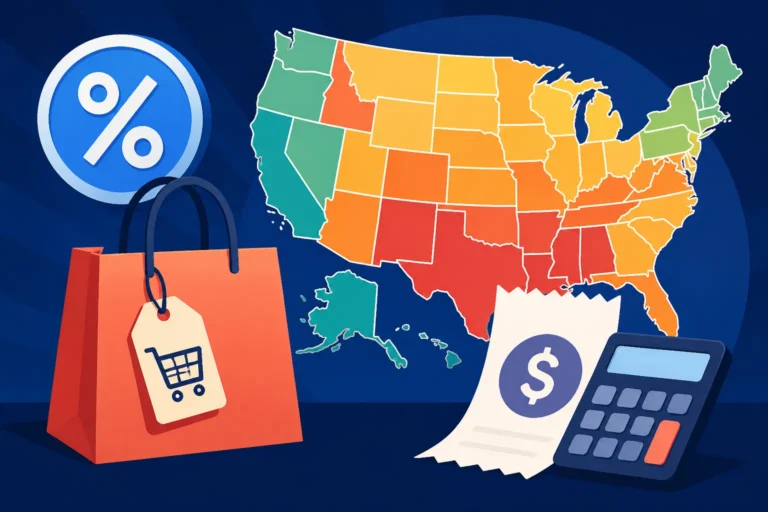
Here's where it gets even more complex: sales tax isn't just a single statewide percentage. Most states allow counties, cities, and special taxing districts to impose their own local sales taxes on top of the state rate. For example, while California has a statewide rate of 7.25%, many cities and counties within California have additional district taxes that push the combined rate much higher, sometimes above 10%.
When you buy online, the system needs to identify all these layers of tax for your specific shipping address. This means calculating the state tax, then adding any county tax, then any city tax, and finally any special district taxes (like those for transportation, schools, or public safety). This combined rate is what you ultimately see. It's why the sales tax on an identical item can vary significantly even between two towns just a few miles apart in the same state. If you want to understand these layers better, check out our piece on Combined State + Local Sales Tax Rates Explained.
The Role of Sales Tax Automation Software
Given the incredible complexity of calculating sales tax for millions of products shipped to thousands of different jurisdictions with constantly changing rates, manual calculation is virtually impossible for most businesses. This is where specialized sales tax automation software comes into play. Solutions like Avalara, TaxJar, and others integrate directly into e-commerce platforms, POS systems, and accounting software.
These tools instantly determine the correct sales tax rate for each transaction based on the customer's shipping address, the taxability of the product (yes, some products are taxed differently than others!), and the seller's nexus obligations. They then collect the appropriate tax, track it, and help businesses file their returns with the correct state and local authorities. For consumers, this means a more accurate charge at checkout. For businesses, it's a lifeline for compliance, helping them avoid penalties and stay on top of their filing requirements. If you're running an online business, our guide to the Best Sales Tax Compliance Software 2027 might be a useful read.
The Impact of Marketplace Facilitator Laws
Another significant development stemming from the Wayfair decision is the widespread adoption of "marketplace facilitator" laws. These laws add another layer of complexity but also a significant simplification, especially for smaller sellers operating on major platforms.
What is a Marketplace Facilitator?
A marketplace facilitator is essentially any entity that operates an online marketplace and facilitates sales for third-party sellers. Think of platforms like Amazon, Etsy, eBay, and Walmart Marketplace. Before these laws, each individual seller on these platforms was responsible for determining their own sales tax nexus and collecting tax in the states where they had it. As you can imagine, this was an enormous burden for small businesses with limited resources.
Marketplace facilitator laws shift that responsibility. Under these laws, the marketplace facilitator itself—Amazon, Etsy, etc.—becomes responsible for calculating, collecting, and remitting sales tax on behalf of its third-party sellers for sales made through their platform. This means that if you buy a handmade mug from a seller in Vermont through Etsy, Etsy, not the individual seller, will collect the sales tax for your state (if applicable) and send it to the relevant tax authorities. This has been a massive relief for countless small online businesses. Our article on Marketplace Facilitator Laws by State provides a comprehensive overview of how this works state by state.
What It Means for Buyers and Sellers
For buyers, marketplace facilitator laws largely simplify things. You'll see sales tax charged at checkout for most purchases you make on major online marketplaces, and you can generally trust that the correct amount is being collected and remitted. You don't have to worry about whether the individual seller has nexus or if they're properly handling their sales tax obligations. It makes the online shopping experience more consistent in terms of sales tax.
For sellers, especially small and medium-sized businesses, these laws have been a mixed bag but largely positive. While it means less control over the sales tax process on those platforms, it also means a huge reduction in compliance headaches. Instead of registering in potentially dozens of states and filing multiple returns, sellers on platforms like Amazon don't typically have to worry about sales tax for their marketplace sales. However, if they also sell products on their own website (e.g., a Shopify store), they still need to manage sales tax compliance for those direct sales independently, potentially using tools like Avalara to help. The question, "Does Amazon Collect Sales Tax for Sellers?" is a common one, and the answer, thanks to these laws, is generally yes!
Navigating the Nuances of Online Sales Tax
As you can see, the world of online sales tax is far more intricate than it once was. The shift from physical presence to economic nexus, coupled with marketplace facilitator laws, means that most online purchases today will include sales tax. While it might feel like an added cost, it's a move toward leveling the playing field for all businesses and ensuring states can collect the revenue needed for public services.
For consumers, it simply means factoring sales tax into your online budget, just as you would for in-store purchases. For businesses, staying compliant requires diligence, understanding specific state rules, and often leveraging technology to navigate the complex tax landscape. No longer can you just assume an online purchase will be tax-free. It's a new reality, but hopefully, with this understanding, it feels a little less frustrating and a lot more predictable.
| Sales Tax Rule Aspect | Before Wayfair (Pre-2018) | After Wayfair (Post-2018) |
|---|---|---|
| Nexus Requirement | Physical presence only | Physical or Economic nexus |
| Online Sellers | Often didn't collect out-of-state | Required to collect if meeting economic thresholds |
| Consumer Duty | Owed use tax (rarely paid) | Sales tax collected at checkout (simpler for consumer) |
| State Revenue | Significant loss from e-commerce | Increased sales tax revenue |
| Compliance Burden | Lower for remote sellers | Higher for remote sellers (managed via software/MPF) |
| Marketplaces | Individual seller responsibility | Marketplace facilitator often collects tax |
Disclaimer
Please remember that sales tax laws are constantly evolving and can be highly complex. The information provided in this article is for general informational purposes only and does not constitute professional tax or legal advice. Always consult with a qualified tax professional or refer to your specific state's tax authority for the most accurate and up-to-date guidance for your individual situation or business.