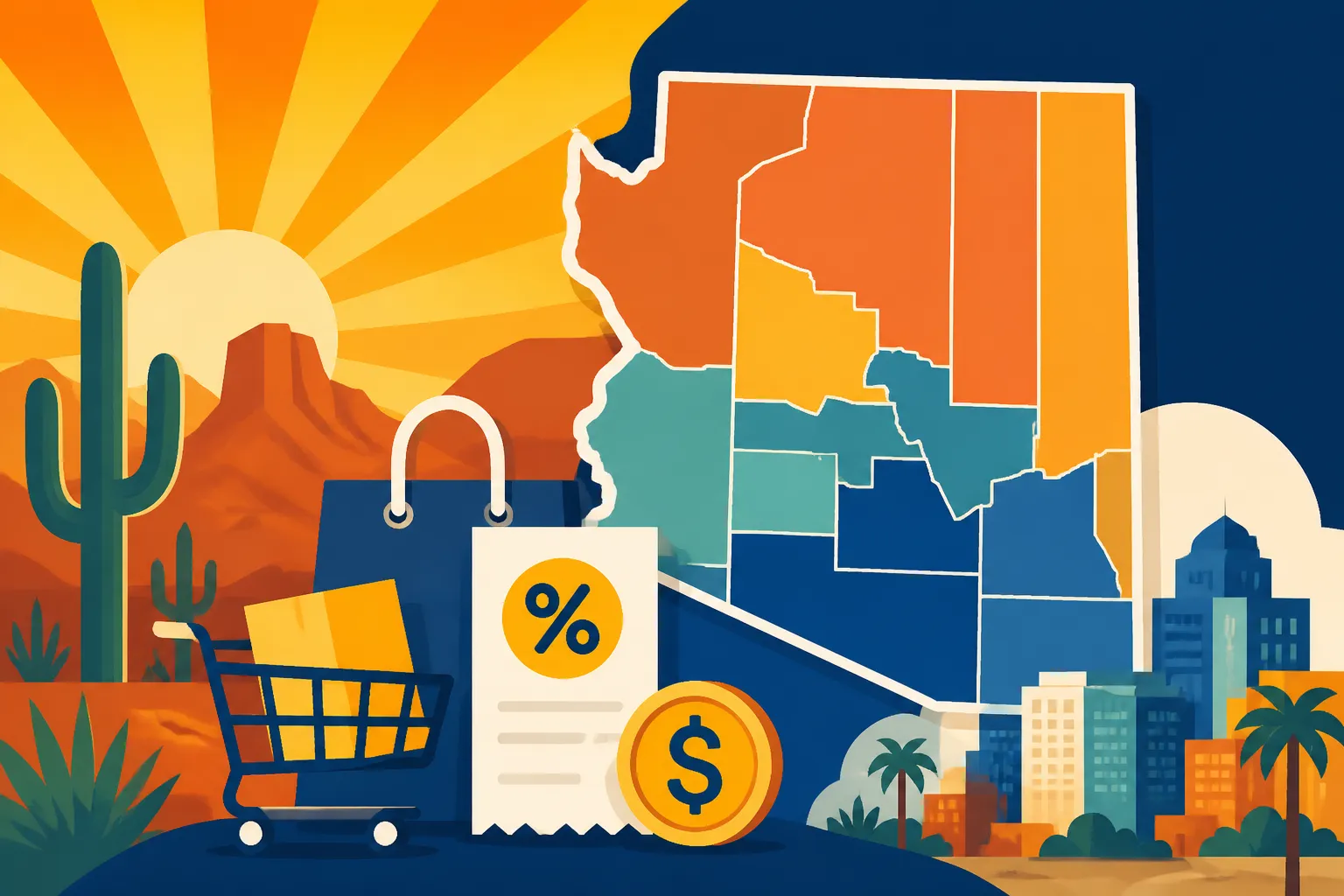
Arizona Sales Tax Rate by City & County
Navigating sales tax can feel like trying to solve a Rubik's Cube blindfolded, and Arizona's system adds another layer of complexity that often leaves business owners scratching their heads. Unlike most states, Arizona charges a Transaction Privilege Tax (TPT) on the seller for the privilege of doing business, rather than a direct sales tax on the consumer. This distinction means understanding not just state rates, but a bewildering array of city and sometimes even county-specific rates is critical. This guide will unravel the intricacies of Arizona's TPT system, helping you pinpoint the correct rates for your business, wherever you operate in the Grand Canyon State.
Understanding Arizona's Transaction Privilege Tax (TPT) – It's Not Sales Tax!
It's easy to mistakenly call Arizona's tax a "sales tax" because, to the end consumer, it often looks and feels the same – an added percentage on their purchase. However, for businesses, the legal distinction is profoundly important. Arizona's Transaction Privilege Tax (TPT) is a tax on the vendor for the privilege of engaging in certain business activities within the state, not a tax on the sale itself. This subtle difference impacts how it's reported, what activities are taxable, and even how audits are conducted.
What Makes Arizona Different?
In most states, sales tax is levied on the retail sale of tangible personal property or certain services, and the merchant is generally seen as the collector of that tax on behalf of the state. The tax burden is typically understood to fall directly on the consumer. In Arizona, the TPT is imposed on the seller's gross receipts from specific business activities. While most Arizona businesses pass this cost onto the customer by separately stating it on the receipt (which is perfectly legal and common practice), the primary legal liability for the tax remains with the business conducting the taxable activity. This structure means that even if a business forgets to collect TPT from a customer, they are still on the hook to remit it to the state based on their gross receipts from taxable transactions. This is a critical point that trips up many new businesses or those expanding into Arizona.
Who Needs to Deal with TPT?
If you're engaged in what Arizona considers a "taxable business activity," you're likely subject to TPT. This isn't just about selling physical goods in a brick-and-mortar store. The Arizona Department of Revenue (ADOR) has over 16 different business classifications, each with its own potential TPT implications. Common taxable activities include:
- Retail Sales: Selling tangible personal property to consumers. This is what most people think of when they hear "sales tax."
- Contracting: Both prime contractors and subcontractors for real property construction, improvements, or repairs.
- Restaurant and Bars: Sales of prepared food and beverages.
- Amusement: Operating places of amusement, exhibition, or entertainment.
- Rentals: Leasing or renting tangible personal property or real property (commercial leasing).
- Utilities: Providing telecommunication, electricity, or natural gas services.
And the list goes on. Each classification can have different rates and rules, not just at the state level but also at the city level, making compliance a significant undertaking. For instance, a contractor building a new home will have different TPT obligations than a store selling a t-shirt, even if they're in the same city. Understanding your specific business activity and its corresponding classification is the first step to accurately determining your TPT liability.
Navigating State-Level TPT Rates in Arizona
Before diving into the local variations, it's essential to grasp the statewide component of Arizona's Transaction Privilege Tax. Every taxable business activity in Arizona will, at a minimum, be subject to the state's TPT rate, which applies across all jurisdictions unless specifically exempted.
The Statewide Base Rate
As of 2026, the statewide retail Transaction Privilege Tax rate in Arizona stands at 5.6%. This percentage is applied to the gross receipts from your taxable retail sales. It's important to remember that this 5.6% is just the state portion. Think of it as the foundational layer upon which city and, in some rare cases, county taxes are stacked. For example, if you sell a $100 item in Arizona that is subject to TPT, the state's portion of that tax will be $5.60, before any local additions are considered. This base rate is relatively stable compared to the constantly shifting landscape of local rates, but it’s the non-negotiable starting point for most businesses. Businesses should also be aware that certain items, such as prescription drugs or food for home consumption (groceries), are typically exempt from the state TPT, meaning you wouldn't collect or remit the 5.6% on those specific sales. However, this isn't always true for prepared food, which generally remains taxable. If you're wondering how to actually calculate this, our guide on how to calculate sales tax (which applies to TPT too!) can walk you through the process.
Other State TPT Classifications
While retail sales are the most common taxable activity people associate with "sales tax," Arizona's TPT system casts a much wider net. As mentioned earlier, there are numerous classifications, and many of them have distinct state TPT rates that apply to their specific gross receipts. For example:
- Contracting (Prime Contracting): The state TPT rate for prime contracting is typically 3.0%. This rate applies to the gross income from the business of contracting, including labor and materials.
- Restaurant and Bars: Generally, sales of prepared food and beverages are taxed at the standard 5.6% state TPT rate.
- Commercial Lease: The state TPT rate on commercial real property rentals is 2.9%. This applies when you rent out commercial space.
The varying rates by classification underscore the importance of correctly identifying your primary business activity for TPT purposes. A business might even engage in multiple classifications, requiring them to report and remit TPT under each applicable category at its specific rate. For instance, a hardware store that sells tools (retail) and also offers installation services (contracting) would need to apply different state TPT rates to those distinct revenue streams. Keeping these classifications separate and accurately applying the right state rate is a key aspect of Arizona TPT compliance.
Decoding City and County TPT Rates in Arizona
Here's where things get really interesting – and often, quite confusing. Arizona operates under a "state-shared" system where local jurisdictions, primarily cities and towns, are empowered to levy their own Transaction Privilege Taxes on top of the state's rate. This results in a patchwork of rates that can vary significantly from one city limit to the next.
The Layered Approach to Local Taxes
Every city and town in Arizona that levies a TPT adds its own rate to the state's 5.6%. This means that the combined TPT rate a customer pays, and a business collects, is the sum of the state rate and the local city/town rate. For instance, if the state rate is 5.6% and a city's rate is 2.0%, the combined rate is 7.6%. What's particularly challenging is that these local rates aren't uniform. Not only do cities have different rates, but they can also have different taxable activities or exemptions than the state, adding to the complexity. Imagine running an online shop and trying to figure out if your customer in Tempe pays the same combined rate as your customer in Flagstaff – spoiler alert, they probably don't! The complexity is a major reason why many businesses rely on tools from companies like Avalara to ensure they're calculating the right local sales tax.
Examples of Varying City Rates
To truly illustrate the point, let's look at some of Arizona's largest cities and their combined TPT rates for retail sales (as of early 2026, though rates can change, so always double-check the Arizona Department of Revenue or a reliable tax lookup tool for the very latest figures). Remember, these are retail rates; other classifications may have different city rates.
| City | State TPT Rate (Retail) | City TPT Rate (Retail) | Combined TPT Rate (Retail) |
|---|---|---|---|
| Phoenix | 5.6% | 2.3% | 7.9% |
| Tucson | 5.6% | 2.6% | 8.2% |
| Mesa | 5.6% | 2.0% | 7.6% |
| Chandler | 5.6% | 1.5% | 7.1% |
| Scottsdale | 5.6% | 1.75% | 7.35% |
| Flagstaff | 5.6% | 2.3% | 7.9% |
| Yuma | 5.6% | 1.7% | 7.3% |
As you can see, a sale in Tucson would incur an 8.2% combined TPT, while the exact same sale in Chandler would be 7.1%. That's a full 1.1% difference! This table only covers retail. If your business activity falls under, say, commercial leasing or contracting, the city-specific rates for those classifications might be entirely different. Our detailed guide on sales tax rates by state 2026 provides a broader perspective on how Arizona fits into the national landscape.
County-Level Nuances (or Lack Thereof for Retail)
It's important to clarify a common misconception: for most general retail sales, Arizona counties do not impose an additional sales tax on top of the state and city rates. Unlike states such as Louisiana, where parish (county) sales taxes can be notoriously high and complex, Arizona's county taxation for retail is generally integrated into the state rate or handled at the city level.
However, some counties may have specific, more narrowly defined taxes or fees. For example, Maricopa County, home to Phoenix, does have a county tax that applies to specific things like certain types of food (prepared for immediate consumption) and some utilities, but it's not a blanket retail sales tax in the same way cities impose theirs. Similarly, Pima County (Tucson) has its own specific taxes on certain transactions. These are often targeted excise taxes or special district taxes rather than a general county-wide TPT on retail goods. Therefore, when calculating TPT for a typical retail transaction, your primary focus will be on the state rate and the specific city or town rate where the transaction occurs. Understanding this distinction can save a lot of headaches, ensuring you're not overcomplicating your calculations by searching for a non-existent county retail sales tax. For a deep dive into hyper-local specifics, you might find our article on sales tax by ZIP code (and why ZIP isn't enough) helpful, as it explains why relying solely on ZIP codes can be misleading due to intricate jurisdictional boundaries.
How to Find the Correct Arizona TPT Rate for Your Business
Given the layered nature of Arizona's Transaction Privilege Tax, simply guessing or relying on outdated information is a recipe for compliance issues. Finding the exact rate applicable to your specific business activity and location is crucial.
The Challenge of Manual Lookup
Imagine you're a small online retailer selling custom t-shirts. You have customers all over Arizona. If you try to manually look up the TPT rate for every single city and town where you make a sale, you'd quickly drown in spreadsheets and conflicting information. The Arizona Department of Revenue (ADOR) website is a valuable resource, offering lists of city codes and rates. However, navigating these lists, understanding the specific business classifications for each rate, and staying on top of frequent rate changes (yes, cities change their rates!) can be a full-time job. It's not just about looking up a single percentage; it's about verifying the effective date, confirming the correct business code for your specific product or service, and then applying that to potentially dozens or hundreds of different city jurisdictions. This manual burden often leads to errors, whether it's under-collecting and owing the state money or over-collecting and frustrating customers.
Tools and Resources for Accuracy
Thankfully, you don't have to tackle this beast alone. There are fantastic resources available to help streamline the process:
- Arizona Department of Revenue (ADOR) Website: This is your primary official source. The ADOR provides TPT rate tables, city codes, and a tax rate lookup tool. While it can be cumbersome, it's the authoritative voice. You'll need to know your business activity classification and the city code.
- Municipal Tax Code Commission (MTCC): Many Arizona cities have adopted the Model City Tax Code, which aims to standardize TPT definitions and classifications. The MTCC website provides resources related to this code, which can help bring some consistency to the chaos.
- Sales Tax Automation Software: For businesses with significant sales volume across multiple Arizona cities, or indeed across different states entirely, sales tax automation software is a game-changer. Solutions like Avalara are specifically designed to handle the complexities of fluctuating rates, jurisdictional boundaries, and diverse taxability rules. These platforms integrate with your e-commerce store or accounting system, automatically calculating the correct TPT at the point of sale based on the shipping address, business activity, and applicable exemptions. This not only saves immense time but drastically reduces the risk of errors and ensures you're ready for filing season. This kind of automation is especially critical for online sellers who might have nexus in many different states and need to determine how much sales tax to collect.
Why Your Business Location Matters
Arizona's TPT system generally follows an origin-based sourcing rule for retail sales within Arizona. This means that if you have a physical location (a brick-and-mortar store, office, warehouse, etc.) in a specific Arizona city, you generally apply the TPT rate of your business's location to sales made from that location to customers within Arizona, regardless of where the customer takes possession.
Let's illustrate: If your retail store is in Mesa, and a customer from Scottsdale comes into your Mesa store to buy a product, you would collect TPT based on Mesa's combined rate (state + Mesa city rate). This differs significantly from destination-based sourcing, which many states use, where the tax rate is determined by the customer's shipping address.
However, it's crucial to understand when this origin rule applies. For remote sellers without a physical presence in Arizona, or for sales shipped out-of-state, the rules can change. If you're an online seller based outside of Arizona, but you've established economic nexus in the state, you'd typically collect based on the destination (the buyer's location) for intrastate sales. This is where the intricacies really stack up, and having a clear understanding of Origin vs Destination Sales Tax Sourcing is paramount for accurate TPT collection. Always verify the specific sourcing rules for your business type and sales channels.
Common Pitfalls and Best Practices for Arizona TPT
Even with the right tools, the Arizona TPT system can still present challenges. Staying compliant requires diligence and an understanding of common stumbling blocks.
Staying Updated with Rate Changes
One of the biggest headaches for businesses operating in Arizona is the sheer frequency of rate changes. While the state TPT rate tends to be stable, individual cities and towns can (and do) change their TPT rates with surprising regularity. These changes might be annual, semi-annual, or even ad-hoc, often driven by local budget needs or special projects. Missing even one of these updates can lead to incorrect collections, underpayment to the state, and potential penalties during an audit. Imagine a city decides to implement a new transportation tax or adjust its general TPT rate; if your system isn't updated, you could be collecting the wrong amount for months. This constant flux underscores why relying on automated solutions, which are continuously updated by tax experts, is often more reliable than manual tracking. It’s a bit like trying to keep up with every single highway speed limit change in real-time without a GPS – virtually impossible. Our post on How Do Sales Tax Rate Changes Take Effect? delves deeper into this dynamic.
The Importance of Accurate Reporting
Collecting the correct TPT is only half the battle; accurately reporting and remitting it to the ADOR is just as vital. When you file your Arizona TPT return, you'll need to report your gross receipts by business classification and then break down your collections by each city and town. This means you can't just send a lump sum; you need detailed records showing how much TPT you collected for Phoenix, how much for Tucson, how much for Mesa, and so on, for each specific business activity (retail, contracting, etc.).
This level of granular reporting can be incredibly complex for businesses making sales in many different jurisdictions. Without precise records, it's easy to misallocate funds or miss reporting requirements for a particular city. If audited, inaccuracies in reporting can lead to significant fines and interest charges. Therefore, meticulous record-keeping, ideally supported by software that categorizes and reports TPT collections automatically, is a best practice. It ensures that the TPT you collected from your customers actually makes it to the correct local and state coffers, keeping your business in good standing with the Arizona Department of Revenue. Understanding Economic Nexus in Arizona: Threshold & Rules is also vital to know when and where you need to register and report.
Disclaimer
Please remember that sales tax laws, especially those as unique as Arizona's Transaction Privilege Tax, are complex and subject to change. This guide provides general information and should not be considered legal or tax advice. Always consult with a qualified tax professional or refer to the official Arizona Department of Revenue resources for advice specific to your business situation.