States With No Sales Tax (NOMAD Explained)
Imagine you are planning a major purchase, perhaps a new fleet of laptops for your growing remote team or a high-end mountain bike for your weekend adventures. You find the perfect item, click through to the checkout page, and suddenly the price jumps by several hundred dollars because of a sales tax percentage you didn't account for. This guide meticulously explores the NOMAD states—New Hampshire, Oregon, Montana, Alaska, and Delaware—to explain how they operate without a statewide sales tax and what that means for your wallet and your business compliance.
The Foundation of the NOMAD Acronym
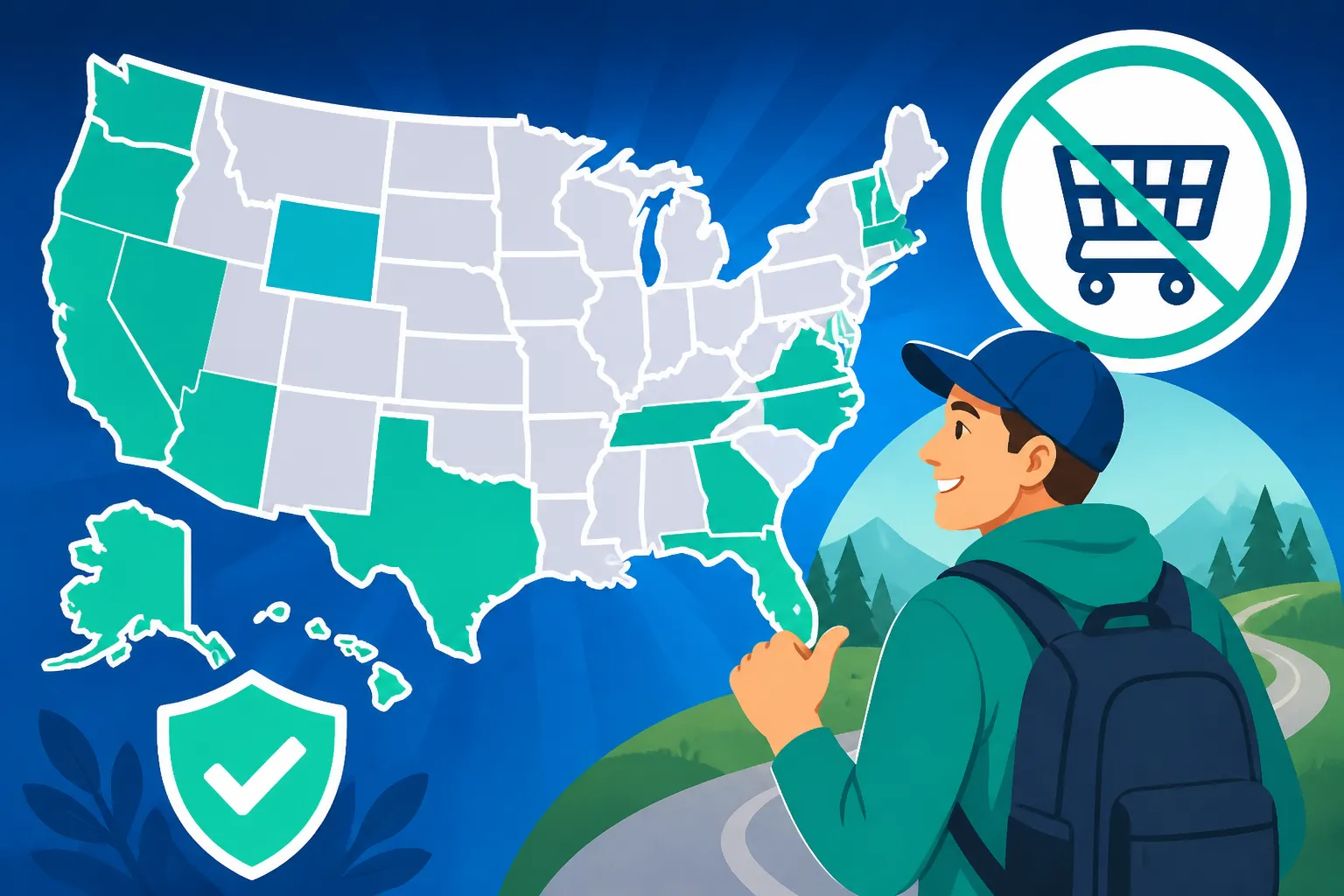
When we talk about tax-free shopping in the United States, we are almost always referring to a specific group of five states. For years, tax professionals and savvy shoppers have used the acronym NOMAD to remember them: New Hampshire, Oregon, Montana, Alaska, and Delaware. These states have historically resisted the implementation of a general statewide sales tax, often as a point of local pride or as a strategic move to attract cross-border commerce. Understanding how these states function is essential for anyone looking at the Highest & Lowest Sales Tax States 2026 to see where they can save the most money on significant transactions.
The philosophy behind these states varies wildly. In New Hampshire, the "Live Free or Die" motto isn't just a license plate slogan; it is a deeply ingrained fiscal policy that prioritizes individual autonomy over state-mandated consumption taxes. Oregon, on the other hand, has a long history of voters rejecting sales tax referendums at the ballot box, preferring to rely on a robust income tax system instead. Each state in the NOMAD group has a different "flavor" of being tax-free, and assuming they are all identical is a mistake that can lead to unexpected costs when you realize that "no state tax" does not always mean "no tax at all."
Furthermore, the NOMAD states serve as a fascinating case study in American federalism. While most of the country has moved toward a model where consumption taxes fund a large portion of infrastructure and education, these five outliers prove that alternative models can survive. However, as we look deeper into their structures, we see that the revenue has to come from somewhere. Whether it is through high property taxes, corporate activity taxes, or petroleum royalties, these states have found other ways to keep their lights on without tapping into the checkout counter at the local grocery store.
Alaska and the Mystery of Local Levies
Alaska is perhaps the most misunderstood member of the NOMAD group. While it is true that there is no statewide sales tax in the Last Frontier, the state allows its "home-rule" jurisdictions and boroughs to implement their own local sales taxes. This creates a patchwork of tax rates that can be incredibly confusing for both residents and visitors. If you are standing in Anchorage, you might enjoy a 0% tax rate, but if you drive a few hours to a different municipality, you could find yourself paying 5% or 6% at the register. This is a primary reason why Sales Tax by ZIP Code (and Why ZIP Isn't Enough) is such a critical concept for anyone doing business in Alaska.
The complexity in Alaska has increased significantly for online sellers in recent years. Following the landmark Supreme Court decision regarding economic nexus, many Alaskan cities banded together to form the Alaska Remote Seller Sales Tax Commission. This body centralizes the collection of local sales taxes for remote sellers, ensuring that if you sell a jacket to someone in a participating Alaskan city, you are collecting the correct local rate even though there is no state-level tax. This unique arrangement is a headache for small businesses that thought they could ignore Alaska entirely because it was part of the NOMAD group.
For the consumer, Alaska represents a land of extremes. You might find some of the lowest overall tax burdens in the country in certain parts of the state, but the cost of living—largely due to shipping and logistics—often offsets those savings. It is a reminder that a 0% sales tax rate does not automatically equal a low-cost lifestyle. When planning a move or a large purchase in Alaska, you must look at the specific borough's rules, as the lack of a statewide mandate gives local governments significant power to shape their own fiscal destinies.
Delaware and the Corporate Nexus
Delaware is often called the "Home of the Free" by shoppers in neighboring Pennsylvania, Maryland, and New Jersey. Because of its small geographic size and its strategic location along the I-95 corridor, Delaware has turned its 0% sales tax status into a massive economic engine. Huge shopping malls like the Christiana Mall sit just over the border, specifically designed to lure in out-of-state shoppers who are looking to avoid their home states' 6% or 7% rates. It is the ultimate destination for those looking for States With No Sales Tax (NOMAD Explained) while living in high-tax regions.
However, Delaware is not without its own forms of taxation that affect businesses. Instead of a sales tax, Delaware employs a Gross Receipts Tax on businesses. This tax is levied on the total amount of a business's gross seller receipts, and the rates vary depending on the type of business activity. While this isn't a "sales tax" in the traditional sense because it isn't added as a line item on a consumer's receipt, it is a cost of doing business that often gets baked into the shelf price of goods. For a company managing high volumes in the state, utilizing a tool like Avalara can help track these specific gross receipts obligations, which are often more complex to calculate than standard sales taxes.
Another interesting aspect of Delaware is its role as a corporate haven. More than half of all publicly traded companies in the U.S. are incorporated there, not because of the lack of sales tax, but because of its sophisticated Court of Chancery and business-friendly legal environment. The lack of a sales tax simply adds another layer of appeal for businesses looking to establish a physical presence or a warehouse hub. When you combine the legal protections with the 0% sales tax, Delaware becomes an incredibly attractive location for logistics and distribution centers, further cementing its status in the NOMAD group.
Montana and the Luxury Purchase Loophole
Montana is a state that many people associate with wide-open spaces and "Big Sky" views, but in the world of finance, it is also famous for its 0% sales tax. This has made Montana a legendary destination for people purchasing high-value items like luxury motorhomes, exotic cars, and private aircraft. You will often see expensive RVs with Montana license plates parked in Florida or California; this is usually because the owners formed a Montana LLC to purchase the vehicle, thereby avoiding tens of thousands of dollars in sales tax in their home states.
It is important to note, however, that Montana does have "resort taxes" in specific high-tourism areas. If you are visiting Big Sky, West Yellowstone, or Whitefish, you might see a 3% or 4% tax on your restaurant bill or your hotel stay. These are localized taxes intended to help small communities deal with the infrastructure demands of thousands of tourists who do not pay local property taxes. While it doesn't change the state's status as a NOMAD member, it is a vital detail for travelers to understand so they aren't surprised when the bill arrives.
For businesses, Montana presents a relatively straightforward environment, but the lack of a sales tax doesn't mean there is no compliance work. As companies grow and sell into other states, they must still track where their customers are located to determine if they have triggered economic nexus elsewhere. Even a business based in a tax-free paradise like Montana must eventually deal with the reality of Combined State + Local Sales Tax Rates Explained when they ship their products to customers in places like Chicago or Los Angeles. Staying compliant requires a bird's-eye view of the entire national landscape, not just the rules of your home state.
New Hampshire and the Live Free Philosophy
New Hampshire is the quintessential "tax-free" state of the Northeast. For residents of Massachusetts who feel the weight of a 6.25% sales tax, a trip north to New Hampshire is a standard weekend ritual for buying electronics, furniture, and appliances. The state prides itself on having neither a general sales tax nor a personal income tax on earned wages. This dual-exemption status is rare and makes New Hampshire a magnet for professionals who want to maximize their take-home pay while minimizing their consumption costs.
But like the other NOMAD states, New Hampshire has its exceptions. The state does have a "Meals and Rentals" tax, which currently sits at 8.5%. This means that while your new couch is tax-free, your dinner at a restaurant or your hotel room for the night will definitely carry a tax. This tax is a significant revenue driver for the state, allowing it to fund services without implementing a broad-based sales tax. Additionally, New Hampshire is known for having some of the highest property tax rates in the nation. This is the classic trade-off: if the state doesn't get you at the cash register, it will likely get you through your annual property tax bill.
From a business perspective, New Hampshire companies often find themselves in a unique position when selling to customers in other states. They may not be used to collecting tax at home, which can make the transition to multi-state filing a bit of a shock. When these companies start hitting thresholds in states like Texas or New York, they often turn to automated solutions. Integrating a platform like Avalara can help a New Hampshire-based e-commerce site stay on top of changing rates in the 45 states that do have a sales tax, ensuring they don't face penalties for failing to collect what they owe to other jurisdictions.
Oregon and the Pacific Northwest Nexus
Oregon is perhaps the most "pure" of the NOMAD states because it has neither a state sales tax nor any local sales taxes. Unlike Alaska, where you have to worry about which city you are in, or New Hampshire, which has a specific meals tax, Oregon is almost entirely free of consumption-based taxes at the point of sale. This makes it a shopper's dream, especially for those living in Washington state, where the Seattle Sales Tax Rate 2026 (10.55%) is among the highest in the country. The "Portland trip" is a cultural staple for people living in Vancouver, Washington, who just want to save a few bucks on their holiday shopping.
However, Oregon has recently introduced a Corporate Activity Tax (CAT) that has changed the landscape for businesses. The CAT is a tax on "modified gross receipts" for businesses with Oregon-sourced receipts of more than $1 million. While consumers don't see this as a line item on their receipt, it has caused many businesses to raise their prices to cover the new tax burden. It is a subtle but important distinction: just because there isn't a "sales tax" doesn't mean there isn't a tax on the activity of selling. For businesses trying to navigate this, understanding How Do Sales Tax Rate Changes Take Effect is a key part of their strategic planning.
Oregon also faces unique challenges regarding its lack of sales tax and its relationship with its neighbors. There is a constant tension between wanting to provide a tax-free environment for residents and the need to fund state services like schools and roads. Because Oregon relies so heavily on income tax, its state budget is much more volatile and sensitive to economic downturns than states with a balanced mix of income and sales tax. For the savvy consumer, though, Oregon remains the gold standard for tax-free living in the U.S., provided you can handle the higher-than-average state income tax.
The Reality of Use Tax for NOMAD Residents
One of the biggest misconceptions about living in or shopping in a NOMAD state is that you are completely "off the hook" for taxes when you bring items back to your home state. This brings us to the concept of "Use Tax." If you live in a state with a sales tax, such as California, and you drive to Oregon to buy a $5,000 mountain bike, you are technically required by law to report that purchase to your home state's tax authority and pay the equivalent sales tax as "Use Tax." Most people ignore this, but for businesses and for high-ticket items like cars or boats, states are very aggressive about enforcement.
States like Massachusetts and New York have even been known to station tax investigators at the borders of New Hampshire and Delaware during peak shopping seasons. They watch for vehicles with in-state plates loading up huge quantities of goods at tax-free malls. While this sounds like a scene from a movie, it is a very real part of how states protect their tax revenue. If you are a business owner, the stakes are even higher. You must be able to prove that you paid the appropriate tax on equipment, or you could face a massive bill during an audit. This is where knowing How to Calculate Sales Tax (Step by Step) becomes useful even if you live in a tax-free zone.
Use tax is essentially a safety net for states with sales tax, ensuring that their local businesses aren't unfairly disadvantaged by tax-free neighbors. It is the "forgotten tax" that many people don't realize they owe until they receive a frightening letter from their state's department of revenue. Whether you are an individual or a corporation, the "border-hopping" strategy only works if you are aware of the legal obligations that follow you back across the state line. Ignoring these rules can lead to interest and penalties that far exceed the original tax savings.
Strategic Comparison of NOMAD States
For those looking to move, start a business, or make a large purchase, comparing these five states is essential. Each has its own set of pros and cons that go far beyond the 0% sales tax rate. In the table below, we break down some of the key secondary factors that affect the total cost of living and doing business in these states.
| State | State Sales Tax | Local Sales Tax Allowed? | Income Tax? | Key Secondary Tax |
|---|---|---|---|---|
| Alaska | 0% | Yes (Varies by city) | No | Petroleum/Resource Taxes |
| Delaware | 0% | No | Yes | Gross Receipts Tax |
| Montana | 0% | Yes (Resort areas only) | Yes | High Luxury/RV Fees |
| New Hampshire | 0% | No | No (On wages) | 8.5% Meals & Rentals Tax |
| Oregon | 0% | No | Yes | Corporate Activity Tax (CAT) |
This table illustrates that while the "0%" is the headline, the fine print matters. For example, a business in Delaware might pay more in total taxes than a business in Alaska, depending on their gross receipts and their specific location. Similarly, a family in Oregon might feel a heavier tax burden than a family in New Hampshire because of the difference in income tax policies. When you are looking for the Average Sales Tax Rate by State, you have to remember that these five states are pulling the average down, but they aren't necessarily "cheaper" across the board.
Compliance Challenges for NOMAD-Based Businesses
If you run a business based in a NOMAD state, you might feel like you are in the clear when it comes to sales tax compliance. However, in the modern era of e-commerce, your physical location is only one part of the equation. As soon as you sell your products to customers in other states, you may be required to register, collect, and remit sales tax in those jurisdictions. This is known as "economic nexus," and it is the single biggest hurdle for small businesses growing out of tax-free states.
Most states have a threshold—often $100,000 in sales or 200 transactions—that triggers this requirement. If your Montana-based boutique sells $101,000 worth of goods to people in Texas, you are now legally obligated to follow the Texas Sales Tax Rate (6.25% + Local 8.25% Max) rules. This can be an administrative nightmare for a small team that has never had to deal with sales tax before. You have to register for a permit in Texas, calculate the correct local rates for every ZIP code, and file regular returns with the state.
This is where automated tax software becomes a lifesaver. Companies often implement Avalara to handle the heavy lifting of tracking nexus thresholds and calculating real-time tax at checkout. Without this kind of automation, a business based in a NOMAD state could easily find themselves out of compliance in dozens of other states, leading to audits and heavy fines. The goal is to spend your time growing your brand, not manually looking up the Sales Tax Rate by Address Lookup for every single customer in Tennessee or Florida.
Why Some States Choose to Stay Tax-Free
You might wonder why, if sales tax is such a reliable revenue stream, more states haven't joined the NOMAD group—or why these five haven't implemented one. The answer is usually a combination of constitutional restrictions and political culture. In many of these states, the lack of a sales tax is seen as a competitive advantage. It draws in shoppers, encourages business investment, and acts as a "check" on government spending. If a state knows it can't simply raise a sales tax to cover a budget shortfall, it is forced to be more disciplined with its existing revenue.
Furthermore, the implementation of a new tax is a political "third rail" in these states. In Oregon, voters have consistently and overwhelmingly rejected sales tax proposals for decades. In New Hampshire, any politician who suggests a broad-based sales or income tax is often looking at a very short career. This cultural resistance is a powerful force that keeps these states in the NOMAD category year after year. They have built their entire economic identities around being outliers, and they aren't likely to change that any time soon.
However, as the digital economy continues to evolve, these states are finding that their "tax-free" status is being challenged in new ways. They are having to find ways to tax digital services, streaming platforms, and corporate activities without technically calling them a "sales tax." It is a delicate balancing act. They want to maintain their NOMAD status to keep the tourists and the luxury car registrations coming, but they also have to fund 21st-century infrastructure. For the observer, it is a fascinating look at how 2026 Sales Tax Rate Changes by State reflect the changing needs of a modern society.
The Hidden Costs of Tax-Free Living
While we have spent a lot of time talking about the savings, it is only fair to discuss the "hidden costs" that often accompany living in a NOMAD state. Because these states don't have a broad sales tax, they often have to make up the revenue in ways that can be quite expensive for residents. We mentioned property taxes in New Hampshire, but let's talk about Alaska. In Alaska, the state's budget is heavily dependent on the price of oil. When oil prices are high, the state is flush with cash; when they are low, the state faces massive deficits and often has to cut services or dip into its "Permanent Fund."
In Oregon, the lack of a sales tax means that the state's income tax rates are some of the highest in the country. If you are a high-earner, you might actually save more money by living in a state with a sales tax but without an income tax, like Washington or Florida. It is a classic "pick your poison" scenario. Would you rather pay 7% more for your clothes and electronics, or would you rather give up 9% of your paycheck every month? For many, the visibility of the sales tax makes it feel more painful, even if the income tax is actually the larger total burden.
There is also the issue of infrastructure. Some critics argue that NOMAD states struggle to keep up with road maintenance and public transport because they lack the steady, consumption-based revenue that a sales tax provides. While this varies from state to state, it is a common theme in the debate over whether these states should finally "modernize" their tax codes. For now, however, the NOMAD states seem committed to their path, providing a unique alternative for those who are willing to navigate the trade-offs of a tax-free lifestyle.
Conclusion and Final Thoughts
Navigating the NOMAD states is a journey through five distinct economic philosophies, each offering its own set of rewards and challenges. Whether you are attracted to the rugged independence of Alaska, the corporate efficiency of Delaware, the luxury-friendly rules of Montana, the granite-tough resolve of New Hampshire, or the pure tax-free shopping of Oregon, understanding the nuances is the key to success. You cannot simply assume that "no sales tax" means "no responsibility." From local levies to use tax obligations and multi-state nexus issues, the reality is far more complex than a simple zero.
As you plan your next big move or business expansion, keep these details in mind. Use tools like Avalara to ensure that your business stays on the right side of the law, and never forget that in the world of taxes, nothing is truly free. There is always a trade-off, and being an informed consumer or business owner is the best way to ensure that you are actually getting the deal you think you are. The NOMAD states will likely remain a fixture of the American tax landscape for years to come, serving as a reminder that there is always more than one way to balance the books.
Disclaimer
This guide is intended for informational purposes only and does not constitute professional tax, legal, or financial advice. Tax laws and rates are subject to frequent change at the state, local, and federal levels. You should always consult with a qualified tax professional or accountant before making significant financial decisions or establishing business nexus in any state. Every business and individual situation is unique, and general information may not apply to your specific circumstances.