Do I Have to Collect Sales Tax in Every State?
One of the biggest headaches for any business owner, especially those selling online or across state lines, is the seemingly endless question: "Do I really have to collect sales tax in every state?" It’s a common frustration, often leading to confusion and even paralysis, as the rules feel like they're constantly shifting. This guide aims to clear up that monumental misunderstanding, explaining exactly when and where you need to be concerned about sales tax collection.
The Myth of "Collect Everywhere" – Understanding Sales Tax Nexus
Let's bust the biggest myth right off the bat: no, you absolutely do not have to collect sales tax in every state. The core principle governing sales tax collection is "nexus." Without nexus in a particular state, you generally have no legal obligation to collect sales tax from customers in that state. It's a critical concept that dictates your sales tax responsibilities, and misunderstanding it can lead to either over-collecting (and complicating your life unnecessarily) or, worse, under-collecting (and facing hefty penalties down the road).
What Exactly is Sales Tax Nexus?
At its heart, sales tax nexus simply means a sufficient connection or presence in a state that triggers a sales tax collection obligation. Think of it as the state saying, "Because you're doing business here in this specific way, you need to act as our agent and collect sales tax from customers for us." Historically, this was pretty straightforward, primarily based on a "physical presence."
A physical presence meant having a brick-and-mortar store, an office, a warehouse, or even just an employee or independent contractor working on your behalf within state borders. If you lived in Ohio and had a store only in Ohio, you only collected sales tax from Ohio customers. Simple, right? But the world of commerce has evolved dramatically, and so have the definitions of "presence." Even sending inventory to an Amazon FBA warehouse in a different state could establish a physical presence nexus for your business there. Participating in a trade show, even temporarily, might also create a fleeting nexus, depending on the state's rules. Understanding the nuances of Sales Tax Nexus Explained Physical vs Economic is the first crucial step for any business.
The Game-Changer: Economic Nexus and the Wayfair Decision
The internet blew the lid off the traditional physical presence rule. Suddenly, businesses could sell to customers nationwide without ever stepping foot in their states. This created a massive revenue hole for states, leading to the landmark 2018 Supreme Court decision in South Dakota v. Wayfair, Inc. This ruling fundamentally changed the landscape of sales tax.
The Wayfair decision introduced the concept of "economic nexus." This means that even if you don't have any physical presence in a state, you can still establish nexus if your sales activity into that state crosses certain economic thresholds. It was a pivotal moment, shifting the burden from just physical location to sales volume and/or transaction count. Essentially, states now argue that if you're doing a significant amount of business within their borders, you have an economic "presence" that warrants sales tax collection. For online sellers especially, understanding South Dakota v. Wayfair What It Means for Sellers is no longer optional; it's absolutely essential.
Deciphering Economic Nexus Thresholds by State
While the Wayfair decision empowered states to enact economic nexus laws, it didn't create a single, uniform rule. Each state (that charges sales tax and has adopted economic nexus) sets its own specific thresholds and rules. This is where the real complexity kicks in and why the idea of "collecting everywhere" feels so overwhelming.
Common Thresholds: Sales Volume and Transaction Count
Most states that have adopted economic nexus rules typically use one of two main criteria, or a combination of both: a sales volume threshold or a transaction count threshold.
- Sales Volume Threshold: The most common threshold is $100,000 in gross sales into a state during the current or preceding calendar year. For example, if your online store sells $105,000 worth of goods to customers in Florida within a year, you likely establish economic nexus in Florida, even if your business is based in Oregon and has no physical tie to the Sunshine State.
- Transaction Count Threshold: Some states, in addition to or instead of the sales volume, include a threshold for the number of separate transactions. A common example here used to be 200 separate transactions into a state. However, many states have begun to drop this transaction count threshold, finding it to be an administrative burden for small businesses. For instance, Texas originally included a transaction threshold but has since removed it, relying solely on the $500,000 sales threshold. California similarly has a high sales volume threshold without a transaction count.
It's critical to realize that these thresholds vary wildly. What might trigger nexus in Alabama might not in New York. You also need to pay attention to what kind of sales count towards the threshold. Is it gross sales, or only taxable sales? Most states use gross sales, meaning all sales, even those that might be exempt or for resale, count towards determining if you meet the threshold. Keeping track of Economic Nexus by State 2026 Thresholds Guide is a full-time job for some, but crucial for any growing business.
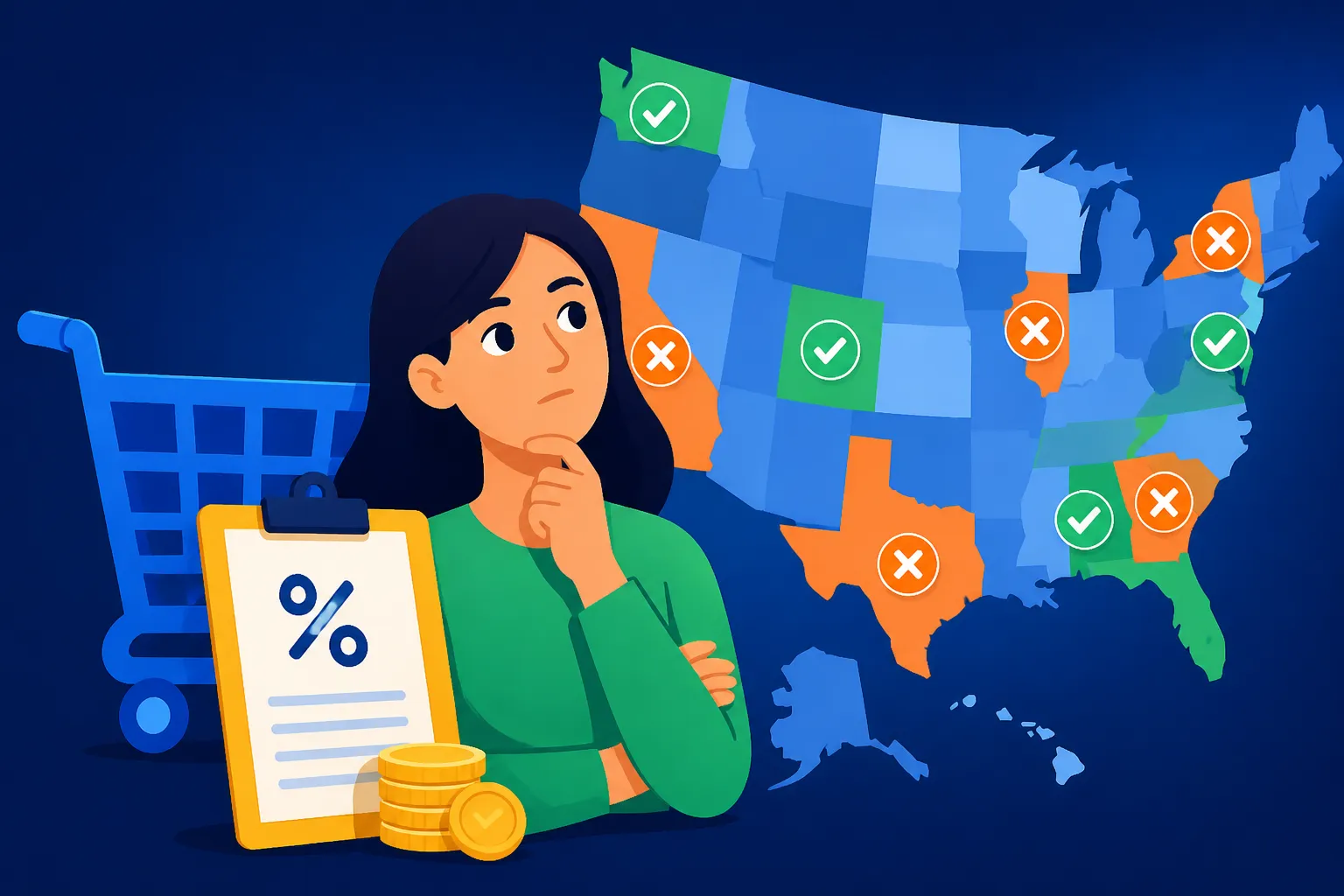
Here's a quick look at a few state economic nexus thresholds for general tangible personal property sales (always check specific state DOR for exact details and any product-specific rules):
| State | Sales Volume Threshold (Annual) | Transaction Count Threshold (Annual) | Notes |
|---|---|---|---|
| California | $500,000 | None | Applies to current or previous calendar year. |
| Florida | $100,000 | None | Effective July 1, 2021. |
| New York | $500,000 | 100 sales | Unique in still retaining a transaction count alongside a high sales threshold. |
| Texas | $500,000 | None | Applies to current or previous calendar year. |
| Washington | $100,000 | None | Applies to current or previous calendar year. |
| Illinois | $100,000 | 200 transactions | One of the states that still uses both thresholds. |
| Colorado | $100,000 | None | Home-rule cities have their own sales tax rules, which can add complexity beyond state-level nexus. |
| Louisiana | $100,000 | None | Note Louisiana's complex local sales tax landscape; nexus at the state level often means nexus at local levels. For more info, check out Louisiana Parish Sales Tax Complexity. |
The "Trailing Nexus" Conundrum
Just when you think you've got a handle on economic nexus, some states throw in the concept of "trailing nexus." This refers to the idea that once you establish nexus in a state, you might retain that nexus for a period even if your sales activity falls below the threshold in subsequent periods.
For instance, a state might say that once you meet their $100,000 sales threshold in a given year, you have nexus for that year and the entirety of the following calendar year, regardless of your sales activity in that subsequent year. So, if your sales dropped significantly the next year, you'd still be obligated to collect and remit sales tax for that second year. This is why continuously monitoring your sales data into each state is so critical. You can't just check once and forget about it; you need ongoing vigilance to avoid being caught off guard by a trailing nexus obligation. This is a subtle but very important detail, and delving into Trailing Nexus Explained can offer deeper insights into its implications for your business.
Practical Steps to Manage Your Multi-State Sales Tax Obligations
Navigating the sales tax landscape can feel like trying to solve a Rubik's Cube blindfolded. But with a structured approach, you can manage your obligations effectively without losing your mind. It starts with understanding your exposure, getting properly registered, and then implementing systems for accurate collection and remittance.
Identifying Where You Have Nexus
Before you can collect sales tax, you first need to know where you're supposed to be collecting. This isn't a one-time task; it's an ongoing process as your business grows and changes.
Start by meticulously reviewing your business operations for any physical presence. Do you have employees working remotely in other states? Are you using third-party logistics (3PL) providers with warehouses in multiple states? Do you attend trade shows or have temporary kiosks? Any of these could create physical nexus. Then, dive into your sales data. Analyze your sales into each state over the past 12-24 months. Compare these figures against the economic nexus thresholds for every state that imposes a sales tax. Many businesses find that manual tracking becomes incredibly difficult as they scale. This is where tools from companies like Avalara can be incredibly helpful, automating the tracking of your sales volume against each state's thresholds, giving you a clear picture of where you’re close to or have already met a nexus trigger. It’s about being proactive, not reactive, which is key to knowing How to Know If You Have Sales Tax Nexus.
Registering for Sales Tax Permits
Once you've identified the states where you have nexus, the next crucial step is to register for a sales tax permit (sometimes called a seller's permit, reseller's license, or certificate of authority) in each of those states. This is not optional; you must be registered before you begin collecting sales tax from customers in that state. Collecting sales tax without a valid permit is illegal and can lead to significant penalties.
The registration process varies by state, but generally involves applying online through the state's Department of Revenue or taxation website. You'll need your federal Employer Identification Number (EIN), business legal name, address, business type, and estimated sales volume. While it might seem daunting to register in multiple states, it's a necessary part of compliance. If you're wondering about the specifics for more than a handful of states, our guide on Registering for Sales Tax in Multiple States can walk you through the general process and what to expect.
Collecting, Remitting, and Reporting Correctly
Once registered, you're ready to collect sales tax. But here's where it gets even trickier: the actual sales tax rate you need to collect can vary significantly within a single state. Most states have a statewide sales tax, but many also allow cities, counties, and special districts to impose their own local sales taxes. This means a customer in Los Angeles, California, will pay a different combined rate than a customer in Sacramento, even though both are in California. The current Sales Tax Rates by State 2026 All 50 States will give you a baseline, but local rates are the real variable.
Furthermore, what's taxable can differ. Some states tax services, others don't. Some have exemptions for certain products like groceries or clothing below a certain price point. You also have to consider sales tax sourcing rules (origin-based vs. destination-based), which determine which local rate applies based on your location or your customer's location.
After collection, you must remit the collected taxes to the proper state authorities. States assign filing frequencies (monthly, quarterly, annually) based on your sales volume. Missing a deadline or filing incorrectly can result in penalties and interest. This level of complexity is why many businesses turn to sales tax automation software. Solutions like Avalara can help automate rate calculations, manage exemption certificates, and even assist with filing returns, saving countless hours and reducing errors. For a deeper dive into the filing process, check out How to File a Sales Tax Return Step by Step.
Common Pitfalls and How to Avoid Them
Even with the best intentions, it's easy to stumble when dealing with multi-state sales tax. Identifying common pitfalls is just as important as knowing the rules themselves.
Ignoring Marketplace Facilitator Laws
If you sell through online marketplaces like Amazon, Etsy, eBay, or Walmart, you might think they handle everything. And in many cases, you'd be partially right! Most states have enacted "marketplace facilitator" laws, which require these platforms to collect and remit sales tax on behalf of their third-party sellers for sales made through their platform into those states. This has been a huge relief for many small businesses.
However, this doesn't absolve you of all sales tax responsibility. If you also sell products on your own website or through other channels, you are still responsible for collecting and remitting sales tax for those direct sales in states where you have nexus. Furthermore, marketplace facilitator laws can have nuances, and it’s crucial to understand your remaining obligations. Always stay updated on Marketplace Facilitator Laws by State to ensure you're compliant across all your sales channels.
The Risk of Non-Compliance
The thought of an audit or penalties is enough to make any business owner cringe. Not collecting sales tax when you should, collecting the wrong amount, or failing to remit on time can lead to serious consequences. States are becoming increasingly aggressive in pursuing non-compliant businesses, especially with the widespread adoption of economic nexus.
Penalties can include interest on unpaid taxes, hefty fines, and in severe cases, even criminal charges. Imagine having to pay years of back taxes, plus penalties and interest, out of your own pocket because you didn't collect from customers. It’s a nightmare scenario that can significantly impact your business's financial health. Understanding What Happens If You Don't Collect Sales Tax? should be a strong motivator to get compliant.
When to Seek Professional Help
Sales tax compliance is not static; it's a constantly evolving area with new regulations, rate changes, and court decisions. For small businesses just starting out, manual tracking might be feasible, but as you grow and your sales expand into more states, the complexity quickly escalates.
At a certain point, it becomes far more efficient and less risky to invest in sales tax automation software or consult with a tax professional specializing in multi-state sales tax. Software solutions, especially robust ones like those offered by Avalara, can integrate directly with your e-commerce platform or accounting system, providing real-time rate calculations, managing exemption certificates, and automating filings. This frees up your time and ensures accuracy, mitigating the risk of errors and penalties. Deciding between manual management and Sales Tax Automation Is It Worth It? is a critical business decision for growing enterprises, and often, the answer is a resounding "yes." For businesses that require a full-service approach, consulting with a specialized tax accountant can provide invaluable peace of mind. To explore solutions, you might consider looking into Best Sales Tax Compliance Software 2027.
Disclaimer
The information provided in this article is for general informational purposes only and does not constitute tax or legal advice. Sales tax laws are complex and constantly changing. Always consult with a qualified tax professional or legal expert for advice tailored to your specific business situation.