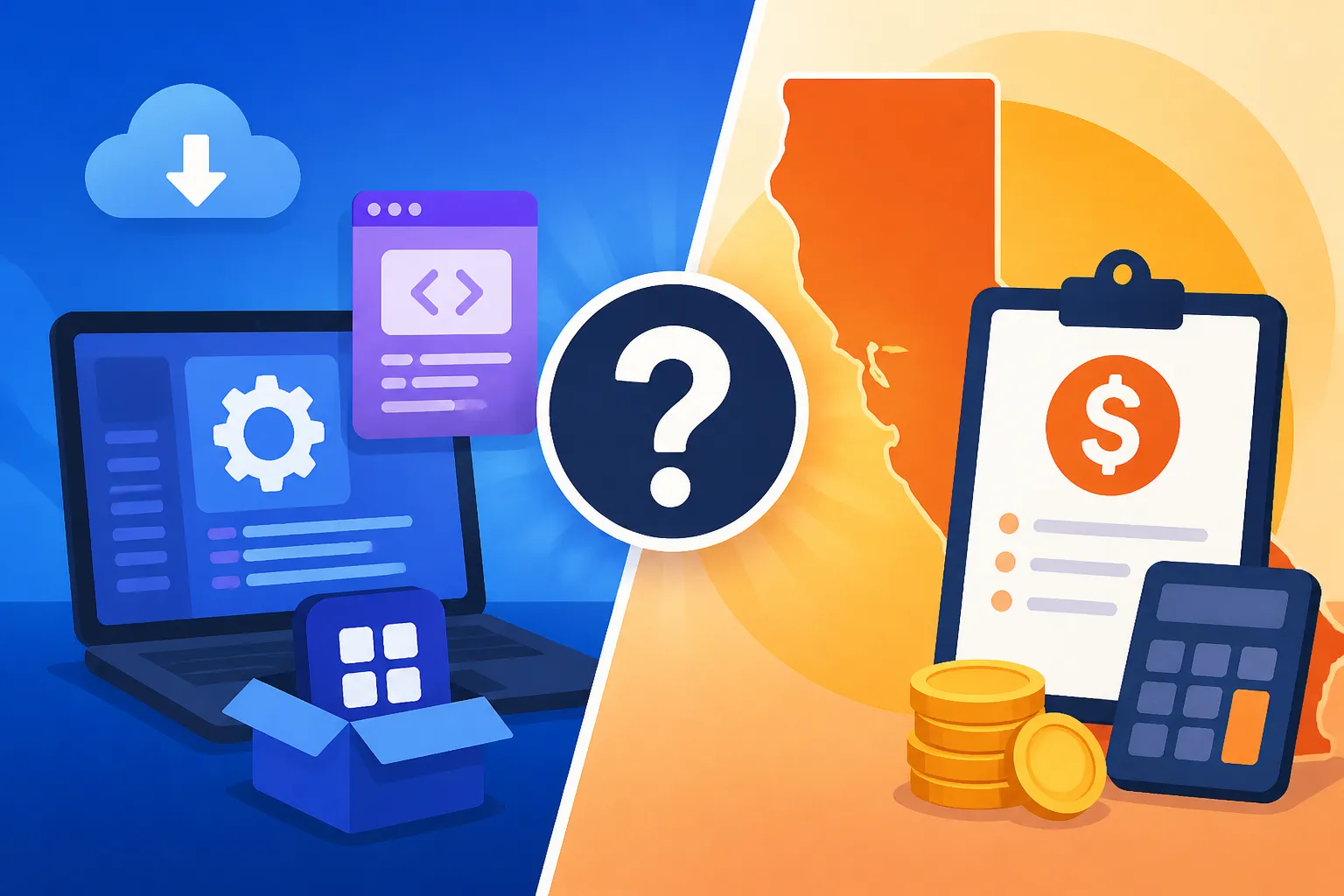
Is Software Taxable in California?
Figuring out the sales tax rules for software can feel like trying to solve a Rubik's Cube blindfolded, especially when you’re dealing with a dynamic state like California. With so many different types of software out there—from the shrink-wrapped box you used to buy, to a downloaded app, to sophisticated Software-as-a-Service (SaaS) platforms—it’s easy to get confused about what's taxable and what's not. This guide is here to untangle the complexities of California's sales tax regulations specifically as they apply to software, helping you understand when you need to collect sales tax and when you don't.
The Nuances of Software Sales Tax in California
California's sales tax system, administered by the California Department of Tax and Fee Administration (CDTFA), generally applies to the sale of "tangible personal property." This fundamental principle is where much of the confusion around software taxability stems from. For decades, software was primarily distributed on physical media like floppy disks or CDs, making it clearly tangible. But with the rise of digital downloads and cloud-based solutions, the lines have blurred considerably.
Distinguishing Between Tangible and Digital Software
The CDTFA takes a pretty clear stance on the delivery method when it comes to prewritten software. If you're selling software that's delivered on a physical medium, like a CD-ROM or USB drive, then it's considered tangible personal property and is subject to sales tax. This is often referred to as "canned" or "off-the-shelf" software.
However, if that same prewritten software is delivered digitally, say, via a download link or directly through the internet, California generally considers it an intangible transfer and therefore not subject to sales tax. This distinction is absolutely critical for businesses that sell software, whether it’s a one-time purchase or a subscription that grants download access. It's not about the software itself, but how it gets into the customer's hands. Think about it: if you bought a physical copy of a game from a store in Los Angeles, you'd pay sales tax. If you downloaded that same game directly to your console, typically no sales tax would apply on the software itself in California.
Canned Software and Its Taxability
Let's dive a bit deeper into what "canned" software really means in the eyes of California tax law. This refers to prewritten, standardized software programs that are not created specifically for a single client. They're mass-produced and sold to multiple customers without significant modification. Examples include popular accounting software like QuickBooks, operating systems like Windows, or photo editing suites like Adobe Photoshop (when sold as a perpetual license on physical media).
If this type of software is transferred to a customer on a physical storage medium—be it a DVD, USB stick, or even an external hard drive—then California imposes sales tax on the transaction. The logic here is straightforward: the physical item itself is tangible personal property, and the software is merely a component of that tangible item. It doesn’t matter if the value is mostly in the intellectual property; the physical medium makes it taxable. Businesses selling these types of products need to factor in the base California sales tax rate, which is 7.25%, plus any applicable California District Taxes Explained based on the customer's location.
Custom Software and When It's Exempt
Now, here's where things get interesting for those in the bespoke software development world. California generally exempts custom software from sales tax. This exemption applies when the software is specifically designed, developed, and created for a particular client. It's unique, tailored to their individual needs, and isn't something that could be sold off-the-shelf to another customer.
For instance, imagine a company hires a developer to build a specialized inventory management system perfectly integrated with their existing unique supply chain processes. Since this software is developed from scratch to meet that specific company's requirements, it’s considered a service and not the sale of tangible personal property. This exemption also typically extends to modifications of existing prewritten software if those modifications are extensive enough to render it "custom" for that client, as well as programming services related to custom software. The key is that the value lies in the service of creation, not the sale of a pre-existing product. This can be a huge relief for businesses developing unique solutions, as it means they don't have to navigate the complexities of Sales Tax Rates by State 2026: All 50 States for these specific offerings.
Software as a Service (SaaS) and Cloud Computing in California
The landscape for software has fundamentally shifted with the advent of Software as a Service (SaaS) and other cloud-based solutions. Instead of buying and owning a software license, businesses and consumers increasingly subscribe to services that provide access to software applications hosted remotely by a vendor. This shift from "product" to "service" has profound implications for sales tax.
Is SaaS Taxable in California?
Generally speaking, pure Software as a Service (SaaS) is not taxable in California. The CDTFA views SaaS as a service, not the sale of tangible personal property. When you subscribe to a SaaS platform, you're not getting a physical disk, nor are you usually downloading the entire software application to your local device. Instead, you're accessing and using the software over the internet, with the vendor maintaining and hosting the application on their servers.
Consider a small business using a cloud-based customer relationship management (CRM) platform like Salesforce or project management tool like Asana. They pay a monthly subscription fee to access and use the software through their web browser or a mobile app. Since there's no transfer of tangible personal property involved, and typically no permanent download of the software itself (only temporary caching), California generally considers this a non-taxable service. This aligns with California’s broader stance on taxing services, which are typically exempt unless specifically enumerated as taxable by statute. This can make a significant difference for businesses considering their total cost of ownership when budgeting for their tech stack. For a deeper dive into the national picture, you might want to explore articles like Is SaaS Taxable? Software-as-a-Service by State.
The "True Object" Test for SaaS Bundles
While pure SaaS is generally exempt, the waters can get murky when SaaS is bundled with other products or services. California, like many states, often applies a "true object" test to determine the primary purpose of a transaction when multiple components are involved.
Let's imagine a scenario: a company offers a SaaS product, but as part of the onboarding, they also provide customers with a USB drive containing proprietary drivers or physical training manuals, or perhaps they include a tangible piece of hardware that is essential for the software to function. In such cases, the CDTFA would look at whether the "true object" of the transaction was the non-taxable service (SaaS) or the taxable tangible personal property (the USB, manual, or hardware).
If the tangible component is incidental to the primary service of providing software access, then the entire transaction might remain non-taxable. However, if the tangible component is substantial and integral to the value proposition, or if the customer wouldn’t get the full benefit without it, then the entire transaction, or at least the tangible portion, could become subject to sales tax. This is where careful itemization on invoices and clear contract language becomes incredibly important. Businesses need to analyze their offerings to determine if they're truly selling a service or if they're inadvertently bundling it with a taxable product.
Key Considerations for Software Sellers in California
Navigating California's sales tax rules for software requires more than just knowing what's taxable. It also involves understanding your obligations as a seller, from where and when you need to register, to how you track and report everything.
Sales Tax Nexus and Registration
Before you even worry about taxability, you need to determine if you have a "nexus" in California. Nexus essentially means you have a significant enough presence in a state to be required to collect and remit sales tax. Traditionally, this meant having a physical presence—an office, warehouse, or employees in California. However, thanks to the landmark South Dakota v. Wayfair Supreme Court decision, states can now require out-of-state businesses to collect sales tax if they meet certain economic thresholds, known as economic nexus.
For California, the economic nexus threshold for out-of-state sellers is currently $500,000 in gross sales into the state during the current or preceding calendar year. If your software sales, or any other sales, to California customers exceed this threshold, you likely have economic nexus and are required to register for a seller's permit with the CDTFA. This is true even if you don’t have a physical office in San Francisco or a warehouse in Sacramento. Understanding Sales Tax Nexus Explained Physical vs Economic is foundational for any business operating across state lines, and specific details can be found in resources like Economic Nexus Threshold in California $500k. Once you've established nexus, the next step is to understand How to Get a Seller's Permit in California.
Maintaining Accurate Records and Compliance
Once you're collecting sales tax, keeping meticulous records is paramount. This includes details of every sale, how the software was delivered (physical vs. digital), whether it was custom or canned, and the amount of sales tax collected. The CDTFA has the right to audit businesses, and accurate records will be your best defense in case of an inquiry.
For businesses selling different types of software—some taxable, some not—it's crucial to categorize sales correctly in your accounting system. If you sell a mix of downloadable software (non-taxable in California) and physical media software (taxable), your records must clearly distinguish between the two. Similarly, if you offer SaaS subscriptions, you’ll want to ensure those are properly classified as non-taxable services, separate from any potentially taxable components or add-ons. Proper classification from the start prevents headaches down the line when it's time to file your returns. Many online sellers find this particularly challenging, which is why a guide like Sales Tax for Online Sellers Complete Guide can be incredibly helpful.
Seeking Professional Guidance or Automation
The complexity of sales tax, especially for evolving digital products like software, often makes professional guidance a wise investment. Tax attorneys or sales tax consultants specializing in e-commerce and software can help you interpret specific situations, ensuring your business is fully compliant. They can provide tailored advice for your unique product offerings and sales models.
Alternatively, for businesses with a high volume of transactions or sales across many states, sales tax automation software can be a game-changer. Tools from companies like Avalara are designed to automatically calculate sales tax rates based on the customer's location (considering both state and local rates), apply the correct taxability rules for products like software, and even help with filing returns. This kind of software can dramatically reduce the risk of errors and free up valuable time that would otherwise be spent manually tracking and calculating sales tax. When considering options, you might look into Sales Tax Compliance Software 2026 to compare different providers. These systems often integrate directly with e-commerce platforms like Shopify or invoicing software, streamlining the entire process from sale to remittance.
Understanding the "Hybrid" Software Scenarios
The world of software isn't always black and white. Many companies offer hybrid solutions or complex bundles that defy simple categorization. It’s in these grey areas that sales tax compliance can become particularly challenging.
Software Maintenance Agreements and Sales Tax
What about ongoing support and maintenance for software? In California, the taxability of software maintenance agreements often hinges on whether the original software was taxable and what the agreement primarily provides. If the maintenance agreement for taxable, canned software provides for mandatory updates delivered on physical media, or if it's considered part of the original taxable sale, it may also be subject to sales tax.
However, if the maintenance agreement solely provides for non-taxable services like phone support, bug fixes delivered digitally, or purely advisory services, it generally remains non-taxable. If the agreement is optional and separately stated from the initial software purchase, and primarily consists of non-taxable services, it's more likely to be exempt. The key is to analyze what the customer is actually receiving as part of the agreement. For instance, if an agreement only covers digital patches and remote troubleshooting, that’s typically a service. But if it guarantees a physical "upgrade kit" annually, that could swing it back to being taxable.
Customization and Implementation Services for Canned Software
Many businesses purchase off-the-shelf software but then pay a developer or consultant to customize it, integrate it with other systems, or provide extensive implementation services. How does California treat these scenarios?
Generally, if the customization or implementation services for canned software are performed after the initial sale of the software and are separately stated on the invoice, they are typically considered non-taxable services. The crucial factor is that these services fundamentally alter or adapt the prewritten software to the customer's specific needs, or involve labor that doesn’t result in the transfer of new tangible personal property.
However, if the customization is minor, or if the services are inextricably tied to the sale of the software itself and not separately itemized, the CDTFA might view them as part of the taxable software sale. This means clear invoicing is vital. An invoice that lists "Software License" and "Customization Services" as two distinct line items is far more likely to see the customization services remain non-taxable than one that simply lumps everything under "Software Solution." This level of detail helps prevent confusion and potential issues during an audit, helping you accurately How to Calculate Sales Tax Step by Step for each component.
Key Takeaways for California Software Sales Tax
Navigating the sales tax landscape for software in California truly boils down to a few core principles. The method of delivery is king for prewritten software: physical means taxable, digital usually means non-taxable. Custom software is generally considered a service and thus exempt. And for the vast and growing world of SaaS, California generally takes a favorable view, deeming it a non-taxable service unless tangible personal property is bundled in a significant way.
The digital economy is constantly evolving, and so too are the interpretations and rules surrounding sales tax. Staying informed, maintaining meticulous records, and utilizing compliance tools, perhaps from a provider like Avalara, can help you keep pace and ensure your business remains compliant in the Golden State.
Disclaimer
The information provided in this guide is for general informational purposes only and does not constitute professional tax advice. Sales tax laws are complex and subject to change. It is essential to consult with a qualified tax professional or the California Department of Tax and Fee Administration (CDTFA) for advice tailored to your specific business situation.