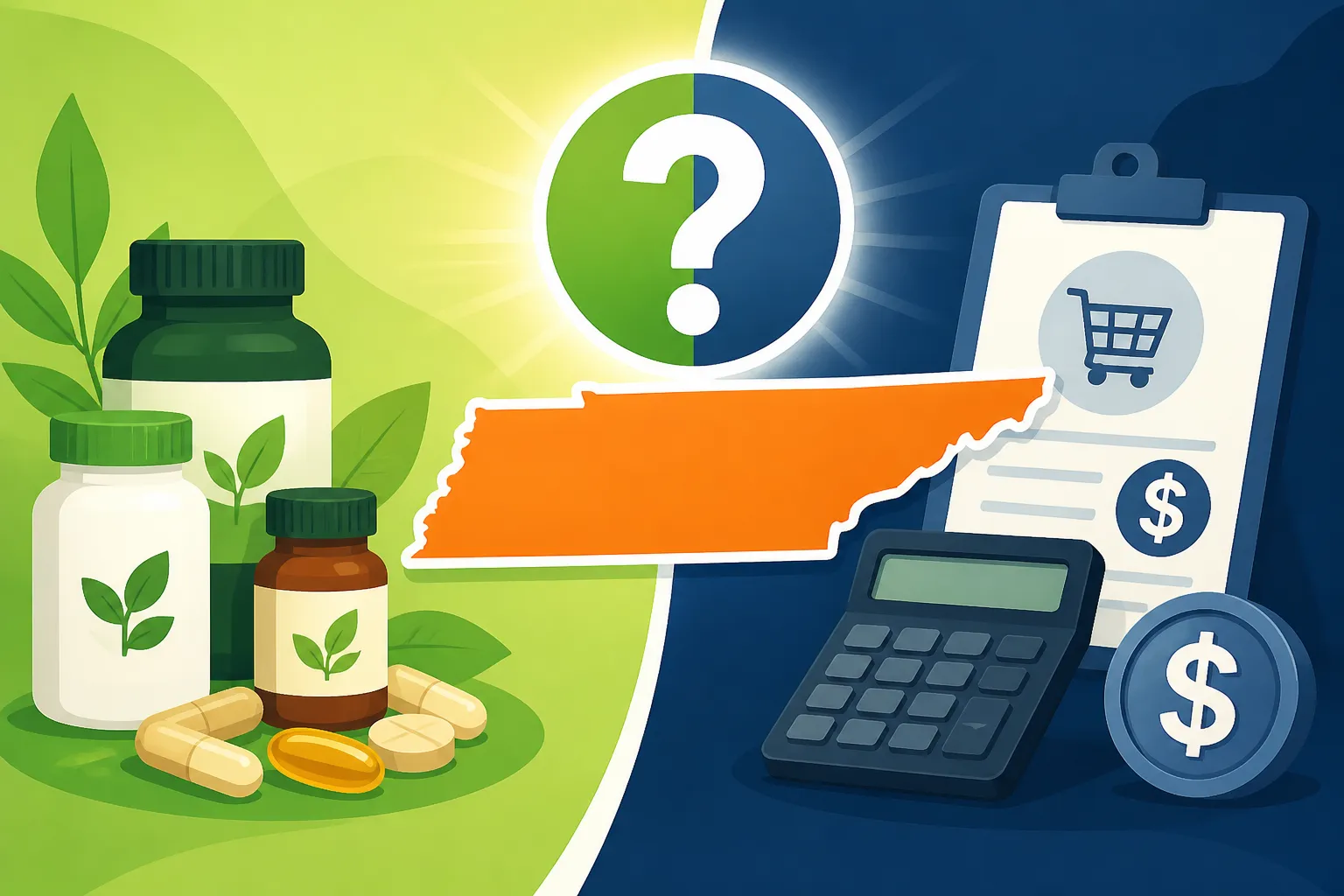
Are Dietary Supplements Taxable in Tennessee?
Navigating the world of sales tax can feel like trying to solve a Rubik's Cube blindfolded, especially when you're dealing with products that straddle the line between food, medicine, and wellness. For anyone selling or buying dietary supplements in the Volunteer State, the question of "Is dietary supplements taxable in Tennessee?" isn't just an academic one; it's a real-world puzzle that impacts everything from pricing strategies to your bottom line. This guide will meticulously unpack Tennessee's sales tax rules for dietary supplements, helping you understand the distinctions, implications, and how to stay compliant.
Understanding Tennessee's Sales Tax on Health Products
Tennessee's sales tax system, like many states, isn't always straightforward. While the state prides itself on its low income tax, it makes up for it with one of the highest combined state and local sales tax rates in the nation. For most tangible personal property, you're looking at a standard rate, but certain items, particularly those related to health and food, have their own unique classifications.
The General Rule for Tangible Goods
First, let's talk about the baseline. In Tennessee, most retail sales of tangible personal property are subject to sales tax. The statewide sales tax rate is 7%. On top of that, local jurisdictions – counties and cities – can impose their own local sales taxes, which generally cap out at 2.75% for most items. This means that a standard item you buy in Nashville or Memphis could easily incur a combined sales tax rate of 9.25% to 9.75%. If you're running a business, you need to be acutely aware of these varying rates, as they directly impact the price your customers pay and the amount you collect and remit. It's a lot to keep track of, and frankly, it's one of the biggest headaches for small business owners. Understanding your local rate is key, and if you're curious about how it all adds up, there are resources that can help you understand the current Tennessee Sales Tax Rate (7% + Local).
For many products, this is pretty simple. Buy a new shirt? Taxable. Purchase a new appliance? Taxable. But when we start dipping into the health and wellness category, things get a bit murky. This is where the crucial distinctions for items like dietary supplements, groceries, and over-the-counter medications come into play, and it's why so many sellers find themselves scratching their heads trying to apply the correct tax.
Distinguishing Food from Supplements in Tennessee
Here's where it gets really important for dietary supplements: Tennessee law makes a very specific distinction between "food and food ingredients" and other items, including dietary supplements. While many states offer a complete or partial exemption for most "food and food ingredients" intended for home consumption, Tennessee has a different approach. The state imposes a lower 4% state sales tax rate on "food and food ingredients" purchased for home consumption. Sounds great, right?
The catch, however, is in the definition. Tennessee Code Annotated § 67-6-102 explicitly excludes several categories from the definition of "food and food ingredients." These exclusions are:
- Dietary supplements
- Prepared food
- Soft drinks
- Candy
This means that if a product falls into any of these four categories, it is not eligible for the lower 4% state sales tax rate on food. Instead, it is subject to the general 7% state sales tax rate, plus any applicable local sales taxes.
So, to directly answer the burning question: Yes, dietary supplements are taxable in Tennessee at the full, standard state sales tax rate of 7%, plus local sales taxes. They are not considered "food and food ingredients" for the purpose of the reduced sales tax rate, nor are they exempt. This distinction is critical for anyone selling these products, whether through a brick-and-mortar store or online, because misclassifying them can lead to under-collection of tax, which ultimately becomes the seller's responsibility. It's a common mistake, but one that can be quite costly if not addressed.
What Qualifies as a Dietary Supplement in Tennessee?
When we talk about sales tax, the exact definition of a product becomes incredibly important. What one person calls a "health food" might be categorized as a "dietary supplement" by the state, leading to different tax treatments. Tennessee generally aligns its definition of dietary supplements with federal guidelines, primarily those established by the Food and Drug Administration (FDA).
Aligning with Federal Definitions
A "dietary supplement" is generally understood to be a product taken orally that contains one or more dietary ingredients intended to supplement the diet. These ingredients can include vitamins, minerals, herbs or other botanicals, amino acids, and other substances. They typically come in forms such as pills, capsules, tablets, powders, or liquids. Think about your daily multi-vitamin, protein powder, fish oil capsules, or that trendy herbal remedy you bought online – these all generally fit the bill.
Tennessee's sales tax law typically mirrors this understanding. If a product is marketed and labeled as a dietary supplement under federal regulations, it's almost certainly going to be treated as such for sales tax purposes in Tennessee. For example, a tub of protein powder from a brand like Optimum Nutrition or MuscleTech, even though it provides nutritional value, is considered a dietary supplement, not "food and food ingredients," because its primary purpose is to supplement the diet, often for specific fitness goals, rather than serve as a conventional meal component. The same goes for dietary supplements, even those that might seem like health-focused food items. This is why it's so important for businesses to not just know what they're selling, but how the state officially classifies it.
The "Prepared Food" and "Soft Drink" Nuance
While dietary supplements are a distinct category, it's worth briefly touching on "prepared food" and "soft drinks" because they also fall under the "full tax" umbrella in Tennessee, further complicating matters. Prepared food generally refers to food sold in a heated state, food sold with eating utensils provided by the seller, or two or more ingredients mixed or combined by the seller for sale as a single item. So, if you're at a juice bar and they blend a protein powder into a smoothie for you, that smoothie would likely be considered "prepared food" and taxed at the full rate, not just the protein powder portion.
Soft drinks are also specifically excluded from the lower food rate and taxed at the full rate. This usually means non-alcoholic beverages that contain natural or artificial sweeteners. These distinctions highlight the careful parsing states do to maximize sales tax revenue. The lines can get fuzzy, and without clear guidance or an automated system, it's easy for businesses to get tangled up. If you're selling a variety of items, some of which might be considered prepared food alongside dietary supplements, you really need to be on your game to ensure correct tax application. This is a level of detail that many entrepreneurs, especially those just starting out, often overlook.
Practical Implications for Businesses and Consumers
The intricate rules surrounding dietary supplements and sales tax in Tennessee have significant ramifications for both businesses operating within the state and consumers making purchases. It's not just about knowing the rule; it's about applying it correctly every single time.
Challenges for Retailers and E-commerce Sellers
For businesses, especially those selling a wide array of health and wellness products, the classification challenge is immense. Imagine a health food store that sells everything from fresh produce (lower tax rate) to organic snack bars (likely full tax as candy or prepared food if heated) to bottles of vitamins (full tax as dietary supplements). Each item needs to be coded correctly in their point-of-sale system or e-commerce platform. If you're an online seller, this complexity is magnified because you're not just dealing with Tennessee's rules but potentially the sales tax laws of every state where you have economic nexus. Trying to manually keep up with these varied regulations and product classifications can quickly become a full-time job.
This is where sales tax compliance software becomes an absolute lifesaver. Companies like Avalara offer solutions that automate the process of calculating sales tax based on the product type, the customer's location, and the specific rules of that jurisdiction. This means their systems can distinguish between "food and food ingredients" and "dietary supplements" in Tennessee, applying the correct state and local rates without you having to be an expert in every single nuanced tax law. This level of precision is virtually impossible to achieve manually, especially for businesses with high sales volumes or diverse product offerings. For any business that has to deal with varying sales tax rates and product definitions, utilizing the Best Sales Tax Compliance Software 2026 can be a game-changer.
Real-World Scenarios for Shoppers
As a consumer in Tennessee, understanding that dietary supplements are taxed at the full rate means you should expect to pay the 7% state sales tax plus applicable local taxes on these purchases. This applies whether you're buying a bottle of Vitamin C from your local pharmacy like CVS or Walgreens, picking up a tub of protein powder at GNC, or ordering your favorite herbal remedies online.
Consider this: you walk into a grocery store. You pick up a bag of apples and a box of cereal. These are "food and food ingredients" and will be subject to the 4% state sales tax rate, plus any local rates on that portion. Then you grab a bottle of your daily multi-vitamin. That multi-vitamin, as a dietary supplement, will be subject to the full 7% state sales tax rate, plus local rates. You also toss in a soda and a candy bar, both of which will also be taxed at the higher rate. The difference in tax rates on various items within the same shopping cart can be a bit surprising if you're not aware of these specific classifications. It highlights why understanding how much sales tax on a $100 purchase by state can vary wildly based on what you're buying.
Importance of Accurate Sales Tax Rate Lookup
Given the complexities, relying on a general idea of "the sales tax" in Tennessee just isn't enough. Businesses need to perform an accurate Sales Tax Rate Lookup Tools Compared to ensure they are collecting the correct amount. This isn't just about the state rate; it's about factoring in county and municipal taxes, and whether those local taxes have different caps for certain types of goods.
For instance, some Tennessee counties have a specific single article maximum for local sales tax, meaning that while the state tax applies to the entire purchase price, the local tax may only apply up to a certain dollar amount (e.g., the first $1,600 or $3,200, depending on the county) of a single item. While this rarely impacts dietary supplements (which typically fall below these thresholds), it exemplifies the type of intricate detail that needs to be considered. Without the ability to precisely determine the tax rate for a specific item at a specific location, businesses risk either overcharging customers (leading to complaints) or undercharging (leading to an audit liability).
Ensuring Compliance and Avoiding Pitfalls
The burden of correctly collecting and remitting sales tax falls squarely on the seller. This isn't just a best practice; it's a legal obligation. Ignoring these nuances, especially with frequently purchased items like dietary supplements, can lead to significant issues down the road.
The Cost of Misclassification
Imagine you're an online store, perhaps selling a popular brand of protein bars that are marketed as "meal replacements" but are truly dietary supplements under Tennessee law. If you mistakenly apply the lower 4% state sales tax rate for food, or worse, no sales tax at all, you're under-collecting. While each individual transaction might seem small, these errors accumulate quickly. During an audit, the state of Tennessee will identify these discrepancies and hold you, the seller, responsible for the uncollected tax, plus potential penalties and interest. This can be a financially devastating blow, especially for small businesses operating on tight margins. For a deeper dive into the potential consequences, it's worth understanding What Happens If You Don't Collect Sales Tax?
Furthermore, repeated errors can flag your business for closer scrutiny, leading to more frequent and more thorough audits. The time and resources required to respond to an audit, even if you eventually prove compliance, can be a major drain on your business operations. It’s a classic case where an ounce of prevention is worth a pound of cure.
Leveraging Sales Tax Automation
This is precisely why robust sales tax automation solutions are no longer a luxury but a necessity for many businesses. Tools like Avalara and others are designed to handle the complexity of sales tax, including the specific classifications like those for dietary supplements in Tennessee. These systems integrate with your e-commerce platforms and accounting software, providing real-time, accurate sales tax calculations at the point of sale. They keep track of changing rates, complex product definitions, and nexus rules across states.
For a business that sells dietary supplements across the country, sales tax automation can:
- Accurately classify products: It ensures your protein powders and vitamins are taxed as dietary supplements, not groceries.
- Apply correct rates: It calculates the precise combined state and local rate for every customer's address in Tennessee, factoring in any unique local caps.
- Monitor nexus: As your business grows, it helps you track your Economic Nexus by State 2026: Thresholds Guide, signaling when you might need to register for a sales tax permit in new states.
- Streamline filing: When it comes time to file your sales tax returns, these systems can generate accurate reports, simplifying the process of How to File a Sales Tax Return: Step by Step.
Trying to manage all these factors manually, especially with varying product classifications like those for dietary supplements, is a recipe for error and stress. Sales tax automation empowers businesses to focus on growth, knowing their sales tax compliance is handled accurately and efficiently. This peace of mind is invaluable, allowing you to confidently expand your offerings, including a wider range of dietary supplements, without constant worry about tax liabilities.
Here's a quick look at how some common health-related products are generally treated for sales tax in Tennessee:
| Product Category | Tennessee Sales Tax Status (State Rate) | Notes |
|---|---|---|
| Dietary Supplements | Taxable at 7% | Explicitly excluded from "food and food ingredients." Includes vitamins, protein powders, herbal supplements, etc. |
| Food & Food Ingredients | Taxable at 4% | For home consumption (groceries). Excludes dietary supplements, prepared food, soft drinks, and candy. |
| Prepared Food | Taxable at 7% | Food sold heated, with utensils, or two or more ingredients mixed by seller (e.g., restaurant meals, custom smoothies, hot deli items). |
| Soft Drinks | Taxable at 7% | Non-alcoholic beverages containing natural or artificial sweeteners. |
| Candy | Taxable at 7% | Defined by federal regulations. The "flour test" (does it contain flour?) is often used to distinguish candy from other food. |
| Prescription Drugs | Exempt | Medications dispensed by a licensed pharmacist by prescription. |
| Over-the-Counter Drugs | Taxable at 7% | Generally treated as tangible personal property, unless specifically exempted (which is rare in TN for general OTCs). This often includes items like pain relievers, cold medicines, etc., without a prescription. Compare this to Is Dietary Supplements Taxable? Sales Tax on Dietary Supplements by State for a broader view. |
As you can see, even within seemingly similar categories like health-related products, Tennessee draws clear lines that affect sales tax. Staying informed and utilizing reliable tools are your best defenses against compliance pitfalls.
Disclaimer
Please remember, this information is intended for educational purposes only and should not be considered tax or legal advice. Sales tax laws are complex and subject to change. Always consult with a qualified tax professional or refer to the official Tennessee Department of Revenue resources for specific guidance regarding your business operations.