Sales Tax Rate for Major State Cities Compared
It's incredibly frustrating, isn't it? You might be shopping online or planning a business expansion, only to realize that the sales tax rate you expect for a state isn't uniform across its cities. It feels like every town, every county, has its own unique set of rules. This guide is here to shed some light on why sales tax rates vary so dramatically from one major city to another within the same state and how you can actually make sense of it all.
The Maze of Sales Tax Rates in Major States
The idea of a single, simple sales tax rate for an entire state is often just a pipe dream. While every state that imposes sales tax has a base rate, that's rarely the final number you pay or collect. The real complexity kicks in when you factor in the layers of local taxes that municipalities, counties, and special districts can add on. This patchwork system is exactly why you see such vastly different rates even within a few miles of each other.
State Base Rates vs. Local Add-ons
Think of the state sales tax rate as the foundation. It's the mandatory minimum that applies across the entire state, unless specific exemptions come into play. For example, states like California have a relatively high base rate, currently 7.25%, which is consistent statewide. Texas has a state sales tax rate of 6.25%. This state-level portion is usually straightforward.
The real challenge, and where the comparisons get interesting, lies in the "local add-ons." These are taxes levied by various local jurisdictions.
- Counties: Many counties impose their own sales tax rates on top of the state rate.
- Cities/Municipalities: Cities often have their own municipal sales taxes, sometimes quite significant.
- Special Districts: This is where it gets truly granular. You might find transit districts, school districts, hospital districts, or even specific infrastructure project districts that have the authority to add a small percentage to the sales tax. These can be tiny geographical areas, making rate determination tricky. For an overview of how these combined rates work, you might want to read our article on Combined State + Local Sales Tax Rates Explained
It's these layers of local taxes that cause the final rate to fluctuate dramatically. A business located literally across the street from another could be collecting a different sales tax rate simply because they fall into different special taxing districts.
The Impact of Home-Rule Cities
Adding another layer of complexity to the mix are "home-rule" cities. These are municipalities that have been granted a degree of self-governance by their state constitution or statutes, allowing them more autonomy over their local affairs, including taxation. Instead of just adding a percentage on top of the state rate, home-rule cities can sometimes establish their own entire sales tax system, independent of the county or state.
This means that while the state might have a certain sales tax structure, a home-rule city might define what's taxable differently, have its own tax base, or implement unique exemption rules. Colorado is a prime example, with many of its major cities operating under home-rule. This can be a real headache for businesses trying to figure out their obligations, especially if they have physical presence or economic nexus in multiple jurisdictions within a single state. Understanding the nuances of Colorado Home-Rule Cities Sales Tax is essential for anyone doing business there.
Diving Deep: Sales Tax Comparisons in Key States and Cities
Let's dig into some real-world examples to see how these different taxing authorities play out in practice. It's one thing to talk about it in theory, and quite another to see the numbers.
California's Complex Landscape
California is notorious for its intricate sales tax system. The statewide base sales tax rate is 7.25%, but almost every city and county tacks on additional district taxes. These can fund everything from local transportation projects (like BART in the Bay Area or Metro in Los Angeles) to essential public services. These district taxes often apply to an entire county or specific regions within it, leading to significant variations.
Let's look at some examples:
- Los Angeles: The base state rate of 7.25% is just the beginning. Los Angeles County has a variety of district taxes. For instance, in the city of Los Angeles itself, the combined sales tax rate is currently 9.50%. This includes the state rate, county-wide additions, and specific district taxes like those for transportation. If you’re selling in the city of Los Angeles, it's crucial to apply the correct combined rate. For more details on this, check out our guide on the Los Angeles Sales Tax Rate Explained.
- San Francisco: Another major California city, San Francisco, has a current sales tax rate of 8.625%. This reflects its share of the state rate plus county and special district taxes, which might differ slightly from its southern neighbor.
- San Diego: Head down to Southern California, and San Diego's rate often hovers around 7.75% or 8.25%, depending on the specific location within the county, as different district taxes apply.
- Oakland: In the East Bay, Oakland's sales tax rate can be 10.25%, one of the higher rates in the state due to specific local measures.
These varying rates demonstrate how California's district taxes create a granular system. A sale in San Francisco will have a different tax rate than one in Los Angeles, or even one in an unincorporated area of the same county. It’s not just about the city name, but the exact address and the districts it falls into. Our article on California District Taxes Explained can offer a deeper dive into this.
Texas: A Uniform Base with Local Flavor
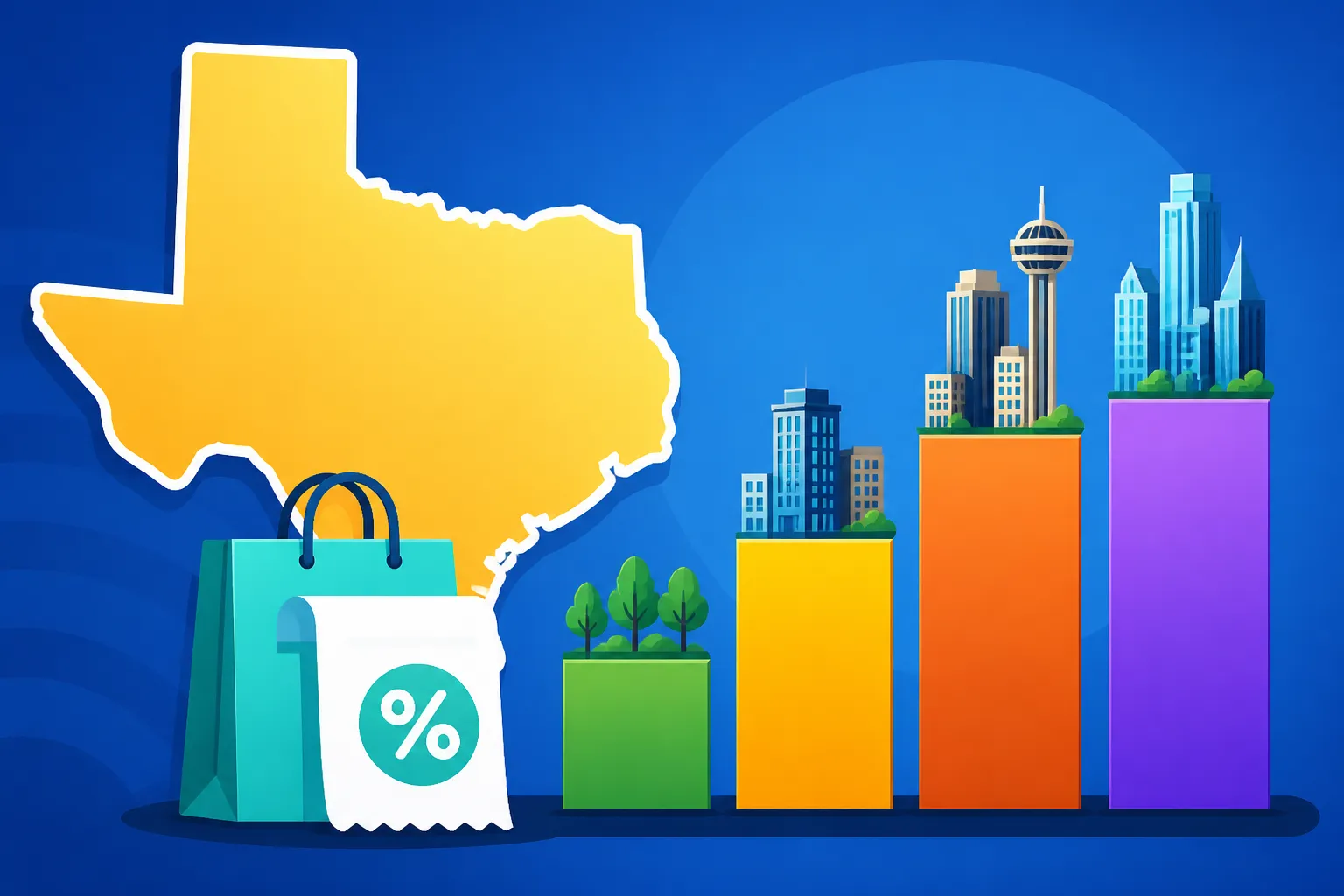
Texas offers a more consistent statewide base rate for sales tax at 6.25%. However, like California, local jurisdictions can add up to an additional 2%. This 2% cap for local taxes helps keep the maximum combined rate at 8.25% for most of the state.
Here's how it plays out in major Texas cities:
- Houston & Dallas: Both Houston and Dallas generally have a combined sales tax rate of 8.25%. This rate is made up of the 6.25% state tax plus the maximum 2% allowed for local options, which typically includes city and metropolitan transit authority taxes. If you’re conducting business in these bustling cities, you'll almost always be applying that 8.25% rate. Our deep dive into the Houston & Dallas Sales Tax Rate (8.25%) gives more specifics.
- San Antonio: Similar to Houston and Dallas, San Antonio also levies the full 2% in local taxes, bringing its combined rate to 8.25%.
- Austin: The state capital also typically sees an 8.25% combined sales tax rate.
While many major Texas cities hit that 8.25% maximum, it's still crucial to verify, as smaller towns or specific districts might have slightly lower local rates, though less common in large metropolitan areas.
New York's City-Specific Charges
New York State has a base sales tax rate of 4%. However, the local add-ons can push the combined rate significantly higher, especially in urban centers.
- New York City: The combined sales tax rate in New York City is 8.875%. This includes the 4% state sales tax, a 4.5% New York City sales tax, and a 0.375% Metropolitan Commuter Transportation District (MCTD) surcharge. This is a rate that stands out and impacts millions of transactions daily. You can find more comprehensive details about the NYC Sales Tax Rate (8.875%) Explained.
- Buffalo: In contrast, Buffalo, located in Erie County, has a combined sales tax rate of 8.75% (4% state + 4.75% county). Notice how it's different from NYC, showcasing the county's significant role.
- Albany: The state capital, Albany, also has an 8.00% sales tax rate (4% state + 4% Albany County).
These examples clearly show that New York's sales tax is far from uniform. The local portion, whether it's a city-specific tax or a county-level tax, significantly alters the final rate consumers pay and businesses collect.
Colorado's Home-Rule Headaches
As mentioned earlier, Colorado is a prime example of states with home-rule cities that complicate sales tax. The state sales tax rate is a relatively low 2.9%, but local jurisdictions can add substantial amounts, and home-rule cities can even manage their own tax bases.
- Denver: Being a home-rule city, Denver collects its own sales tax. The current combined sales tax rate in Denver is 8.81%. This includes the 2.9% state tax, 0.81% for various special districts (like Regional Transportation District – RTD, Scientific & Cultural Facilities District – SCFD, Football Stadium District – FSD), and Denver's own city sales tax of 4.81%. It’s a complex calculation that often catches businesses off guard. You can dive deeper into the specifics of the Denver Sales Tax Rate (Home-Rule).
- Colorado Springs: In contrast to Denver, Colorado Springs generally has a lower combined sales tax rate, often around 8.25% (2.9% state, 1% El Paso County, 3.12% City of Colorado Springs, plus specific district taxes like Pikes Peak Rural Transportation Authority – PPRTA).
- Aurora: Straddling multiple counties, Aurora’s sales tax rate can actually vary depending on which county a specific address falls into, further exemplifying the localized nature of tax collection in Colorado. For instance, the rate in Arapahoe County is usually 8.0%, while in Adams County, it can be 8.5%.
The implications for businesses in Colorado are particularly challenging. They often need to register with multiple home-rule cities in addition to the state, and each might have different reporting requirements and taxable goods definitions.
Here's a quick comparison of some of these city sales tax rates:
| State | City | State Sales Tax Rate | Local Sales Tax Rate (Approx.) | Combined Sales Tax Rate |
|---|---|---|---|---|
| California | Los Angeles | 7.25% | 2.25% | 9.50% |
| California | San Francisco | 7.25% | 1.375% | 8.625% |
| Texas | Houston | 6.25% | 2.00% | 8.25% |
| Texas | Dallas | 6.25% | 2.00% | 8.25% |
| New York | New York City | 4.00% | 4.875% | 8.875% |
| New York | Buffalo | 4.00% | 4.75% | 8.75% |
| Colorado | Denver | 2.90% | 5.91% | 8.81% |
| Colorado | Colorado Springs | 2.90% | 5.35% | 8.25% |
Note: Sales tax rates are subject to change. Always verify current rates for specific addresses.
Why These Differences Matter for Consumers and Businesses
These varied sales tax rates aren't just an interesting fact; they have tangible impacts on everyone, from the casual shopper to large e-commerce businesses. Ignoring these differences can lead to overpaying, under-collecting, and even legal trouble.
Budgeting and Purchase Decisions
For consumers, sales tax directly impacts the final price of goods. If you're planning a major purchase, say a new appliance or a car, the difference of even half a percentage point can amount to significant money.
- Cross-border Shopping: It's not uncommon for shoppers to drive a few miles to a neighboring city or county if they know the sales tax rate is lower. For instance, if you're in an area with a 10% sales tax and a city just 15 minutes away has an 8% rate, that 2% difference on a $1,000 purchase is $20. Multiply that by several big-ticket items, and the savings add up. This phenomenon is particularly noticeable on state borders or between high-tax and low-tax districts.
- Online Price Perception: When shopping online, the sales tax calculation might feel arbitrary if you don't understand the underlying local rates. A consumer in a city with high district taxes might feel like they're paying "more" in tax than a friend in a nearby town for the exact same online purchase. This can sometimes lead to customer service queries or frustration if the tax breakdown isn't transparent. Knowing How Much Is Sales Tax on a $100 Purchase by State can really highlight these differences.
Compliance Challenges for Sellers
For businesses, especially those selling across state lines or even just across multiple cities within a state, navigating these variable rates is a significant compliance burden.
- Determining the Correct Rate: The biggest challenge is accurately identifying the correct sales tax rate for every single transaction. It's not enough to know the state rate or even a county rate; often, it requires pinpointing the exact address of the buyer to determine all applicable city and special district taxes. The sales tax rate can truly vary by address and not just by ZIP code, as ZIP codes can span multiple tax jurisdictions. This is why our guide on Sales Tax by ZIP Code (and Why ZIP Isn't Enough) is so crucial.
- Sourcing Rules: States also have different "sourcing rules" that dictate whether the sales tax rate is based on the seller's location (origin-based sourcing) or the buyer's location (destination-based sourcing). Most states use destination-based sourcing for remote sales, meaning you need to collect the rate at the customer's shipping address. However, for in-store sales, or in some origin-based states, the seller's location determines the rate. This adds another layer of complexity that varies state by state. For more on this, check out Origin vs Destination Sales Tax Sourcing.
- Software Solutions: Manually tracking all these rates is virtually impossible for businesses with significant sales volume. This is where sales tax automation software becomes invaluable. Services like Avalara are specifically designed to handle the thousands of sales tax jurisdictions across the U.S., ensuring businesses collect and remit the correct amount of tax for every sale, regardless of how complex the local rates are. Without such tools, the risk of errors, audits, and penalties skyrockets.
Finding Accurate Sales Tax Rates for Any Location
Given the incredible complexity of sales tax rates, especially when comparing major cities within a state, how can you consistently find accurate information? It boils down to utilizing the right tools and understanding the principles behind the calculations.
Leveraging Online Lookup Tools
The days of relying solely on state revenue department websites are largely over, mainly because those sites often provide state and county rates but might lack the granular detail needed for specific city and special district taxes. This is where advanced online sales tax lookup tools shine.
- Address-Level Accuracy: The best tools, often offered by specialized sales tax compliance companies, can determine the precise sales tax rate based on a full street address. They take into account not just the city and county, but also all the overlapping special taxing districts that contribute to the final rate. These tools are constantly updated to reflect the 2026 Sales Tax Rate Changes by State, ensuring accuracy as rates fluctuate.
- Integration with E-commerce Platforms: Many of these lookup tools can integrate directly with popular e-commerce platforms like Shopify, WooCommerce, or enterprise resource planning (ERP) systems. This means that when a customer enters their shipping address at checkout, the correct sales tax is automatically calculated and applied, taking the guesswork out of the process for the business owner.
- Choosing the Right Tool: There are various options available, from basic free lookup widgets to comprehensive, paid automation platforms. For a business with significant sales volume across multiple jurisdictions, investing in a robust solution like Avalara or TaxJar is often a necessity rather than a luxury. These platforms not only provide accurate rate lookups but also help with nexus determination, filing, and reporting. You can compare various options in our guide on Sales Tax Rate Lookup Tools Compared.
Understanding Address-Based Sourcing
It's critical to reiterate: the sales tax rate you need to apply is usually tied to the destination address (where the product is shipped or delivered). This is often referred to as "destination-based sourcing." As we discussed, a simple ZIP code lookup is often insufficient because a single ZIP code can encompass multiple taxing jurisdictions, each with slightly different rates.
For instance, if you're a business selling from New York and your customer is in Los Angeles, California, you need to collect the sales tax rate applicable to that specific Los Angeles address, not your New York rate. This means the system must be smart enough to identify all the layers of tax – state, county, city, and any special district taxes – that apply to that exact delivery point.
Accurate address validation is paramount. Some sophisticated systems even use geographic information system (GIS) data to precisely map an address to all relevant tax boundaries. This ensures that even if a customer lives on a street where one side is in one tax district and the other side is in another, your system can correctly identify and apply the right rate. This attention to detail is what separates basic sales tax estimation from true compliance.
Disclaimer
Please remember that sales tax laws are constantly changing, and the information provided here is for general guidance only. It is not legal or tax advice. We highly recommend consulting with a qualified tax professional or using up-to-date sales tax compliance software to ensure accuracy for your specific business needs. Tax rates mentioned are illustrative and subject to change.